Braking points you can repeat, not remember
Braking points you can repeat rather than remember: the arithmetic behind the distances, why markers fail and the method that survives a race.
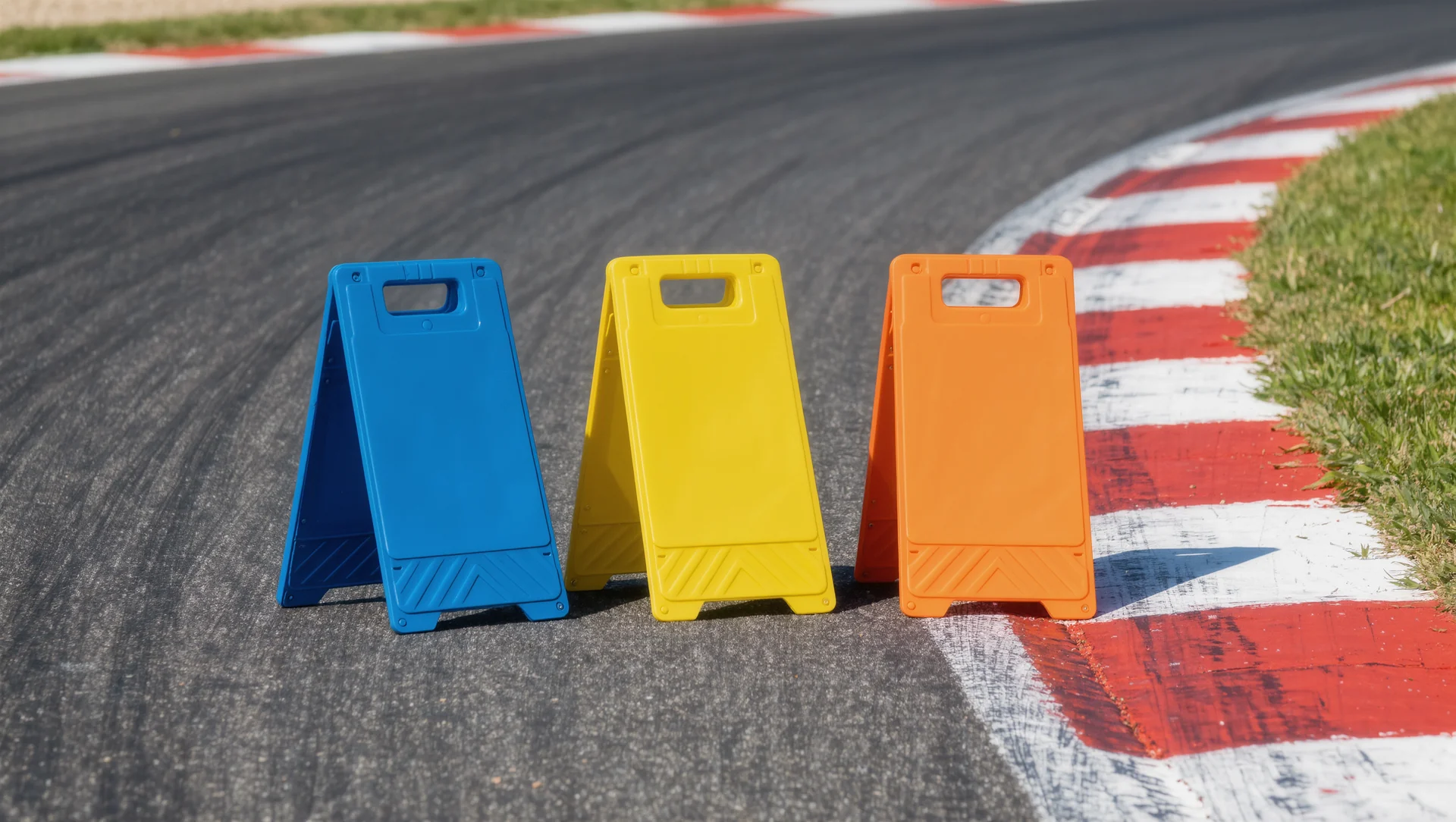
A braking point you have to remember is a braking point you will lose in the third hour of a race. The alternative is not a better memory but a system, and the system is built from distances you can compute rather than landmarks you have to recognise.
The arithmetic nobody does
Braking distance follows from speed and deceleration: distance equals speed squared divided by twice the deceleration. At 200 km/h, which is 55.6 metres per second, a car decelerating at 1.5 g, or 14.7 metres per second squared, needs about 105 metres. The same car at 1.2 g needs about 129 metres, which is nearly a quarter more.
Two consequences follow immediately. First, a small error in speed produces a large error in distance, because speed is squared: arriving 10 km/h faster at the same braking point adds roughly 11 metres to the distance you need. Second, the difference between a good and a mediocre first application of the brake is measured in tens of metres, not in centimetres.
The third number is the one that turns this into a technique. At 200 km/h a car covers 5.6 metres in one tenth of a second, so a braking point that varies by two tenths between laps varies by 11 metres. That is the entire margin at most corners, and it is why consistency and pace are the same problem rather than two.
| Situation | Figure |
|---|---|
| Speed of 200 km/h | 55.6 metres per second |
| Deceleration at 1.5 g | 14.7 metres per second squared |
| Braking distance at 1.5 g from 200 km/h | about 105 metres |
| Braking distance at 1.2 g from 200 km/h | about 129 metres |
| Distance covered in one tenth at 200 km/h | 5.6 metres |
| Effect of arriving 10 km/h faster | about 11 metres more braking distance |
Why visual markers fail
Boards work until the field arrives. A 100 metre board is invisible when a car is alongside it, and a braking point that depends on seeing an object fails exactly in the situation where getting it right matters most.
Boards also fail across simulators and updates. A track model may place them differently, a mod may not have them at all, and a driver whose whole system is built on markers has to rebuild it every time the content changes.
And they fail in the wet and at night, which are the two conditions where a reliable braking point is worth the most. A system that only works in the dry in daylight with an empty track is not a system.
What to use instead
Use the track surface itself. Changes in tarmac colour, seams, patches, kerb starts and the shape of a barrier are attached to the geometry and are visible from every position in the field. A driver who brakes at the second seam rather than at a board keeps the reference when a car is alongside.
Then anchor it with pressure rather than with distance. A load cell pedal rated at 120 kg that delivers about 65 kg at the pedal face lets you brake to a force rather than to a position, and a force is something your leg reproduces reliably. Learn what 80 per cent of your maximum feels like and use that as the first application at every heavy corner.
And build the reference in three layers: a coarse one for where to lift, a fine one for where to apply the brake, and a corner exit reference to tell you whether the entry was right. The third layer is the one that lets you correct without a lap time on the screen.
Practising it so it survives
Practise the same corner twenty times in a row rather than driving twenty laps. Twenty laps gives you twenty attempts at fourteen corners with a gap between them; twenty repetitions of one corner gives you twenty attempts with the previous one still fresh, and the learning rate is not comparable.
Then measure rather than judge. If your lap times over twenty laps vary by more than half a second, the braking points are not yet points. Under two tenths and the system is working, and further gains come from where you brake rather than from how repeatably.
Sources
Frequently asked questions
Why do my braking points move during a race?
Fuel load, tyre wear and leg fatigue all change the distance you need. A reference tied to pedal force adapts better than one tied to a fixed marker.
Should I brake at a board or at a surface feature?
A surface feature. Boards disappear behind other cars exactly when the reference matters most.
How much does braking too early cost?
Less than braking too late, which is why almost every driver is too early. The honest measure is corner exit speed rather than entry speed.
Is a load cell necessary for this?
It makes braking to a force possible, which is the part that repeats. Without one you are braking to a position, and positions drift.
More in Driving Technique

Assetto Corsa Competizione: the first ten hours
The first ten hours in Assetto Corsa Competizione: what the game contains, what to ignore at the start and the order that gets you racing rather than tinkering.

Le Mans Ultimate: where the sim stands now
Le Mans Ultimate in 2026: the published content, the physics figures, what the season update changed and who the simulator is now for.
How the big sims differ where it counts: the tyre model
Where the big simulators really differ: not graphics or content, but the tyre model and the rate it runs at. What the published figures mean at the wheel.