Mastering Sim Racing: The Ultimate Steering Wheel Guide
So, you’re looking to dive deep into sim racing and want to pick the right steering wheel. Good move! The short answer is: the best sim racing wheel is the one that fits your…

So, you’re looking to dive deep into sim racing and want to pick the right steering wheel. Good move! The short answer is: the best sim racing wheel is the one that fits your budget, your preferred racing genre, and your available space. There’s no single “ultimate” wheel for everyone, but understanding the options will help you make a smart choice. This guide will walk you through what to look for and what to avoid, without trying to sell you anything specific.
Understanding Force Feedback: The Heart of the Experience
Force feedback (FFB) is what makes a sim racing wheel more than just a controller. It’s the technology that translates what’s happening on the virtual track, bumps, grip loss, cornering forces, into tactile sensations you feel through the wheel. Think of it as the car talking to you.
Types of Force Feedback
There are three main types of FFB, each with its own pros and cons:
- Gear-Driven: These are generally the entry-level options. A motor drives gears, which in turn move the wheel itself. They’re affordable and robust but can be a bit noisy. You might feel a “notchy” sensation as the gears mesh, and the detail of the force feedback isn’t as refined as other types. Good for beginners, but you’ll notice the limitations as you get more serious.
- Belt-Driven: A step up from gear-driven, these wheels use belts to transfer power from the motor to the wheel. This smooths out the FFB significantly, reducing that notchy feeling and offering more detail. They’re quieter than gear-driven wheels and provide a more authentic feel. Many mid-range wheels fall into this category, offering a great balance of performance and price.
- Direct Drive (DD): This is the top tier. Here, the motor is the wheel axle itself, directly connected without any gears or belts in between. This eliminates any mechanical “play” or loss of detail. Direct drive wheels offer the most powerful, realistic, and nuanced force feedback. You’ll feel every ripple in the track, every scrub of the tire. They are also significantly more expensive and require a sturdy mounting solution, often a dedicated sim rig. If you’re serious about sim racing and have the budget, this is where you’ll eventually want to be.
What Force Feedback Delivers
Beyond just resistance, good FFB communicates:
- Road texture: You feel the gravel, the rumble strips, the smooth tarmac.
- Tire grip: As you lose traction, the wheel lightens or vibrates differently.
- Weight transfer: The forces of cornering and braking translate to resistance in the wheel.
- Collisions: Bumps and crashes will give you a jolt.
Without good FFB, you’re essentially driving blind. It’s the primary way the game tells you what the virtual car is doing.
The Ecosystem: Picking Your Platform and Brand
Before you even think about specific wheels, you need to consider your gaming platform (PC, PlayStation, Xbox) and then decide on a brand ecosystem.
Platform Compatibility
Most wheels are not universally compatible. A PlayStation-compatible wheel won’t necessarily work on Xbox, and vice-versa. PC is usually the most flexible, with many wheels offering native PC support. Always double-check compatibility before purchasing. Some manufacturers offer “universal” bases with swappable wheel rims, but the base itself will still be platform-specific.
Major Brand Ecosystems
Once you pick a platform, you’ll likely commit to a brand’s ecosystem. This means your wheel base, pedals, and often shifters or handbrakes, will all be from the same manufacturer. Switching brands later can mean replacing your entire setup.
- Logitech: Generally seen as the entry point. Affordable, reliable, and gear-driven (though their new Pro wheel is direct drive). Good for casual racers or those just starting out. The G920/G29/G923 series are common choices.
- Thrustmaster: Offers a wider range, from belt-driven entry-level FFB (like the T150/TMX) up to more powerful belt-driven units (TS-PC Racer, TS-XW) and even a direct drive option (T818). They often have a good selection of add-on rims and pedal sets. A popular mid-range choice.
- Fanatec: A long-standing player in the enthusiast space. Known for excellent build quality, modularity, and a wide range of direct drive bases, high-end pedals, shifters, and wheel rims. They offer a strong ecosystem of their own. Often considered the step up from Thrustmaster into serious sim racing.
- Moza Racing: A newer brand that has quickly gained popularity, particularly with their direct drive offerings. They provide excellent value for money in the direct drive segment and have a growing ecosystem of wheels and pedals. Often compared directly to Fanatec for performance.
- Simucube / VRS DirectForce Pro / Asetek / AccuForce / etc.: These are often considered “boutique” or high-end direct drive manufacturers. They focus purely on powerful, highly detailed direct drive wheel bases, often leaving pedals and other peripherals to be sourced separately or from other high-end brands. This is typically for the most dedicated sim racers who are building a custom, top-tier setup.
Understanding these ecosystems is important. If you buy a Logitech wheel, you’re probably buying Logitech pedals too. If you buy a Fanatec wheel base, you’ll be buying Fanatec wheel rims and often Fanatec pedals. This impacts future upgrade paths and overall cost.
Pedals: As Crucial as the Wheel
While the wheel gets all the glory, your pedals are arguably just as important, if not more so, for consistent performance.
Two-Pedal vs. Three-Pedal Sets
- Two-pedal (Clutch-less): Often come with cheaper wheel bundles. These are fine for arcade racers or cars with automatic transmissions. However, for more serious sim racing, you’ll quickly miss the clutch.
- Three-pedal (with Clutch): Essential for cars with manual transmissions and for advanced techniques like heel-and-toe shifting. Even if you drive automatic cars, a clutch pedal is useful for setting off from a standstill or in pits.
Potentiometer vs. Hall Effect vs. Load Cell
This refers to how the pedals measure input:
- Potentiometer: Found in most entry-level pedals. These measure resistance based on the physical movement of a sliding contact. They can wear out over time, leading to “spiking” inputs (inconsistent readings). Fine for casual use but a weak point in cheaper setups.
- Hall Effect: Uses magnetic fields to measure distance, meaning no physical contact to wear out. This makes them more durable and precise than potentiometers. A good mid-range option.
- Load Cell (Pressure Sensitive): The gold standard for braking. Instead of measuring how far the pedal travels, a load cell measures the force you apply. This is much more realistic, as braking in a real car is about pressure, not travel distance. It allows for much more consistent braking and trail braking. If you can only upgrade one part of your pedal set, make it the brake to a load cell. They require firm mounting as you’ll be pushing hard.
Key Pedal Features
- Adjustability: Can you move the pedal faces, adjust the spring tension, or change the throw? More adjustability means you can tailor them to your preference.
- Build Quality: Plastic pedals tend to feel flimsy. Metal construction, especially for the arms and base, indicates better durability and feel.
- Mounting: Cheaper pedals are light and can slide around. Better pedals have mounting holes for a rig or at least sturdy rubber feet. Load cell pedals require a solid mounting solution.
Don’t skimp on pedals if you can avoid it. Good pedals will improve your lap times more than a slightly better wheel base, especially the brake.
Wheel Rims: Your Connection to the Race
The wheel rim itself is what you hold. It’s about feel, ergonomics, and functionality.
Material and Grip
- Plastic/Rubber: Common on entry-level wheels. Can feel cheap and sweat-inducing.
- Leather/Alcantara: More premium, offering better grip and a nicer feel. Alcantara looks and feels great but can wear out faster if not cared for.
- Foam/Suede: Less common but also found on some higher-end rims.
The diameter and thickness also play a role. Some prefer a smaller, thicker rim, others a larger, thinner one.
Buttons, Switches, and Encoders
More advanced wheels offer a plethora of buttons, rotary encoders, and multi-position switches. These can be mapped to various car controls (brake bias, traction control, engine modes, pit limiter, etc.), allowing you to adjust settings on the fly without reaching for a keyboard.
- Number of Buttons: How many functions do you want to map?
- Button Placement: Are they easy to reach without taking your hands off the wheel?
- Rotary Encoders: Great for fine adjustments.
- LED Displays: Some wheels have built-in displays for gear, RPMs, lap times, etc. While nice, this often comes at a premium.
Fixed vs. Swappable Rims
- Fixed Rims: Most entry-level wheels have a permanently attached rim. This limits your choice of style.
- Swappable Rims: Common on mid-to-high-end systems (Thrustmaster, Fanatec, Moza, etc.). This allows you to change wheel styles (e.g. open-wheel F1 style, round GT style) depending on the car you’re driving. This adds versatility but also cost.
Think about the types of cars you primarily race. An F1-style open-wheel rim is great for single-seaters, but less comfortable for rallying or classic cars. A round GT-style rim is more versatile.
Mounting Solutions: Where Will Your Rig Go?
A powerful wheel is useless if it’s sliding off your desk or wobbling uncontrollably.
Desk Clamp
- Pros: Cheapest, easiest setup.
- Cons: Not very stable, prone to movement, often limits pedal placement. Not suitable for powerful direct drive wheels. Good for entry-level gear-driven wheels.
Wheel Stand
- Pros: More stable than a desk clamp, often foldable for storage, specifically designed for racing peripherals.
- Cons: Still a compromise, can flex under high forces, takes up floor space. Good for belt-driven wheels and some less powerful direct-drive units. Examples include the Next Level Racing Wheel Stand 2.0 or Playseat Challenge.
Cockpit / Sim Rig
- Pros: Most stable and immersive solution. Designed to withstand strong FFB, provides a consistent driving position. Often highly adjustable.
- Cons: Expensive, takes up a dedicated space, not easily moved. Essential for any powerful direct drive wheel base and load cell pedals. These range from simple tubular steel frames to advanced aluminum profile rigs.
If you’re serious about sim racing, a proper sim rig is an eventual must-have. It puts you in a consistent, ergonomic position and lets your wheels and pedals perform at their best without any wobbling or flexing.
The Budget Breakdown: What to Expect
Let’s talk money, because this is often the biggest factor.
Entry Level ($200 – $400 USD)
- What you get: Typically a gear-driven wheel (Logitech G29/G920/G923) or a basic belt-driven wheel (Thrustmaster T150/TMX). Basic two or three-pedal set (potentiometer). Desk clamp mounting.
- Who it’s for: Beginners, casual racers, those unsure if they’ll stick with sim racing.
- Expectations: Good introduction to FFB. Some noise and less detailed FFB. Pedals will be the weakest link.
Mid Range ($400 – $1000 USD)
- What you get: Belt-driven wheel base (Thrustmaster TS-PC Racer, Fanatec CSL Elite, some entry-level Moza DD systems like the R5). Better three-pedal set, possibly with a load cell brake upgrade. Wheel stand or basic cockpit.
- Who it’s for: Enthusiasts who have outgrown entry-level gear, committed sim racers on a budget.
- Expectations: Much smoother and more detailed FFB. Significant improvement in pedal feel, especially with a load cell. More robust build quality.
High End ($1000 – $3000+ USD)
- What you get: Direct drive wheel base (Fanatec CSL DD/CSL DD Pro, Moza R9/R12/R16, Simagic Alpha Mini). High-quality load cell pedals (Fanatec ClubSport V3, Heusinkveld Sprints). Multiple wheel rims. Dedicated aluminum profile sim rig.
- Who it’s for: Serious sim racers, competitive players, those who want the most realistic and immersive experience possible.
- Expectations: Incredibly detailed and powerful FFB. Exceptional pedal feel and consistency. Rock-solid mounting. The closest you can get to real racing at home.
Remember, these are rough estimates. Prices can vary greatly based on region, sales, and specific components.
Making Your Decision: A Practical Checklist
Now that you have all this information, here’s a practical way to approach your purchase:
- What’s Your Budget? Be realistic. This will narrow down your options significantly.
- What Platform Are You On? PC, PlayStation, Xbox? This is a non-negotiable filter.
- What Kind of Racing Do You Do Most?
- Casual/Arcade: An entry-level gear-driven wheel is perfectly fine.
- GT/Endurance: A versatile round GT-style rim, good FFB, and solid pedals are key.
- Formula/Open Wheel: F1-style rim, powerful FFB for detail, and excellent brake feel.
- Rally: Strong FFB to feel the terrain, a round rim, and ideally a handbrake (an add-on for most systems).
- How Much Space Do You Have?
- Small desk: You’re limited to a desk clamp.
- Dedicated corner: A wheel stand might fit.
- Whole room: A full cockpit (sim rig) is possible.
- How Serious Are You?
- Just starting out: Start with entry-level. You can always upgrade later.
- Committed hobbyist: Aim for mid-range, prioritizing a load cell brake.
- Competitive/Hardcore: Save up for direct drive and a proper rig.
- Read Reviews and Watch Videos: Once you’ve narrowed it down to a few options, look for independent reviews. Pay attention to how people describe the FFB feel, the pedal performance, and the build quality.
- Consider Buying Used: The sim racing market for used gear is quite active. You can often find excellent deals on well-maintained equipment, especially mid-range or even older direct drive units, which can stretch your budget further. Just be cautious and check the seller’s reputation.
Choosing the right sim racing wheel is a big investment, but it’s one that can hugely enhance your enjoyment and performance in virtual racing. Take your time, do your research, and pick the setup that genuinely suits your needs and aspirations. Happy racing!
FAQs
What is a Sim Racing steering wheel?
A Sim Racing steering wheel is a specialized controller designed for use in racing simulation games. It is designed to mimic the look and feel of a real racing wheel, providing a more immersive experience for players.
What features are typically found on a Sim Racing steering wheel?
Sim Racing steering wheels often include features such as force feedback, paddle shifters, programmable buttons, and adjustable sensitivity settings. Some models also include LED displays and customizable grips.
What platforms are Sim Racing steering wheels compatible with?
Sim Racing steering wheels are typically compatible with a range of gaming platforms, including PC, PlayStation, and Xbox. Some models may also be compatible with other gaming consoles and virtual reality systems.
How does a Sim Racing steering wheel enhance the gaming experience?
A Sim Racing steering wheel enhances the gaming experience by providing a more realistic and immersive way to control vehicles in racing simulation games. The force feedback and responsive controls allow players to feel more connected to the virtual driving experience.
What are some popular brands of Sim Racing steering wheels?
Some popular brands of Sim Racing steering wheels include Logitech, Thrustmaster, Fanatec, and SimXperience. These brands offer a range of models with varying features and price points to suit different gaming preferences and budgets.
More from Equipment & Gear

Sim Racing PC Build Guide
Sim racing PC build guide: why the AMD Ryzen 7 7800X3D wins on single-thread cache, how to match your GPU to your display, plus four complete budget b…
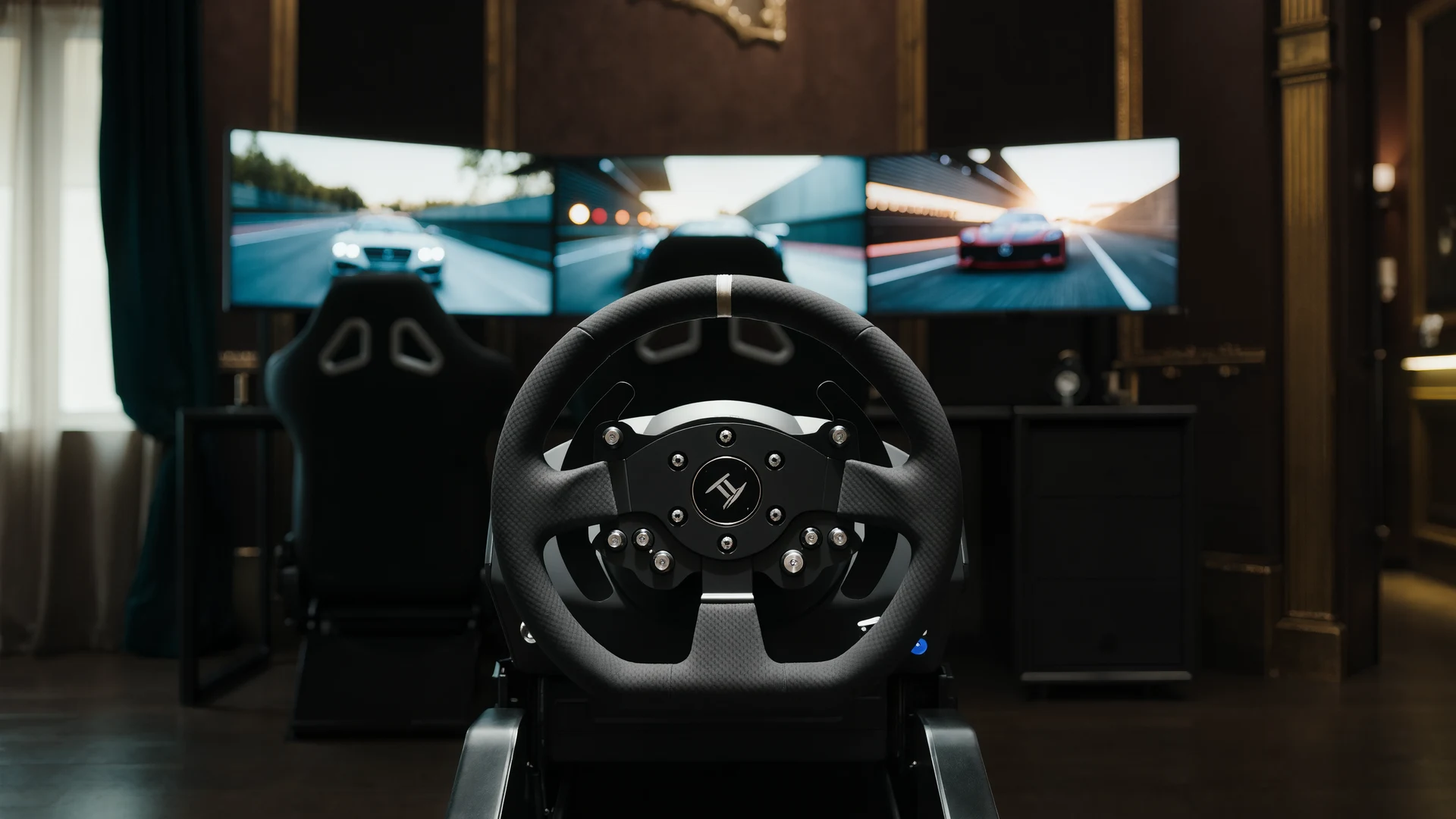
Sim Racing VR vs Triples Guide
VR vs triple monitors for sim racing in 2026: compare Quest 3, Pimax Crystal Light and triple 1440p setups on field of view, depth, comfort, cost and …
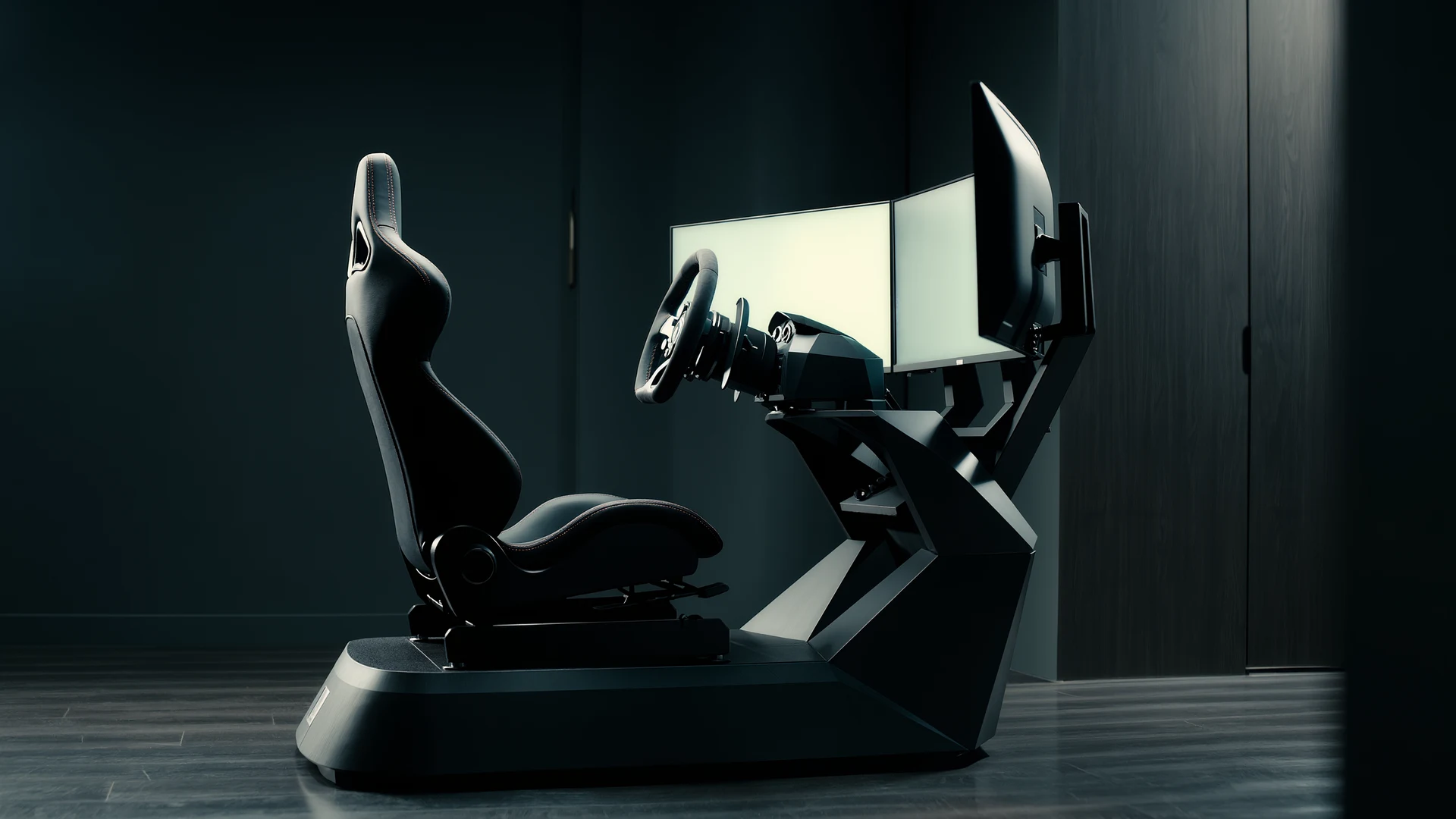
Sim Racing Motion Platforms Guide
Sim racing motion platforms guide: compare seat movers, chassis movers, D-BOX, PT Actuator, and bass shakers, with prices from $150 to $20,000-plus an…