Reading telemetry: the four channels that matter first
Reading telemetry: the four channels that matter first, what each curve shape means and how to turn a trace into a change you can test.
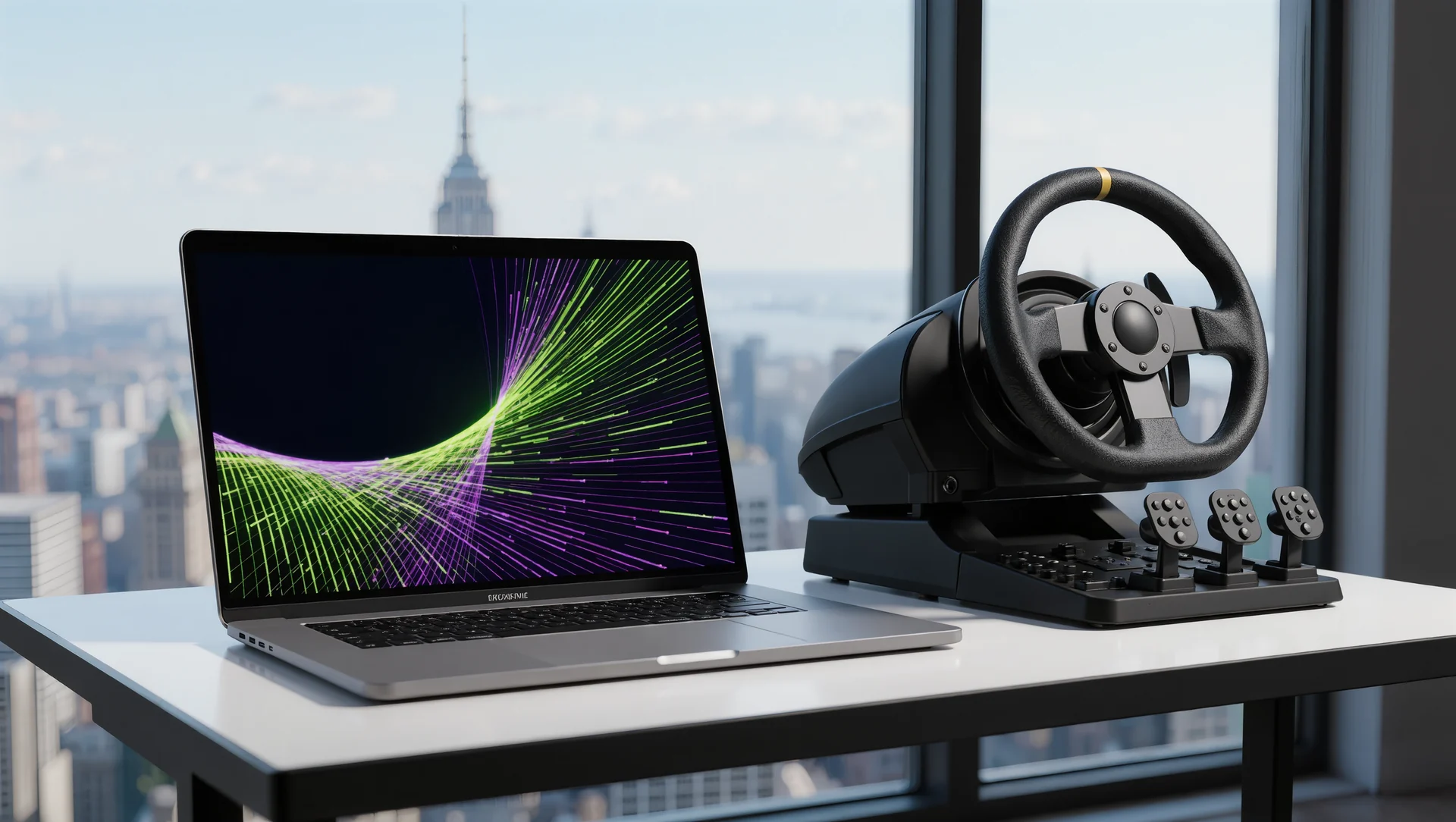
Telemetry does not tell you that you were slow; it tells you where and in which of your four inputs. Four channels answer almost every question a driver has, and reading them is a matter of shapes rather than numbers.
Why four channels are enough
A modern simulator records dozens of channels, and a driver who opens all of them learns nothing. Speed, throttle, brake and steering angle, each plotted against distance rather than time, cover the four things you control and the one thing you are trying to maximise.
Distance, not time, is the axis that matters. Two laps plotted against time drift apart and never realign, so a difference at turn 3 shifts everything after it. Plotted against distance, every corner lines up on both laps and the comparison stays honest for the whole lap.
The resolution is generous enough that shapes are meaningful. Le Mans Ultimate publishes a physics engine running at 400 Hz for force feedback, and iRacing runs force feedback at 360 Hz, which is a value every 2.5 to 2.8 milliseconds. At 200 km/h that is a sample every 14 to 16 centimetres of track.
What each shape means
On the speed trace, look for where two laps separate rather than where the gap is largest. The gap is usually widest halfway down a straight, and it opened at the corner exit before it. Speed against distance is the only channel that shows you the origin rather than the consequence.
On the throttle trace, the point of full throttle is the number. A trace that reaches one hundred per cent ten metres earlier at a corner leading onto a long straight is worth more than anything at the entry, and a trace that reaches it, drops and reaches it again is a driver correcting a car that is not ready for the power.
On the brake trace, read the shape and not the peak. A trace that jumps to maximum and holds flat is straight line braking; one that peaks and falls away gradually is trail braking. A trace that peaks twice in one braking zone is a driver who braked, released and braked again, which costs more than either version done properly.
On the steering trace, a single smooth arc through a corner is the target. A plateau in the middle where angle is added but the car does not rotate is understeer. A sawtooth is corrections, and corrections cost time twice: once for the slide and once for the correction.
| Channel | What to look for | What it means |
|---|---|---|
| Speed against distance | where two laps separate | the origin of the loss |
| Throttle against distance | point of full throttle | corner exit quality |
| Brake against distance | shape, not peak | flat is straight line, falling is trail braking |
| Steering against distance | single smooth arc | plateau is understeer, sawtooth is corrections |
| Force feedback meter | red | clipping, wheel capacity exceeded |
| Physics thread meter | full bar | about 16.7 ms at 60 Hz |
The comparison that produces a change
Overlay your best lap on your average lap first, not on somebody else's. Your own two laps differ in one or two places, and those are the places where you already know how to be faster and are not doing it consistently. That is the cheapest lap time available.
Then overlay a faster driver, and look at only one corner. Comparing a whole lap produces a list of twelve differences and no action; comparing turn 4 produces one difference and one thing to try.
And rule out the machine before you conclude anything. The published thresholds are specific: a full bar on the physics thread meter means about 16.7 ms at 60 Hz, latency is one second, packet loss is 50 per cent per direction, page faults are 30 per second, and red on the force feedback meter means clipping, that is the wheel capacity has been exceeded. A lap driven in clipping is a lap where your hands were told less than the simulation sent.
Turning a trace into a test
Write the change as a prediction. Not I should brake later at turn 4, but braking five metres later at turn 4 should give me 3 km/h more at the apex and cost nothing at the exit. Then drive five laps and check the two numbers.
One prediction per session. A driver who takes three changes from one telemetry session gets one lap time and no idea which change produced it, which is the same problem as changing three setup values at once and has the same solution.
Sources
Frequently asked questions
Against time or against distance?
Distance, always. Time drifts apart between laps and misaligns every corner after the first difference.
Which channel should I look at first?
Speed against distance, because it is the only one that shows where the loss started rather than where it became visible.
How do I spot understeer in a trace?
A plateau in the steering trace where angle is added and the car does not rotate. It is clearer in the data than in the seat.
Should I compare against a faster driver?
After comparing against yourself, and only one corner at a time. A whole lap comparison produces a list rather than an action.
More in Setup & Telemetry
Lift and coast: saving fuel without losing the place
Lift and coast: the arithmetic of saving fuel without losing the position, when it pays and the three ways drivers get it wrong.
Learning a new track in three structured sessions
Learning a new circuit in three structured sessions instead of ten unstructured ones, with what each session is for and how to know it worked.
The replay session: finding the mistake you cannot feel
The replay session: finding the mistake you cannot feel, which four channels to look at first and how to turn a replay into a change.