The tool list for an aluminium profile build
The tool list for an aluminium profile build, with the published torque limits and the two tools that decide whether the frame stays square.
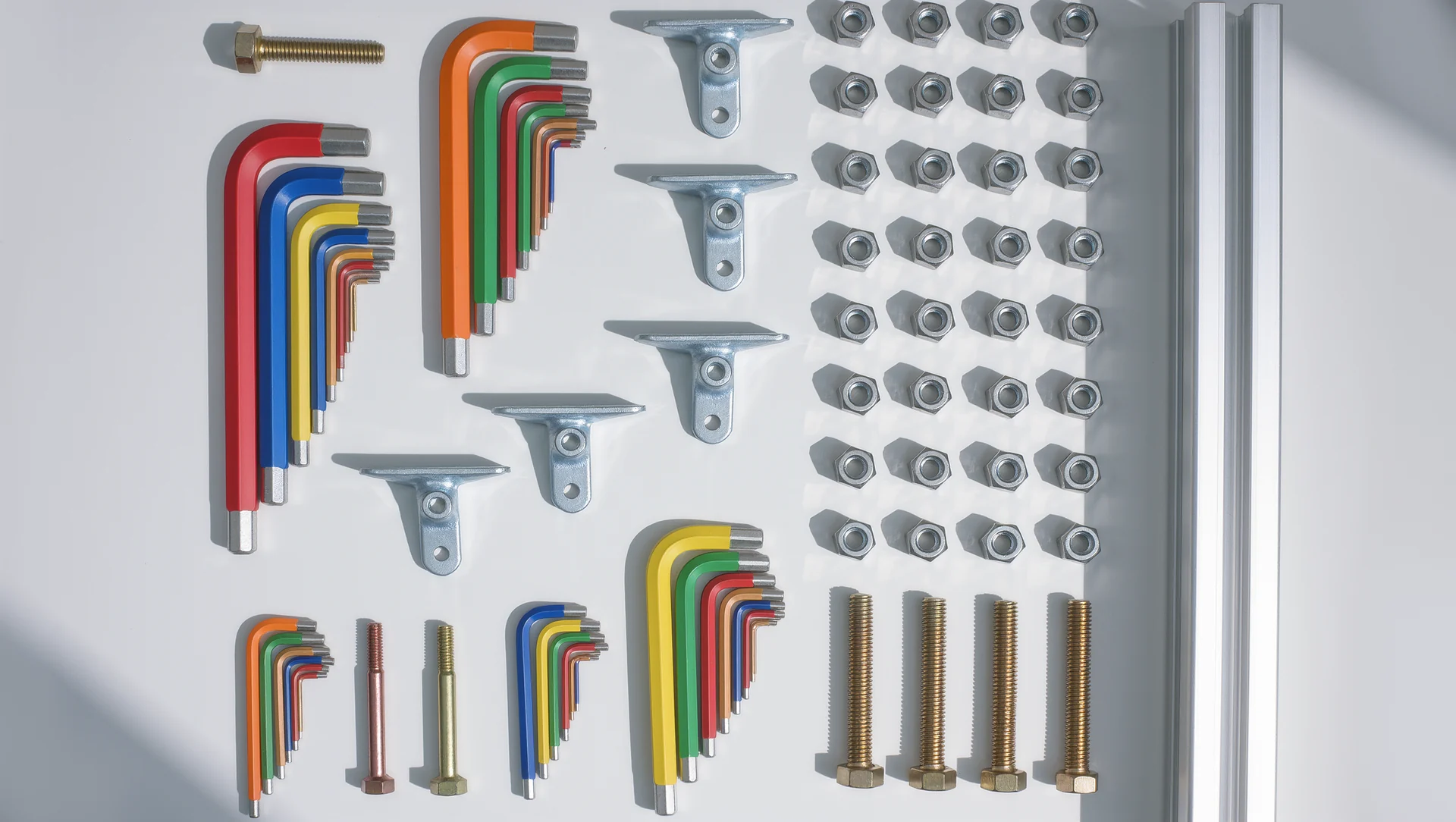
An aluminium profile rig needs six tools, and one of them is a torque wrench that most builders skip. Skipping it is why frames come apart under a strong base and why slot walls end up permanently deformed, and the published figures make the limit unambiguous.
The six tools that actually matter
A set of hex keys covers almost every fastener on a profile rig, because the cap screws used are standard: an M5 takes a 4 mm key, an M6 takes 5 mm and an M8 takes 6 mm. A second, longer key in the size you use most saves an hour over a full build, because reach inside a 160 by 40 mm beam is the real constraint.
A torque wrench with a hex bit adapter is the tool the instructions assume and most people do not own. item publishes a maximum tightening torque of 20 Nm for the M8 T-slot nut in an 8 mm groove, with a permissible force of 4,000 newtons and a nut weighing 9.3 grammes. Above that torque the nut body pulls up hard enough to deform the slot walls, which weakens the profile permanently and stops the nut ever sliding there again.
The other four are a builder's square, a rubber mallet, a tape measure and a marker. The square is not optional: a profile frame is only as square as you made it, and every bracket you tighten locks in whatever error was there when you tightened it.
| Item | Figure |
|---|---|
| M8 T-slot nut, groove 8 | maximum tightening torque 20 Nm |
| Permissible force per nut | 4,000 newtons |
| Nut weight | 9.3 grammes |
| Hex key sizes | M5 takes 4 mm, M6 takes 5 mm, M8 takes 6 mm |
| Typical corner bracket | 40 by 40 mm, about 32 grammes |
The order that saves the afternoon
Lay every beam out and check the lengths against the parts list before a single bolt goes in. A 1400 mm base beam and a 1200 mm one look identical on a carpet, and finding the swap at the end means undoing everything.
Assemble loose, square, then torque. Every bracket goes on finger tight, the frame gets squared with the square and the tape across both diagonals, and only then does anything get torqued to specification. A frame torqued as it is built will be out of square and will stay that way.
Torque in a pattern, not in a sequence. Working around the frame like a wheel rather than along one side keeps the error distributed, which matters because each bolt you tighten pulls the geometry slightly toward itself.
The consumables people forget
Buy more T-slot nuts than the parts list says, in the sizes your profile takes. A build always grows a shifter mount, a phone holder or a cable bracket, and at 9.3 grammes each they cost nothing next to the frustration of stopping mid build. The same applies to corner brackets: at 32 grammes each on a typical 40 by 40 mm bracket, an extra four are an afternoon insurance policy.
Add thread locking compound for the wheel mast bolts only. Those see the most reversing load of any joint in the rig, and they are also the joint that is hardest to reach for a retighten. Everything else should be able to come apart with a hex key.
What to check after the first week
Go around the frame once with the torque wrench after roughly ten hours of driving. Bolts settle, brackets bed into the slot, and the first retighten typically recovers the first millimetre of flex without any parts at all. After that, twice a year is enough unless the rig moves or gains a motion platform.
Sources
Frequently asked questions
Do I really need a torque wrench?
For the load bearing joints, yes. Twenty newton metres is easy to exceed by hand, and the damage to the slot wall is permanent.
Can I use an impact driver?
Not on T-slot nuts. It will pass the torque limit before you hear anything change, and the slot is what pays.
How square is square enough?
Measure both diagonals across the base. If they differ by more than two millimetres over a metre and a half, loosen and redo it.
What if a nut spins in the slot?
The slot wall is already deformed at that point. Move the nut a few centimetres along the groove rather than tightening harder.
More in Cockpits & Rigs

Wheel distance and the ninety degree elbow
Wheel distance decides whether your shoulders or your elbows do the steering. The angle to aim for, the published rim sizes and how to measure it in five minutes.
Buying a used rig: what to check before you pay
Buying a used sim rig: the parts that carry value, the damage that is invisible in photographs and the price arithmetic that decides whether it is a bargain.
How much direct drive torque you actually need
Direct drive torque compared: 5 Nm to 25 Nm across Fanatec, MOZA, Logitech and Simucube, what each level costs and where more torque stops paying.