How much direct drive torque you actually need
Direct drive torque compared: 5 Nm to 25 Nm across Fanatec, MOZA, Logitech and Simucube, what each level costs and where more torque stops paying.
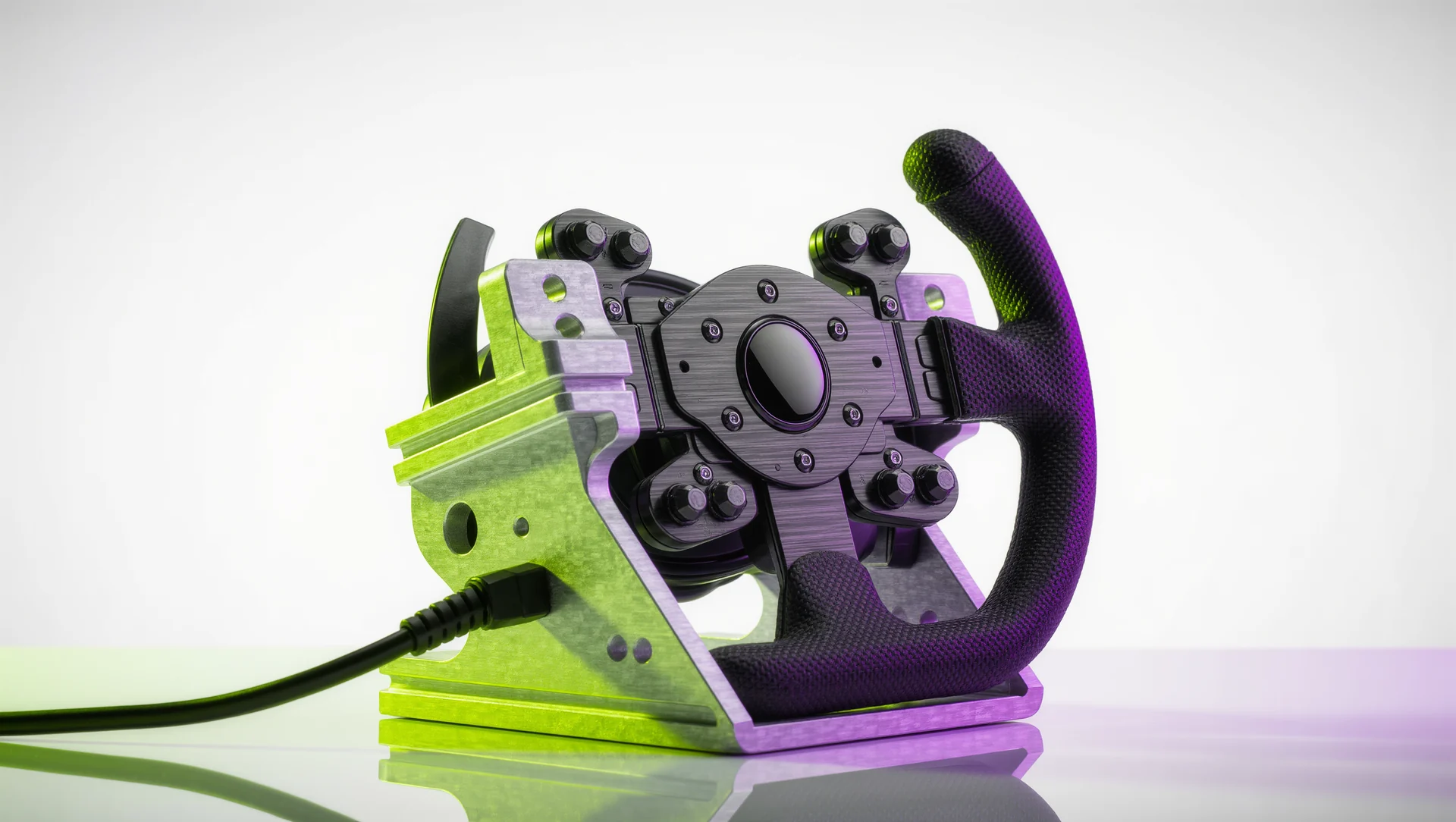
Between 8 and 12 Nm covers almost every driver and almost every car; beyond that you are buying resolution and headroom, not lap time. The number on the box says how hard the base can pull at its peak. What you feel is decided by the encoder, the slew rate and whether your rig moves.
What peak torque actually describes
Peak torque is the maximum force the motor can apply at the wheel rim, measured in Newton metres. It is a ceiling, not a working value. A base set to 100 per cent in software will only reach that ceiling in the hardest kerb strike or the moment a front tyre bites again after a lock up. For the other 99 per cent of a lap you are somewhere between 10 and 40 per cent of the ceiling, which is why two bases with the same headline figure can feel completely different.
Two specifications describe that difference better than torque does. The slew rate says how quickly the motor can change force: the Simucube 2 Sport is rated at 4.8 Nm per millisecond, the Simucube 2 Pro at 8.0 Nm per millisecond. The encoder resolution says how finely the base knows its own position, 21 bit on the MOZA R9 and R12, 22 bit on the Simucube 2 Sport. A high ceiling with a coarse encoder feels strong and vague. A moderate ceiling with a fine encoder feels informative, and information is what makes you faster.
The market in numbers
The current lineup spreads from 5 to 25 Nm, and the steps between the classes are smaller than the marketing suggests. The Fanatec CSL DD runs at 5 Nm and reaches 8 Nm with the Boost Kit 180 power supply, which the manufacturer states can be sustained without active cooling because the machined aluminium housing works as the heatsink. MOZA fills the middle with 9, 12, 16 and 21 Nm, Logitech sits at 11 Nm, and Simucube takes the top with 17 and 25 Nm at 280 and 450 watts respectively.
Price does not scale with torque in a straight line. The Simucube 2 Sport is listed at 1,006.14 euro for 17 Nm, the Simucube 2 Pro at 1,346.62 euro for 25 Nm. That is 34 per cent more money for 47 per cent more torque, but the Pro also doubles the power supply and raises the slew rate by two thirds, which is the part you actually feel.
| Base | Peak torque | Notable specification |
|---|---|---|
| Fanatec CSL DD | 5 Nm, 8 Nm with Boost Kit 180 | Passive cooling, aluminium housing as heatsink |
| MOZA R9 V3 | 9 Nm | 21 bit encoder |
| Logitech G PRO | 11 Nm | TRUEFORCE feedback, OLED display |
| MOZA R12 V2 | 12 Nm | 21 bit encoder |
| MOZA R16 | 16 Nm | Carbon fibre rotor sleeve |
| Simucube 2 Sport | 17 Nm | 4.8 Nm/ms slew rate, 280 W, 22 bit encoder |
| MOZA R21 | 21 Nm | Same motor family as the R16 |
| Simucube 2 Pro | 25 Nm | 8.0 Nm/ms slew rate, 450 W |
Where more torque stops paying
Torque you cannot mount is torque you cannot use. A base at 20 Nm bolted to a folding rig moves the rig instead of your hands, and every millimetre the frame flexes is detail that never reaches you. As a working rule, up to 8 Nm survives a good wheel stand, 8 to 15 Nm wants a steel or aluminium profile chassis, and beyond 15 Nm the frame has to be bolted together with the base treated as a structural member.
The second limit is your own arms. A two hour endurance stint at 20 Nm is physical work, and tired arms are imprecise arms. Most professional teams run their bases well below the ceiling for exactly that reason. Set the in game force so that the strongest event of the lap just reaches full scale, then leave it there for a week before judging it.
Choosing by discipline
Formula cars with power steering produce light, fast, detailed forces and reward a fine encoder over a big motor. GT3 and touring cars sit in the middle and are the reason 8 to 12 Nm is the most sold class. Rally, off road and heavy historic cars without power steering are the only discipline where 16 Nm and upward is a genuine advantage rather than a preference, because the real cars fight back that hard.
Sources
Frequently asked questions
Is 8 Nm enough for GT3 cars?
Yes. GT3 cars run power steering, so the forces a real driver feels are moderate and fast rather than heavy. Eight Newton metres reproduces the full range without clipping if the in game gain is set so that only the hardest kerb reaches full scale.
Does more torque make you faster?
Not by itself. Torque decides how strong the strongest event can be; the encoder and the slew rate decide how much information arrives between those events. A 25 Nm base run at 40 per cent gain gives you the same forces as a 10 Nm base at full gain, with more headroom and less clipping.
What rig do I need for 15 Nm or more?
A bolted steel or aluminium profile chassis with the base treated as a structural member. Up to roughly 8 Nm a rigid wheel stand still works. Anything that folds will move under a strong base, and the movement is subtracted from what your hands feel.
Why do two bases with the same Nm feel different?
Because peak torque is a ceiling, not a texture. Slew rate, encoder resolution, torque ripple and the filtering in the driver decide the texture. Simucube quotes 4.8 Nm per millisecond for the Sport and 8.0 for the Pro, which is a larger practical difference than the eight Newton metres between them.
Should I buy the strongest base I can afford?
Only if you race rally, off road or historic cars without power steering. For circuit racing the money is better spent on a load cell brake and a rigid frame, both of which change lap times more reliably than the last few Newton metres.
More in Wheels & Pedals
How to measure rig flex instead of guessing it
Rig flex is measurable with a ruler and a phone. The method, the numbers that separate a stiff frame from a soft one, and what to tighten first.
GT or formula seating: what the angle changes
GT and formula seating are two different jobs for the same body. The published angles, what each position gives you and what it costs over a two hour stint.
Pedal plate angle: the setting most rigs get wrong
Pedal plate angle decides how much of your leg strength reaches the load cell. The geometry, the published adjustment ranges and how to set it in one session.