USB power: the invisible cause of random disconnects
USB power is the invisible cause of random disconnects: the published current budgets, why a hub fixes it and how to diagnose it in ten minutes.
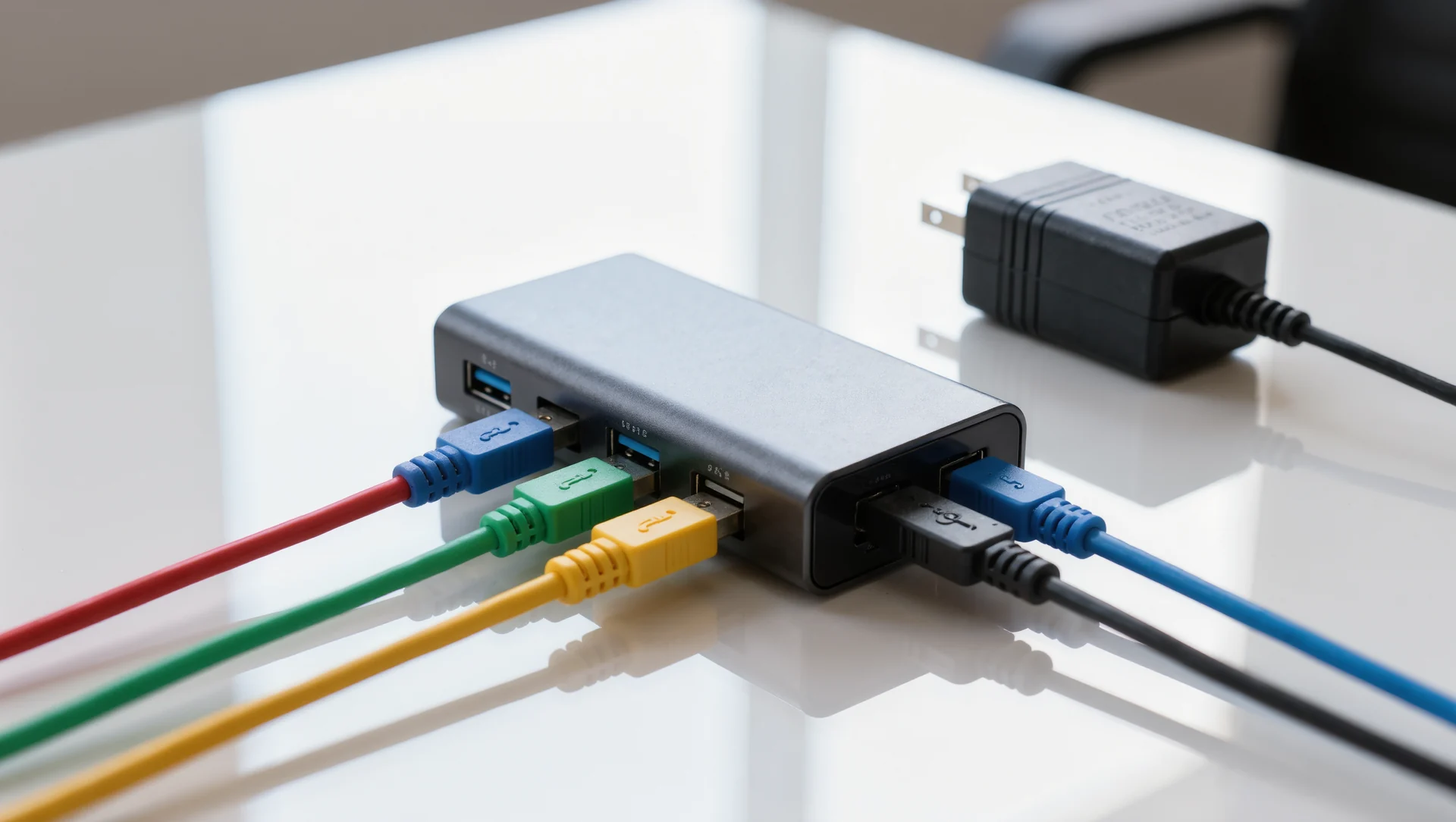
A wheel base that disappears mid race, a pedal set that goes to zero for half a second, a shifter that works until the button box is plugged in: all three are usually the same problem. The published current budgets explain it, and the fix costs less than any component you were about to replace.
The published budgets
The specification is precise. A unit load is defined as 100 mA in USB 2.0 and 150 mA in USB 3.0. A device may draw a maximum of five unit loads from a port in USB 2.0, which is 500 mA, or six unit loads in USB 3.0, which is 900 mA. At 5 volts that is 2.5 watts and 4.5 watts respectively.
Those figures are per port, and a hub shares them. An unpowered hub with four devices connected to a single USB 2.0 port is dividing 500 mA between four things, and the moment one of them draws its full allowance the others are running below specification.
The devices in a rig are not equal. A wheel base with its own power supply draws almost nothing from the port; a load cell pedal set, a button box with lit switches and a handbrake all draw from the bus. It is usually the accessories rather than the base that exhaust the budget.
| Standard | Unit load | Maximum per port | Power at 5 volts |
|---|---|---|---|
| USB 2.0 | 100 mA | 5 unit loads, 500 mA | 2.5 watts |
| USB 3.0 | 150 mA | 6 unit loads, 900 mA | 4.5 watts |
| Unpowered hub | shares the host port budget | ||
| Powered hub | supplies each port separately |
Why the symptom looks like something else
A device that browns out disappears from the device list, and what you see is the simulator losing the wheel. The natural conclusion is that the wheel base failed, and the natural next step is to replace an expensive component that was never at fault.
The timing makes it worse. Power problems appear under load, which in a rig means when the force feedback is working hardest and the button box is lit, which is to say during a race rather than in the pits. A fault that never reproduces in testing is the signature of a power problem.
And a marginal connection produces the same symptom as a marginal budget. A cable at the edge of its specified length has voltage drop along it, and voltage drop at the far end looks exactly like a port that cannot supply enough current.
Diagnosing it in ten minutes
Unplug everything except the wheel base and drive five laps. If the problem disappears, it is power or bus contention rather than the base, and you have halved the search in ten minutes.
Then add devices back one at a time, five laps each. The device that reintroduces the fault is not necessarily the faulty one; it is the one that pushed the total past the budget, which is a different statement and points at the hub rather than at the device.
And watch the published meters while you do it. A full bar on the page fault meter is 30 per second and points at memory rather than USB, while a device vanishing from the list with the physics thread meter unaffected points squarely at the bus.
The fix, in order of cost
A powered hub first, because it costs the least and solves the most. A hub with its own supply gives every port its full allowance instead of sharing one port's 500 or 900 mA between everything.
Then shorter cables and direct ports. Move the wheel base to a port on the motherboard rather than a front panel or a monitor hub, because every intermediate connector is another voltage drop and another contact that can age.
And only then suspect the device. A component that works alone on a direct port and fails in a full rig has told you the answer, and it is not a component that needs replacing.
Sources
Frequently asked questions
How much current does a USB port actually supply?
500 mA on USB 2.0 and 900 mA on USB 3.0, which is 2.5 and 4.5 watts at 5 volts. Those are per port and a hub shares them.
Why does the problem only happen during races?
Because power problems appear under load, and in a rig that means when force feedback is working hardest and every accessory is active.
Powered or unpowered hub?
Powered, always. An unpowered hub divides one port's budget between everything connected to it.
My wheel base disappears. Is it broken?
Test it alone on a direct motherboard port for five laps. If it behaves, the base is fine and the bus was the problem.
More in Technology

Streaming your races without wrecking your frame rate
Streaming your races without wrecking them: the encoder numbers that matter, the headroom the simulator needs and the setup that survives a full race distance.

From sim to seat: what a shootout really tests
What transfers from the simulator to a real car, what does not, and the licence steps that stand between a fast sim driver and a race entry.

Mental training: concentration for a two hour stint
The mental side of sim racing measured rather than described: sleep, attention budgets, the routine before a race and what to do after a bad one.