Quick release standards and what fits what
Quick release standards explained: the 70 mm bolt pattern, why QR1 and QR2 do not mix, and which variant belongs on which torque level.
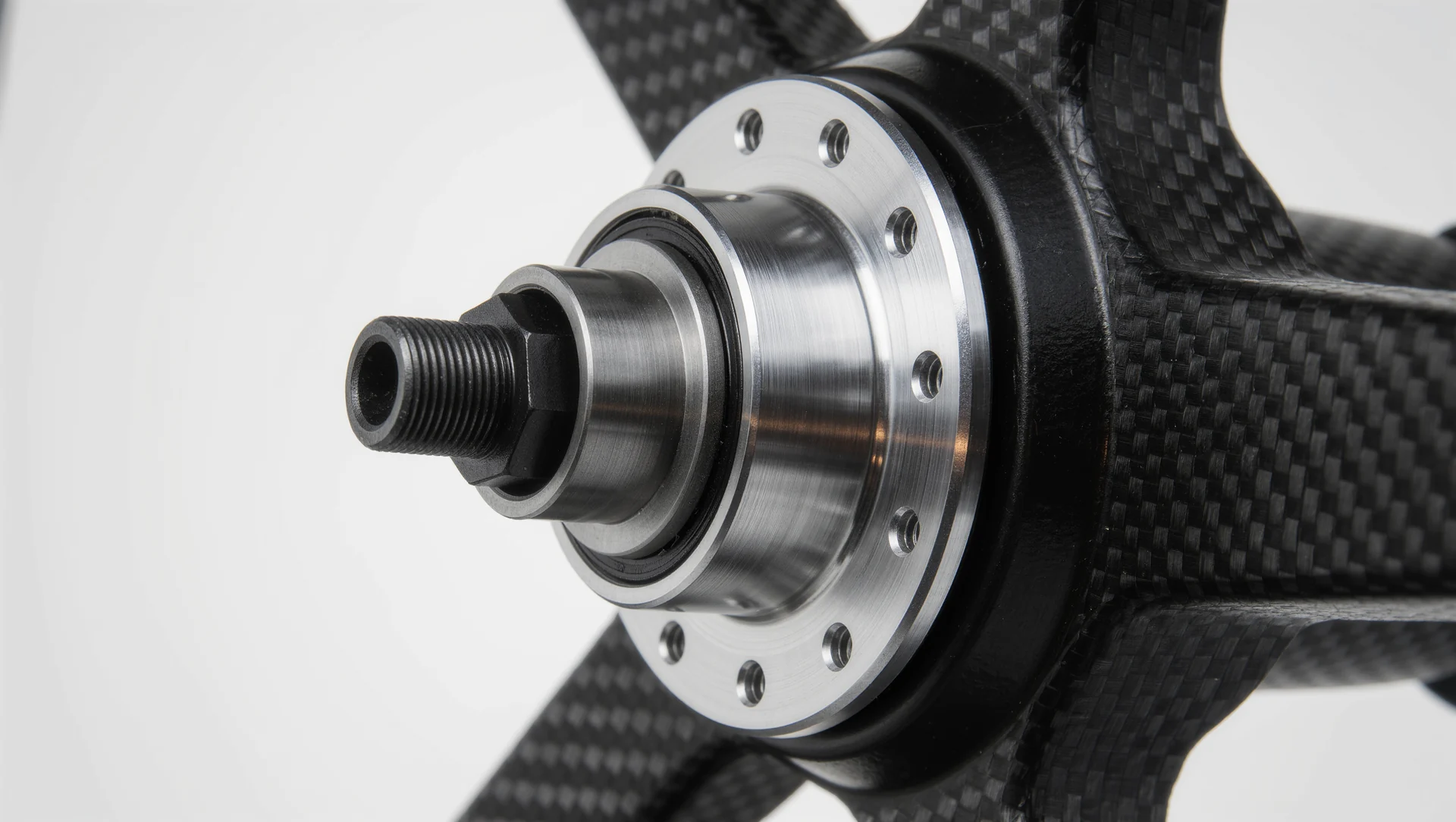
There is one nearly universal standard on the wheel side and no standard at all on the base side, and that asymmetry explains every compatibility problem in this part of the hobby. The wheel side is six bolts on a 70 mm circle; the base side is whatever your manufacturer decided.
The one thing that is standard
Almost every sim racing rim is drilled with six holes on a 70 mm pitch circle, measured from the centre. That 6 by 70 mm pattern is what lets a rim from one maker sit on an adapter from another, and it is the reason the aftermarket for hubs and adapters works at all. Moza, Simagic and most modern direct drive bases build around it.
Everything from the adapter to the base is manufacturer specific. Fanatec makes the point plainly in its own comparison: a steering wheel equipped with a QR1 is not compatible with a wheel base equipped with a QR2, and the reverse is equally true. That is not a licensing decision, it is a different mechanical coupling.
So the practical rule is simple. Buy rims for the 70 mm pattern and treat the coupling as part of the base, not part of the wheel. A rim outlives two or three bases, and the coupling is the part you expect to replace.
What the variants are actually for
The variants differ by material, and material is a proxy for torque. Fanatec describes the QR2 Pro wheel side as a fully CNC machined part in aviation grade billet aluminium, the standard QR2 as diecast aluminium, and the QR2 Lite as carbon fibre reinforced plastic. The company states that the Lite has been verified for operation at high torque levels of 15 Nm and above, while some CSL wheels remain limited to 8 Nm regardless of which coupling is fitted.
The third party market follows the same ladder. Simube sells QR2 compatible parts from a composite Lite at 60 dollars through a diecast aluminium standard at 100 to a CNC machined billet Pro at 200 with FIA certification for real world motorsport use, and its wheel side mate for the 70 mm pattern fits any QR2 base side in either ecosystem.
The reason the coupling matters at all is that it sits directly in the force path. Fanatec lists the redesign benefits as a far stronger construction, a more secure electronic connection, less mechanical noise while driving and an improvement in force feedback detail. Play in a coupling is play between the motor and your hands, and no software setting recovers it.
| Variant | Material | Typical use | Price |
|---|---|---|---|
| QR2 Lite wheel side | Carbon fibre reinforced plastic | verified 15 Nm and above | about 60 dollars |
| QR2 standard | Diecast aluminium | mid range direct drive | about 100 dollars |
| QR2 Pro | CNC billet aluminium, FIA certified | strong bases and real cars | about 200 dollars |
| Wheel side bolt pattern | 6 bolts on 70 mm pitch circle | nearly universal |
Choosing without the marketing
Below 8 Nm the coupling is not the limiting part, and the cheapest variant that fits is the right one. Between 8 and 15 Nm the metal versions start to matter, mostly because the spring loaded locking mechanism has to hold under reversing load thousands of times a session. Above 15 Nm buy the version the base maker specifies for that torque and stop optimising.
Count your rims before you count the price. A coupling costs 60 to 200 dollars per wheel side, so a driver with four rims pays four times, and that arithmetic often decides between the Lite and the Pro more honestly than any specification does.
Check the electrical side too. The coupling carries the button and paddle signals as well as the mechanical load, and a poor contact shows up as buttons that work intermittently, which people usually blame on the rim.
What to check when you swap
A quick release that clicks but rattles is worn or dirty rather than broken. Clean the pins, check for burrs and only then consider replacing. And when you buy a used rim, confirm which generation of coupling is on it, because the mounting bolts look identical on both and the shapes only reveal themselves when the parts are in your hands.
Sources
Frequently asked questions
Will my old rim fit a new base?
The 70 mm bolt pattern almost certainly fits, the coupling almost certainly does not. Budget for a new wheel side per rim.
Is the plastic version safe on a strong base?
Fanatec states the Lite is verified at 15 Nm and above. What limits you more often is the rim itself, not the coupling.
Why do my buttons drop out intermittently?
Usually the electrical contacts in the coupling rather than the rim. Clean them before you suspect the electronics.
Can I use an adapter between two systems?
Adapters for the 70 mm pattern exist and work. Adapters between two base side couplings add a joint in the force path, which is exactly where you do not want one.
More in Wheels & Pedals

Freestanding monitor stands and why motion needs them
Free standing monitor stands against rig mounted arms: the published load ratings, VESA ranges and the reason motion platforms leave no choice.
Bass shakers on a rig: placement, power, limits
Bass shakers on a sim rig: the published power and frequency figures, where to mount them, how many you need and where the limits genuinely are.
Cable management that survives a motion platform
Cable routing that survives a moving rig: the published filling rules for energy chains, the USB length limits and the order in which to lay a loom.