Freestanding monitor stands and why motion needs them
Free standing monitor stands against rig mounted arms: the published load ratings, VESA ranges and the reason motion platforms leave no choice.
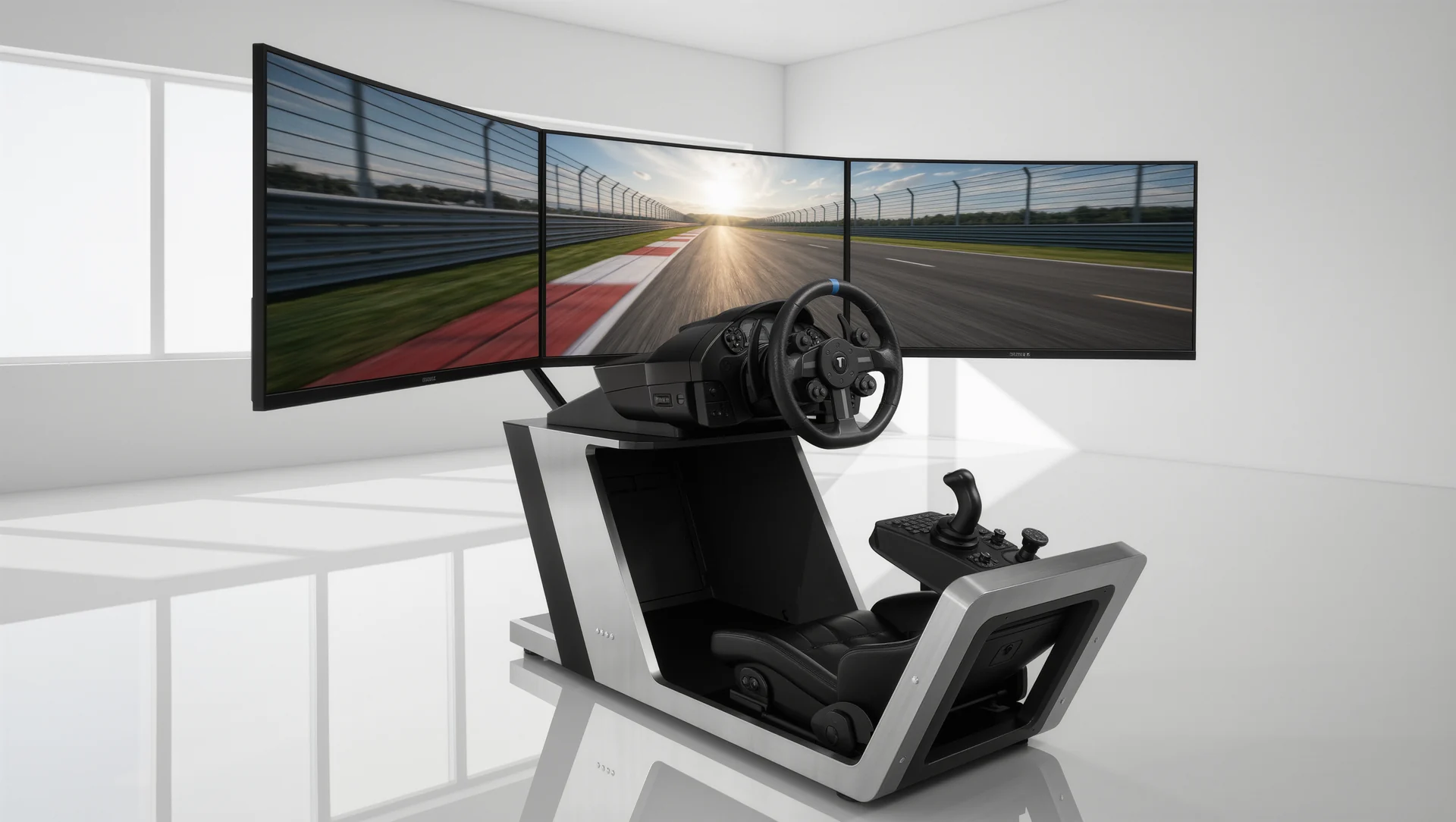
A monitor bolted to the rig moves with the rig, and a monitor that moves with the rig cancels exactly the motion the rig is trying to create. That single sentence decides the question for anyone with a motion platform, and the published load ratings decide it for everybody else.
Two mounting philosophies
A rig mounted arm bolts the screen to the same frame that carries the wheel. It saves floor space, it keeps the geometry constant when you slide the seat, and it means one object to move rather than two. For a static rig in a small room it is often the right answer, and the arm costs less than a stand.
A free standing stand carries the screens on their own legs. The rig can move, be replaced or be rolled away without touching the display, and the mass of a large screen never loads the rig. It occupies its own footprint, which is the price.
The moment a motion platform enters the plan, the argument ends. If the screen moves with the seat, the visual horizon stays fixed relative to your eyes while your inner ear reports movement, which is both less convincing and a reliable way to feel unwell. Every motion vendor mounts the screens separately for this reason.
What the load ratings mean
Trak Racer publishes a large free standing triple stand at 1200 mm wide, built from 80 by 40 mm aluminium profile, rated for up to 170 kg of load, supporting screens up to 55 inches with VESA points from 75 to 400 mm, weighing 40 kg itself and listed at 599 dollars. The dual version in 2 inch steel tube carries a primary display up to 80 inches and a secondary up to 45, with the same 75 to 400 mm VESA range, at 419 dollars.
Those numbers are generous on purpose. Three 32 inch panels weigh perhaps 21 kg in total, so a 170 kg rating is not about the mass, it is about the moment: a screen hanging 400 mm forward of the column loads the base as if it were far heavier, and the stand has to stay still while a 17 Nm base shakes the floor next to it.
The VESA range is the specification that catches people out. A panel with 400 mm spacing needs a stand that reaches 400 mm, and a small monitor with 75 mm spacing needs an adapter if the stand starts at 100. Check the pattern on the back of the screen you already own before you order anything.
| Stand | Screens | Load rating | Price |
|---|---|---|---|
| Trak Racer large triple, 1200 mm | up to 55 inches | up to 170 kg | 599 dollars |
| Trak Racer dual, 2 inch steel tube | 80 inch plus 45 inch | not published | 419 dollars |
| Rig mounted arm | depends on the rig | depends on the rig | lower |
| VESA range on both stands | 75 to 400 mm |
Getting the geometry right
Set the height so the horizon in the game sits slightly above the centre of the screen, which is roughly where it sits in a real car. Then set the distance: closer is more immersive but exposes pixel structure, further away is calmer but shrinks the useful field of view. On a triple, angle the side screens so their inner edges continue the centre screen rather than pointing at your ears.
Do the geometry with the seat in its final position and the wheel in place, because a wheel rim in front of the lower third of the screen is the most common and least noticed mistake. If the rim covers the mirrors, either the stand is too low or the wheel is too high, and both are cheaper to fix now than after the cables are tied down.
The quiet advantage of a separate stand
A rig outlives its screens and its screens outlive the rig. Separating them means each can be replaced on its own schedule, and a stand rated for 170 kg with a 75 to 400 mm VESA range will still fit the panel you buy in five years. A custom arm bolted to a specific profile will not.
Sources
Frequently asked questions
Do I need a free standing stand without motion?
Not necessarily. On a static rig an arm is cheaper and saves space; the stand wins on replaceability and on keeping screen mass off the frame.
Why does a stand need a 170 kg rating for 21 kg of screens?
Because of the lever, not the mass. A panel 400 mm in front of the column loads the base far more than its weight suggests.
What VESA pattern do I need?
Whatever is on the back of your screen. Stands commonly cover 75 to 400 mm, and anything outside that range needs an adapter plate.
Triple or one large screen?
A single 55 inch panel is simpler and cheaper to mount; triples give real peripheral vision. The stand rating matters more with triples because of the side arms.
More in Cockpits & Rigs
Bass shakers on a rig: placement, power, limits
Bass shakers on a sim rig: the published power and frequency figures, where to mount them, how many you need and where the limits genuinely are.
Cable management that survives a motion platform
Cable routing that survives a moving rig: the published filling rules for energy chains, the USB length limits and the order in which to lay a loom.
Rig noise through the floor and what actually stops it
Rig noise through the floor is structure borne, not airborne. Why carpet does nothing, what the isolation figures mean and how to size a decoupling pad.