Rig noise through the floor and what actually stops it
Rig noise through the floor is structure borne, not airborne. Why carpet does nothing, what the isolation figures mean and how to size a decoupling pad.
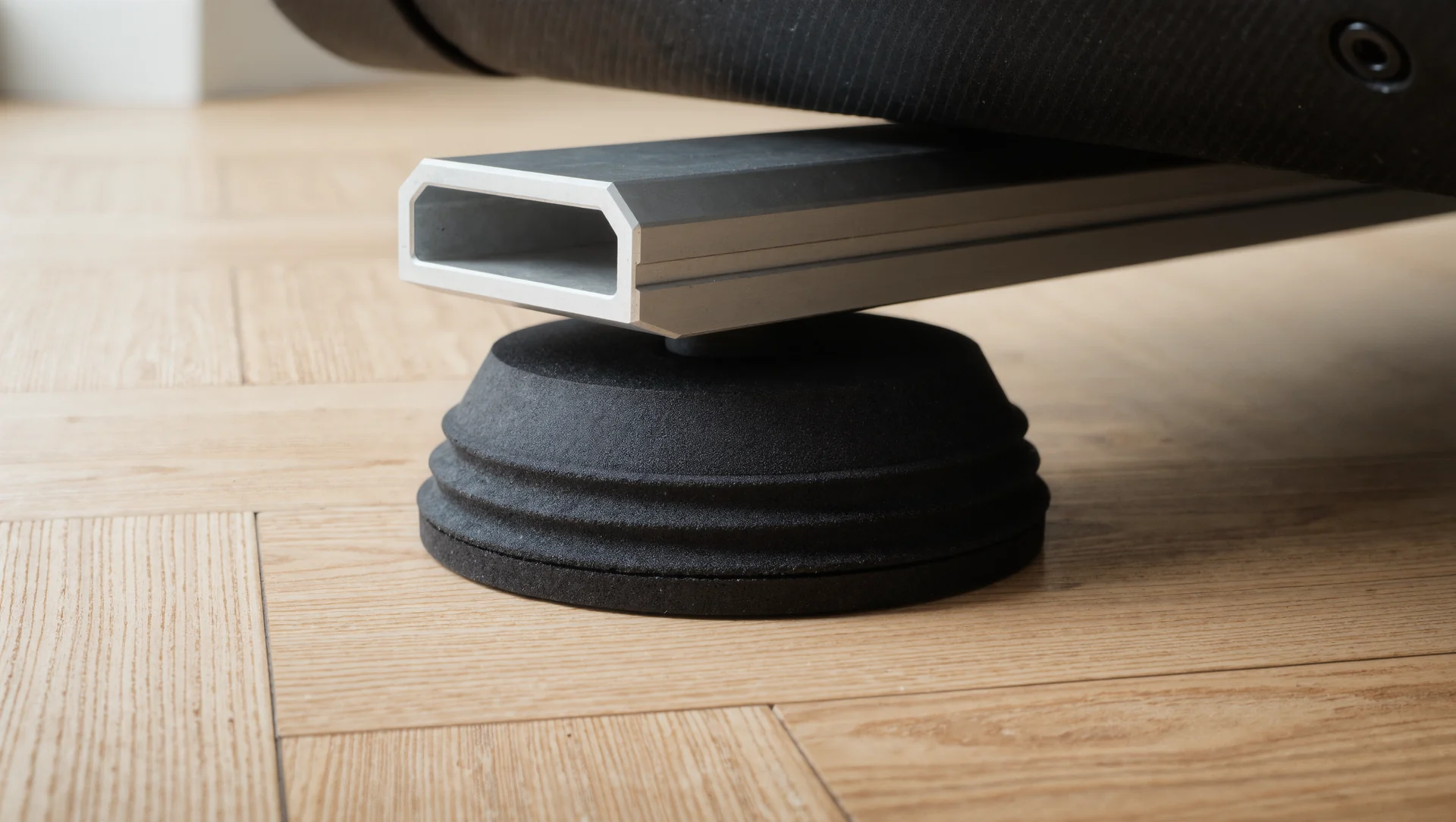
The complaint from downstairs is almost never about the sound of your wheel; it is about a 40 Hz vibration travelling through a concrete slab. That distinction decides which measures work, and it is why a thicker carpet has never solved this problem for anybody.
Airborne against structure borne
Airborne noise is the clatter of a shifter and the fan of a PC, and it is stopped by mass and by soft surfaces. Structure borne noise is the energy your rig puts directly into the floor, and it travels through concrete for tens of metres with almost no loss. A bass shaker covers 5 to 200 Hz, and everything below about 60 Hz in that range goes into the building rather than into the air.
That is why the two obvious measures fail. Carpet absorbs airborne sound in the room you are already in, and the neighbour hears nothing that started in the air. Turning the speakers down helps the room and does nothing for the shaker, because the shaker never used the air in the first place.
The pedals are the second source people miss. A load cell calibrated to 60 kg puts 588 newtons into the rig on every corner, which is a repeated impulse into the floor at the exact rate at which you brake. In a timber floor building, that arrives downstairs as a knock.
What decoupling actually needs to do
An isolation pad works by lowering the natural frequency of the whole assembly below the frequencies you want to stop, and it only starts isolating above roughly 1.4 times that natural frequency. Getzner publishes Sylomer with a natural frequency between 7 and 11 Hz depending on type and thickness, which means isolation begins somewhere around 10 to 16 Hz and covers the whole band a shaker produces.
The catch is load. The same material is specified for a static range of use from 0.011 to 1.2 N per square millimetre with load peaks up to 6.0 N per square millimetre, and the isolation only works if the pad is loaded into its intended range. Under loaded, it is too stiff and passes vibration straight through; over loaded, it bottoms out and does the same.
So the pad has to be sized, not just bought. Take the total mass on the floor: a 41 kg frame plus an 80 kg driver is 121 kg, which is about 1,187 newtons. Spread over four feet that is roughly 297 newtons each. At a target pressure of 0.05 N per square millimetre, each pad needs about 5,940 square millimetres, which is a square of roughly 77 by 77 mm.
| Item | Figure |
|---|---|
| Shaker frequency range | 5 to 200 Hz |
| Sylomer natural frequency | 7 to 11 Hz by type and thickness |
| Static range of use | 0.011 to 1.2 N per square millimetre |
| Load peaks | up to 6.0 N per square millimetre |
| Frame plus driver | 41 kg plus 80 kg, about 1,187 newtons |
| Per foot at four feet | about 297 newtons, roughly 77 by 77 mm of pad |
The measures in order of effect
First, lower the level. Most drivers run a 90 watt shaker amplifier far above what the information requires, and halving the level halves the energy going into the building before any material is bought.
Second, decouple the four feet properly sized as above. Rubber feet from a hardware shop are a lottery because their load range is unknown, and a pad that is too hard for 297 newtons transmits almost everything.
Third, add mass between the rig and the floor. A heavy board on top of the pads gives the assembly more inertia at the frequencies that matter, and it also spreads the load so that the pads see a pressure closer to their design range.
Fourth, agree on times. None of the above makes a rig silent, and a neighbour who knows that the driving happens between six and ten is a different neighbour from one who is surprised at midnight.
What not to bother with
Foam mats sold for gyms are designed for impact, not for continuous low frequency, and they compress to nothing under a point load. Egg box foam on the walls is airborne treatment and does nothing here. And moving the rig to a corner makes it worse, because the corner is where the floor is stiffest and best coupled to the structure.
Sources
Frequently asked questions
Does a thicker carpet help?
Against airborne noise in your own room, a little. Against the structure borne vibration the neighbour hears, no.
Are rubber feet from the hardware shop enough?
Only by luck. Isolation depends on the pad being loaded into its design range, and an unspecified rubber block has no published range.
Is a wooden floor worse than concrete?
For impacts, usually yes, because a timber floor radiates like a membrane. Concrete carries low frequencies further but radiates them less.
Will decoupling change how the rig feels?
Slightly. Very soft pads let the whole rig rock under heavy braking, which is why the pad has to be sized for the load rather than chosen for softness.
More in Cockpits & Rigs
The tool list for an aluminium profile build
The tool list for an aluminium profile build, with the published torque limits and the two tools that decide whether the frame stays square.

Wheel distance and the ninety degree elbow
Wheel distance decides whether your shoulders or your elbows do the steering. The angle to aim for, the published rim sizes and how to measure it in five minutes.
Buying a used rig: what to check before you pay
Buying a used sim rig: the parts that carry value, the damage that is invisible in photographs and the price arithmetic that decides whether it is a bargain.