Wheel distance and the ninety degree elbow
Wheel distance decides whether your shoulders or your elbows do the steering. The angle to aim for, the published rim sizes and how to measure it in five minutes.
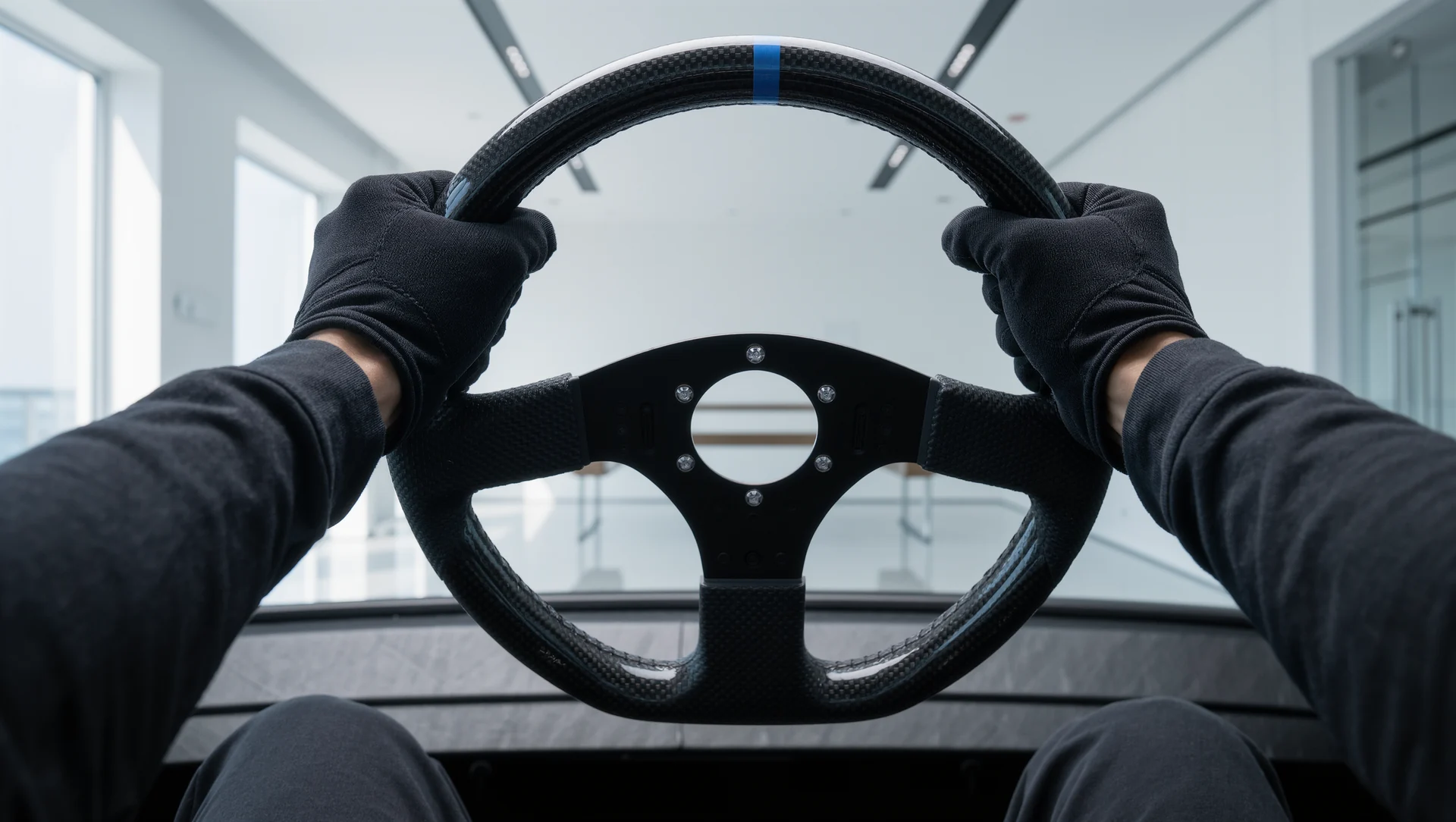
If your arms are straight at the wheel, your shoulders are doing the correcting, and shoulders are slow. A bent elbow puts the correction in the forearm, which is faster, more precise and does not tire over a two hour stint.
Why the elbow angle is the whole point
Every correction you make at the wheel starts as a muscle contraction somewhere. With straight arms, the only joints available are the shoulders, and the shoulder is a large joint moving a long lever. It is powerful and imprecise, which is the wrong combination for a catch that has to happen in a tenth of a second.
With the elbow bent, the forearm can rotate the wheel without the upper arm moving at all. The lever is shorter, the muscles are smaller and faster, and the hands stay at nine and three without your body following them. That is why the classic advice of resting the wrist on top of the rim with a straight arm exists: it is a check, not a driving position, and it defines the far limit rather than the target.
The target is somewhere between 90 and 120 degrees at the elbow with the hands at nine and three. Closer to 90 for a formula position where the wheel is at the chest, closer to 120 for a GT position where the arms reach further forward.
What the rim size changes
Rim diameter changes both the leverage and the distance. Fanatec publishes the ClubSport GT V2 at 330 mm in diameter and 979 grammes, while the formula style rims sit at 270 mm. That 60 mm difference in diameter moves your hands 30 mm closer to the hub on each side, which changes the elbow angle without touching a single bolt on the rig.
It also changes the force. Torque at the rim is torque divided by radius: 17 Nm on a 330 mm rim is a radius of 0.165 m and therefore about 103 newtons at the hands, while the same 17 Nm on a 270 mm rim is a radius of 0.135 m and about 126 newtons. A smaller rim feels stronger with the base set identically, which is why a formula rim usually needs the strength setting turned down.
And it changes what you can hold. A 979 gramme rim hanging on an extension changes the mast loading, so the same distance achieved by moving the seat rather than by adding a quick release extension is always the stiffer solution.
| Rim | Diameter | Force at the hands with 17 Nm |
|---|---|---|
| ClubSport GT V2 | 330 mm, 979 grammes | about 103 newtons |
| Formula style rim | 270 mm | about 126 newtons |
| Target elbow angle GT | roughly 120 degrees | |
| Target elbow angle formula | roughly 90 degrees |
Measuring it in five minutes
Sit in your final position with the seat set and the backrest at its angle, because the wheel distance follows from those. Put your hands at nine and three and have someone photograph you from the side, or set a phone on a timer. A photograph resolves the elbow angle far better than your own sense of it does.
Then check the extremes rather than the middle. Turn the wheel 90 degrees each way and watch whether your shoulder lifts off the seat; if it does, the wheel is too far away. Then check the mirrors: if your forearm covers them at rest, the wheel is too high rather than too far.
Change one thing at a time and drive between changes. Wheel distance, wheel height and wheel angle all feel similar from the chair and different on track, and a rig with a 110 mm seat slider gives you plenty of travel to find the answer without unbolting anything.
The mistake that hides as a preference
Drivers who like the wheel far away are usually compensating for a rim that is too large, a seat that is too upright, or a screen that is too low. Fix the cause and the preference disappears; leave the cause and every other setting on the rig gets bent around it.
Sources
Frequently asked questions
Is the wrist on the rim test still valid?
As a limit, yes. It tells you the furthest the wheel should ever be, not where it should sit for driving.
Should a smaller rim mean less force in the software?
Usually yes. The same torque on a smaller radius arrives as more force at your hands, so the setting that felt right on a 330 mm rim will feel heavy on a 270.
Does an extension help or hurt?
It helps the distance and hurts the stiffness, because a 979 gramme rim further from the mast increases the load. Move the seat first.
My shoulder aches after an hour. What is wrong?
Almost always a wheel that is too far away or too low. Both put the correction into the shoulder instead of the forearm.
More in Cockpits & Rigs
Buying a used rig: what to check before you pay
Buying a used sim rig: the parts that carry value, the damage that is invisible in photographs and the price arithmetic that decides whether it is a bargain.
How much direct drive torque you actually need
Direct drive torque compared: 5 Nm to 25 Nm across Fanatec, MOZA, Logitech and Simucube, what each level costs and where more torque stops paying.
Load cell or potentiometer pedals: the braking difference
Load cell against potentiometer pedals: what changes in the braking, which figures the manufacturers publish and why the upgrade is felt on the second lap.