Bass shakers on a rig: placement, power, limits
Bass shakers on a sim rig: the published power and frequency figures, where to mount them, how many you need and where the limits genuinely are.
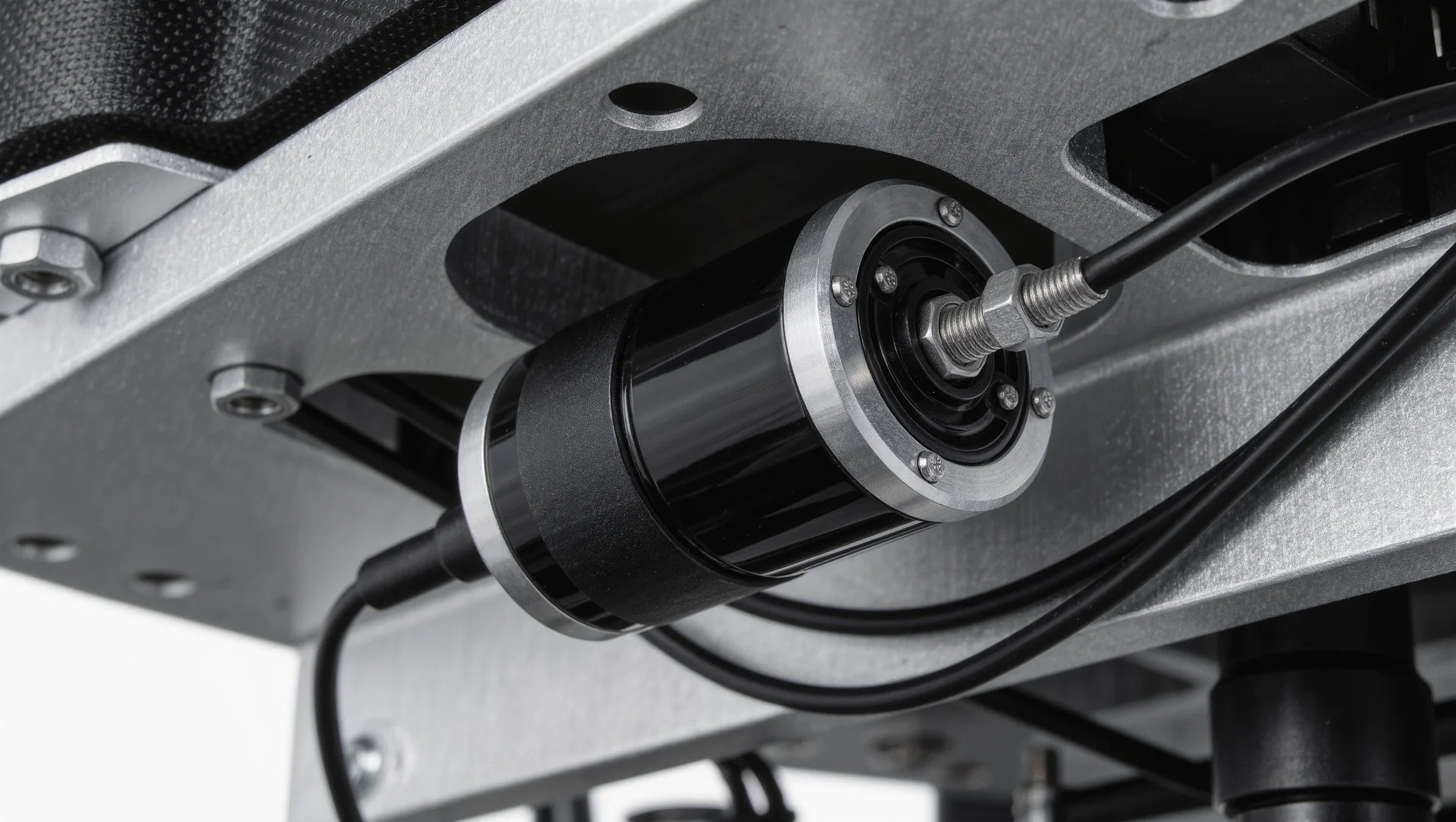
A bass shaker does not make noise, it makes the frame vibrate, and your body reads that vibration as kerbs, wheelspin and the moment a tyre lets go. It is the cheapest information channel in the whole rig, and the one most often installed in the wrong place.
What the specification actually says
ButtKicker publishes the Gamer PLUS package at 279.95 dollars. The amplifier delivers 90 watts RMS at 2 ohms with a frequency response of 10 to 300 Hz, measures 9.4 by 7.6 by 2.8 inches and weighs 3.7 lbs. The transducer itself covers 5 to 200 Hz at a nominal impedance of 2 ohms, handles 75 watts minimum and 250 watts maximum, measures 8.5 by 5 by 3.75 inches, weighs 2.7 lbs and carries a piston of 6 ounces.
Two of those numbers explain the whole product. The 5 to 200 Hz range is below what a speaker does well and below where the ear is precise, which is exactly the band your body feels rather than hears. And the 6 ounce piston is the moving mass: the shaker works by throwing that weight against the frame, so what you feel depends as much on what the frame does with it as on the amplifier.
The impedance figure matters when people add a second unit. Two 2 ohm transducers wired carelessly present 1 ohm to an amplifier rated at 2, and the amplifier either protects itself or dies. Two units means either two channels or a wiring plan, never a Y splitter.
| Item | Figure |
|---|---|
| Amplifier power | 90 watts RMS at 2 ohms |
| Amplifier frequency response | 10 to 300 Hz |
| Transducer frequency response | 5 to 200 Hz |
| Transducer power handling | 75 watts minimum, 250 watts maximum |
| Piston weight | 6 ounces |
| Package price | 279.95 dollars |
Where to mount them
The seat is the obvious place and the wrong one to start with. A shaker bolted directly under the seat pan gives a strong, undifferentiated thump that quickly stops carrying information. Mounting to the frame beneath the seat, so the vibration reaches you through the structure, gives less amplitude and far more detail.
The pedal plate is the position most people never try, and it is the one that changes driving. Wheel lock and ABS activity arrive through the same foot that is applying the pressure, which closes the loop between input and result without occupying your ears or your eyes.
Avoid mounting to anything that rings. A thin steel plate or an unsupported panel turns a 40 Hz signal into audible buzz, which is noise for your neighbours and information for nobody. Mount into a profile beam or a solid bracket and the same signal stays where it belongs.
How many, and what they cost you
One unit under the seat frame covers road texture and kerbs. Two, one at the seat and one at the pedals, is where the setup starts giving distinct information rather than atmosphere. Four units with separate channels for each wheel is where diminishing returns begin for most drivers, because the body struggles to localise vibration below roughly 60 Hz.
The cost is not only money. A 90 watt amplifier and a transducer that throws 6 ounces put real energy into your floor, and in a flat that energy has a destination. The measures that work are decoupling feet under the rig, a heavy mat and, most effectively, keeping the level down: most drivers run their shakers far louder than the information requires.
Setting the level once, properly
Start with the amplifier at minimum and drive a lap on a smooth surface. Raise the level until you can just feel the road texture, then stop. Now drive over kerbs: if the kerbs are painful, the level is set for the loudest event rather than the quietest, which wastes the entire dynamic range on one moment.
Then check the crossover if your software has one. Everything above roughly 200 Hz is outside what the transducer reproduces anyway, and filtering it out removes buzz without removing anything you can feel.
Sources
Frequently asked questions
Is one shaker enough?
For atmosphere, yes. For information, two, with the second one on the pedal plate rather than a second seat position.
Can I run two transducers from one amplifier?
Only with a wiring plan. Two 2 ohm units in parallel present 1 ohm, which is below what a 2 ohm amplifier is rated for.
Will the neighbours hear it?
The frequencies below 60 Hz travel through the structure, so yes, unless you decouple the rig and keep the level moderate.
Does it work in every simulator?
It needs either a telemetry driven plugin or the game audio. Telemetry gives cleaner, more specific effects; game audio works everywhere but shakes on engine noise too.
More in Cockpits & Rigs
Cable management that survives a motion platform
Cable routing that survives a moving rig: the published filling rules for energy chains, the USB length limits and the order in which to lay a loom.
Rig noise through the floor and what actually stops it
Rig noise through the floor is structure borne, not airborne. Why carpet does nothing, what the isolation figures mean and how to size a decoupling pad.
The tool list for an aluminium profile build
The tool list for an aluminium profile build, with the published torque limits and the two tools that decide whether the frame stays square.