Field of view: the calculation, not the preference
Field of view is a calculation, not a preference: the formula, what a wrong setting costs you and why the correct number always feels too narrow at first.
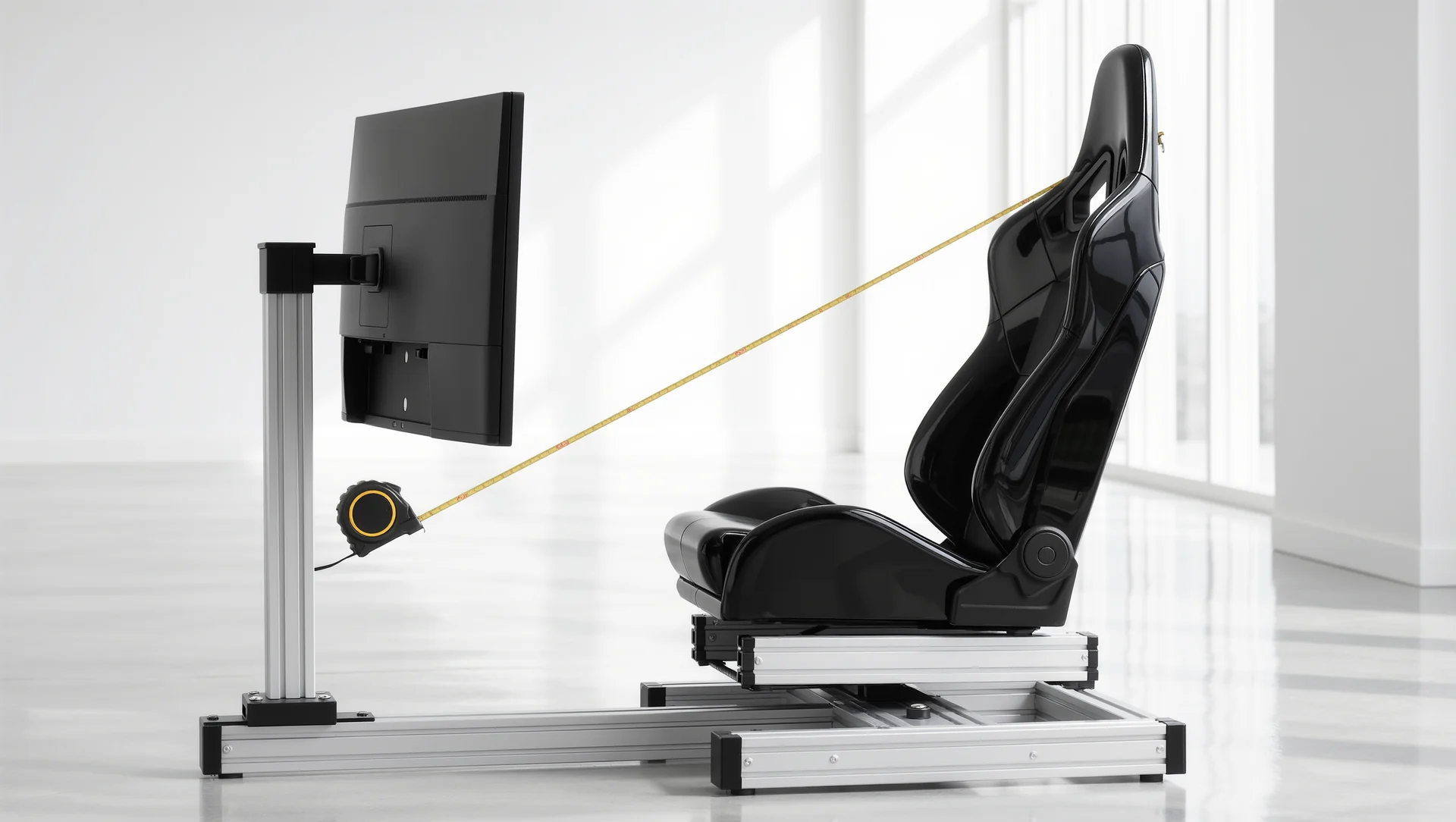
Field of view is the only setting in a racing simulator with a mathematically correct answer, and almost everybody runs it too wide because the correct value feels claustrophobic for the first twenty minutes. The formula takes two measurements and a calculator.
The formula and the two measurements
The calculation is one line of trigonometry: field of view equals two times the arctangent of half the screen width divided by the eye to screen distance. Half the screen width turns the isosceles triangle into two right angled triangles, the arctangent gives the half angle, and doubling it gives the full angle in radians, which then converts to degrees.
You need exactly two numbers: the physical width of the screen and the distance from your eyes to it. Not the diagonal, not the advertised size, the actual width of the visible picture, and the distance measured from your eyes rather than from your chest.
A worked example makes the size of the effect obvious. A 27 inch 16 by 9 monitor is about 60 cm wide, so at 60 cm distance the correct angle is 2 times the arctangent of 30 over 60, which is about 53 degrees. Move to 80 cm and the same screen wants about 41 degrees, a difference of 12 degrees from 20 cm of seat position. A default of 90 degrees is nearly double the correct figure, and that is why braking points arrive early.
Distance is by far the larger factor. Most sim racers sit between 50 and 100 cm from the screen, and moving from 80 cm to 60 cm changes the correct angle by more than any change of monitor size within one size class. Measure it rather than estimating.
| Input | What to measure |
|---|---|
| Screen width | the visible picture, not the diagonal |
| Eye to screen distance | from your eyes, typically 50 to 100 cm |
| Formula | 2 times arctangent of half width divided by distance |
| Triple screens | total width across all three, plus correct side angles |
| Headset | no calculation needed, optics fix the geometry |
| Settling time | about twenty minutes before judging |
What a wrong setting actually costs
Too wide is the common error, and it does three things. Distances compress, so braking points arrive faster than they should and every reference is at the wrong place. Speed feels exaggerated because the edges of the picture rush past. And the sense of rotation is wrong, so catching a slide becomes guesswork rather than reading.
Too narrow costs situational awareness instead. You see less of what is beside you, which matters in traffic, and the correct answer for a single screen driver is usually to accept that limitation rather than to widen the angle and break the geometry.
The setting is also what makes lap times transfer. Two drivers running different fields of view are looking at different worlds, and a braking reference described by one is at a different apparent distance for the other, which is why coaching advice sometimes simply does not work.
Why the correct number feels wrong
Because a correct field of view shows less scenery than the one you are used to, and less scenery reads as less speed. The impression fades in about twenty minutes and the improvement in braking accuracy stays, which is the opposite of most settings where the first impression is the honest one.
The way through it is to change it once and drive twenty laps without touching it. A driver who adjusts it back after five laps has measured their discomfort rather than their lap time, and the reference points will not have had time to settle.
And judge it by braking accuracy rather than by feel. If your braking points become more repeatable within two sessions, the number was right; if they get worse, you measured wrong, most likely the distance.
Triples, single screens and headsets
On a triple setup the calculation uses the total width across all three screens, and the side screens have to be angled so that the geometry is continuous. Getting the angle wrong produces the same distortion as a wrong field of view on one screen, and it is harder to notice because only the edges are affected.
In a headset the question does not arise, because the optics fix the geometry and the simulator matches it. That is one of the genuine advantages of VR, and iRacing notes that headsets require the recommended tier of system specifications rather than the minimum.
Sources
Frequently asked questions
Why does the correct field of view feel too narrow?
Because it shows less scenery, and less scenery reads as less speed. The impression fades in about twenty minutes; the braking accuracy stays.
Diagonal or width?
Width, always. The diagonal includes the height, which the formula does not use for a horizontal field of view.
How do I know my setting is right?
Braking points become more repeatable within two sessions. If they get worse, the measurement was wrong, usually the distance.
Does this matter in VR?
No. The optics fix the geometry, which is one of the real advantages of a headset, though iRacing notes headsets need the recommended system tier.
More in Technology
Driver swaps: the choreography that loses or wins hours
Driver swaps: the rule that disqualifies teams, the arithmetic behind a fair share and the choreography that loses or wins hours.
Pit strategy: undercut, overcut and the safety car
Pit strategy: undercut, overcut and the safety car, with the arithmetic that decides each one and the published rules that limit your options.
Founding a team: roles, rules and the first season
Founding a team: the roles that actually matter, the rules that bind a team and the first season planned so it survives to the second.