Brake bias: moving it during the lap, not before
Brake bias: what moving it forward and rearward actually does, why the best drivers move it during the lap and where the dangerous end of the range is.
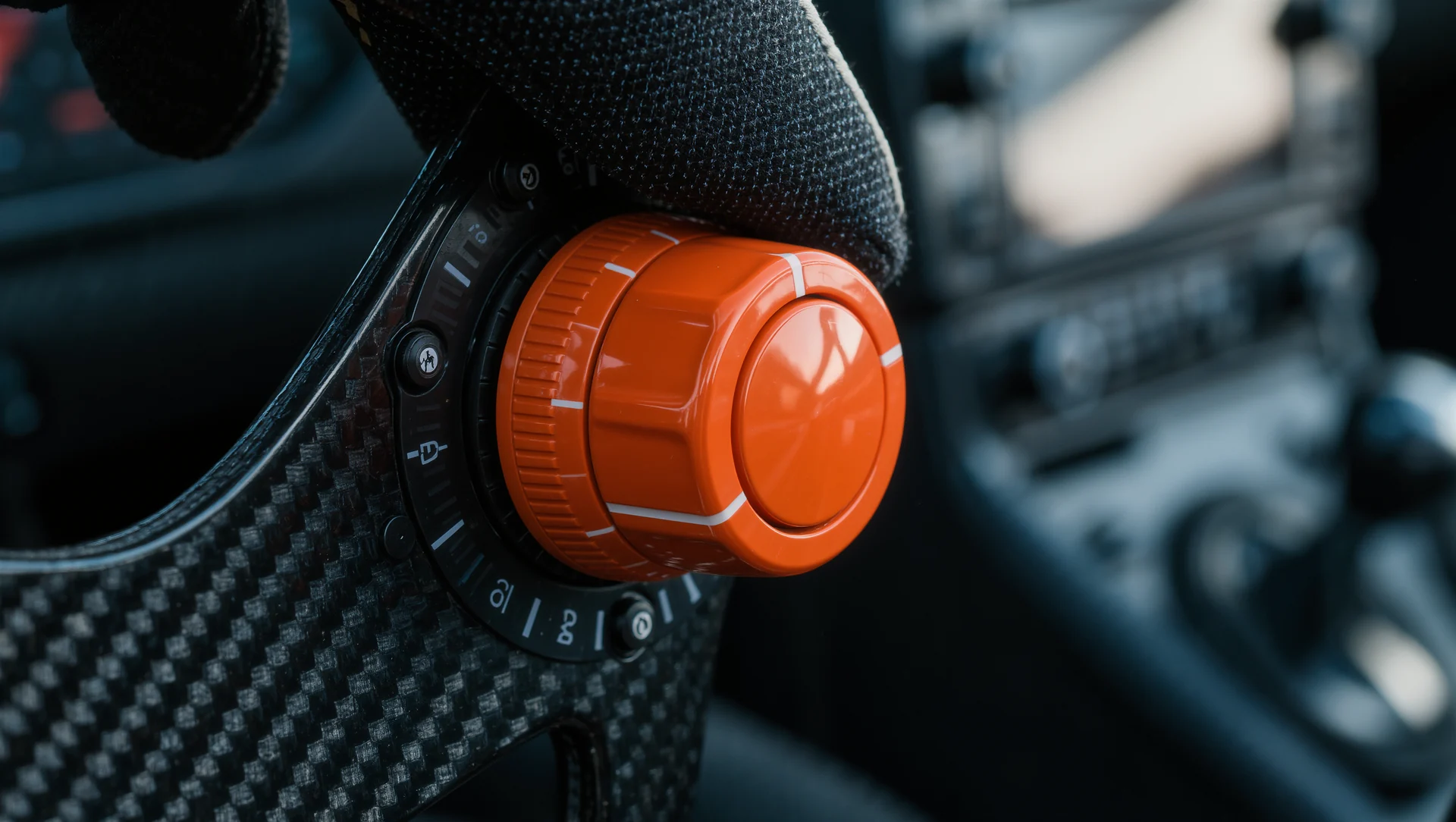
Brake bias is the only balance adjustment you can make while the car is moving, which makes it the most useful setting on the whole car and the one most drivers set once and forget. The published effects are precise, and so is the warning about going too far.
What bias actually controls
The guide describes the mechanism first: as a car decelerates, load transfers to the front tyres, which generally improves their grip while decreasing grip at the rear. The goal of the bias setting is to adjust the proportion of braking force between front and rear in order to maximise overall braking efficiency.
It has a second job that matters more for lap time. If the brakes are still applied as the car turns into the corner, the bias setting will also affect the car's turn in balance. That is why bias and trail braking are the same conversation, and why a bias set for straight line braking is usually wrong for a driver who carries the brake into the corner.
The scale is stated as well: increasing front bias is shown as a larger number, putting more braking force into the front tyres. That is worth checking on your own car, because the direction of the number is not universal across simulators.
Forward and rearward, as published
Increasing front bias stabilises the car in braking zones and increases understeer at corner entry. The compromise is named directly: with too much front bias the rear tyres are being under utilised and overall braking efficiency will suffer, so the car stops in a longer distance while feeling safer.
Reducing front bias puts more braking on the rear tyres, which within limits improves braking efficiency. The guide notes the useful middle ground too: with a moderate amount of rear brake bias the car will tend to rotate, that is oversteer, at corner entry upon brake release.
The warning at the far end is unusually blunt. Too much rear brake bias hurts performance in two ways: it reduces overall braking efficiency, and more seriously it can cause the rear tyres to lock up, particularly if the driver is not braking in a straight line or has weak footwork on downshifts, which puts the car in a dynamically unstable condition that can easily result in loss of vehicle control.
| Change | Effect | Compromise |
|---|---|---|
| More front bias, shown as a larger number | stabilises in braking zones, more understeer at entry | rear tyres under utilised, braking efficiency suffers |
| Moderately less front bias | improves braking efficiency within limits | car tends to rotate at entry on brake release |
| Far too little front bias | rear tyres can lock up | dynamically unstable, easy loss of control |
| In the wet | usually move forward | smaller load transfer means less extra front grip |
Moving it during the lap
A worked example makes the trade concrete. At 56 per cent front bias a car might stop from 200 km/h in 105 metres; at 60 per cent it takes 4 to 6 metres more because the 2 rear tyres contribute less, and at 52 per cent it stops 2 metres shorter but locks the rear in 1 corner out of 10. Those 3 numbers, not the feeling, are what the setting is choosing between.
The reason to move it is that the correct value differs per corner. A slow hairpin at the end of a straight rewards rearward bias because rotation is what you need; a fast corner entered under braking rewards forward bias because stability is what you need. One setting for both is a compromise you do not have to make if you have a rotary encoder.
It also differs across a stint. Fuel burn moves the weight distribution and tyre wear changes the grip at each axle, so a bias that was correct on lap five is often too far rearward by lap thirty. Drivers who move it two or three clicks over a race are responding to a real change rather than fidgeting.
Put the range in numbers so the clicks mean something. A typical adjuster covers 50 to 60 per cent front bias in steps of 0.2 per cent, which is 50 or more positions, and most drivers use 3 of them all season. Over a 40 lap race the weight distribution shifts by roughly 60 kg of fuel, which is worth 2 to 4 clicks, so a driver who never moves it is running the wrong setting for 30 of those 40 laps.
And it differs with conditions. In the wet, load transfer under braking is smaller, so the front has relatively less extra grip and the bias usually needs to move forward to avoid locking the rear, which is exactly the failure the guide warns about.
Finding your range in one session
Set the bias two clicks forward of default and brake hard in a straight line at a marked point five times, noting where the car stops. Then move two clicks rearward and repeat. The shortest stopping distance is your efficiency optimum, and it is usually further rearward than the setting that feels comfortable.
Then repeat the test while turning in. A load cell pedal rated at 120 kg delivering about 65 kg at the pedal face lets you hold a repeatable pressure through the entry, which is what makes the comparison meaningful. The setting you race is between the two results, and knowing both numbers is what lets you move it deliberately.
Sources
Frequently asked questions
Which way is safer, forward or rearward?
Forward. It stabilises the car under braking, at the cost of a longer stopping distance because the rear tyres are under utilised.
Why does my car spin when I brake late?
Often too much rear bias combined with braking that is not in a straight line. The guide names exactly that combination as a cause of rear lock up.
Should I move the bias during a race?
If the car has an adjuster, yes. Fuel burn and tyre wear change the correct value across a stint, and two or three clicks over a race is normal.
How do I find my optimum?
Brake hard at a marked point five times at two settings and compare stopping distances. The efficiency optimum is usually further rearward than the comfortable setting.
More in Setup & Telemetry

The tyre window: how to get in and stay there
The tyre window: how to get into it, how to stay there and which of the four readings on the screen actually tells you something.
Lift and coast: saving fuel without losing the place
Lift and coast: the arithmetic of saving fuel without losing the position, when it pays and the three ways drivers get it wrong.
Learning a new track in three structured sessions
Learning a new circuit in three structured sessions instead of ten unstructured ones, with what each session is for and how to know it worked.