The tyre window: how to get in and stay there
The tyre window: how to get into it, how to stay there and which of the four readings on the screen actually tells you something.
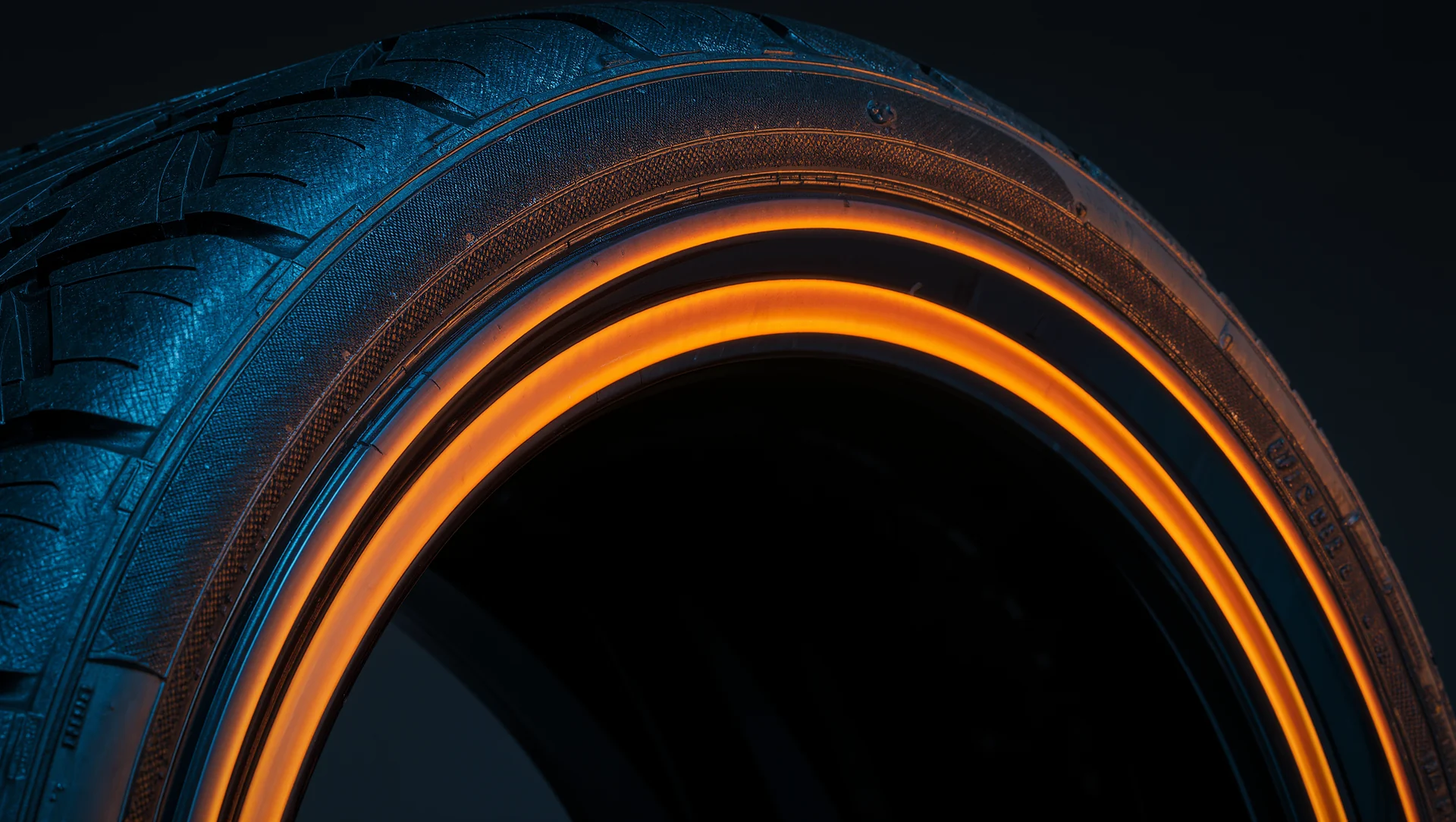
A tyre outside its temperature window is a slower tyre no matter how good the driver is, and most drivers spend the first three laps and the last five outside it. Getting in and staying in is a set of decisions rather than a consequence of pace.
The four readings and what they mean
The official setup guide names them precisely. Cold pressure is the inflation pressure measured in psi when the tyre is at ambient temperature in the pits, before having been run. Last hot pressure is the pressure as recorded when you exit the car or pull into your pit stall, whichever is first, and the guide notes that as tyre temperature rises during a run, so does the pressure.
Last temps O M I are the surface temperatures at three points across the tread: outer, middle and inner. Those three numbers are the diagnostic, and the guide gives a usable rule of thumb: the temperature differential should be about 10 degrees, plus or minus 5.
Read them as a shape rather than as values. Outer much hotter than inner means the tyre is rolling onto its shoulder and wants more negative camber; inner much hotter means the opposite. A middle far hotter than both edges is over inflation, and a middle far cooler is under inflation. That is four diagnoses from three numbers.
| Pattern across the tread | Diagnosis | First adjustment |
|---|---|---|
| Outer much hotter than inner | rolling onto the shoulder | more negative camber |
| Inner much hotter than outer | too much camber | less negative camber |
| Middle much hotter than edges | over inflation | lower cold pressure |
| Middle much cooler than edges | under inflation | raise cold pressure |
| Spread of about 10 degrees, plus or minus 5 | in range | leave it alone |
Getting into the window
Load builds temperature faster than distance does. Braking and cornering put energy into the tyre, and a driver who uses the out lap to brake firmly in a straight line and load the car through slower corners is in the window several laps earlier than one who weaves.
Weaving heats the surface and not the core, which is the reason it disappoints. Surface temperature rises quickly and falls just as quickly, while the carcass temperature is what holds grip through a corner, and only load builds that.
And pressure rises with temperature, so the cold pressure you set has to anticipate the hot pressure you want. This is why the correct workflow is to set cold, run five laps, read hot, and adjust cold by the difference rather than guessing.
Staying in the window
The main enemy is your own pace early in a stint. A driver pushing at ten tenths on lap three overheats tyres that then never recover, and the same driver is four tenths a lap slower from lap fifteen. The tyre window is a budget spent over a stint rather than a state you reach.
The second enemy is traffic. Following closely reduces cooling airflow and increases both the temperature and the pressure, and a stint spent two seconds behind another car ends with different tyres from one spent alone. This is worth planning around rather than enduring.
The third is the track itself. The rulebook describes a dynamic track that heats up and collects rubber, marbles and dirt over a session, so the tyre behaviour on lap forty is responding to a surface that did not exist on lap one.
The workflow that settles it
Set cold pressures at the recommended figure, run five laps at your intended race pace, then read hot pressures and the O M I spread together. Adjust cold pressure to bring hot pressure into range, then adjust camber to bring the spread towards 10 degrees, and only then look at anything mechanical.
Keep the arithmetic in view. Pressure rises roughly 1 psi for every 5 to 6 degrees the tyre gains, so a 30 degree rise from cold to working temperature is about 5 to 6 psi, and a cold setting of 20 psi lands near 26. Over a 40 lap stint the same tyre may pass through 3 states: 5 laps warming, 25 laps in the window and 10 laps degrading, and only the middle 25 are the ones your lap times should be judged on.
Repeat it with a full tank and with a low one. Pressure and temperature both behave differently under different loads, and a setup optimised at one fuel level is a compromise at every other point in the race.
Sources
Frequently asked questions
Does weaving warm the tyres?
The surface only, and it cools again just as fast. Load through braking and cornering builds the carcass temperature that actually holds grip.
What spread should I see across the tread?
About 10 degrees, plus or minus 5, according to the official guide. A much larger spread is a camber question.
Why do my pressures keep rising during a stint?
Because pressure follows temperature. Set cold pressure to land the hot pressure where you want it rather than setting the number you want cold.
Why are my tyres worse after following a car for ten laps?
Reduced cooling airflow raises temperature and pressure together. Plan the stint around traffic rather than enduring it.
More in Driving Technique
Rally sims: why gravel rewrites everything you learned
Why gravel rewrites everything circuit racing taught you, what the official rally simulator contains and the three techniques that transfer in the other direction.
Oval racing: the discipline road racers underestimate
Oval racing is the discipline road racers underestimate: what actually makes it hard, how the simulators support it and the first month done properly.

Updates that break your mods, and how to survive them
Updates that break your mods and your settings: why it happens, how to survive it and the routine that turns a lost weekend into ten minutes.