Nordschleife in the Sim: Learning the Green Hell by Section
How to learn the 20.8 kilometre Nordschleife in a simulator: which sims have it, a five part split in lap order, and how to practise.
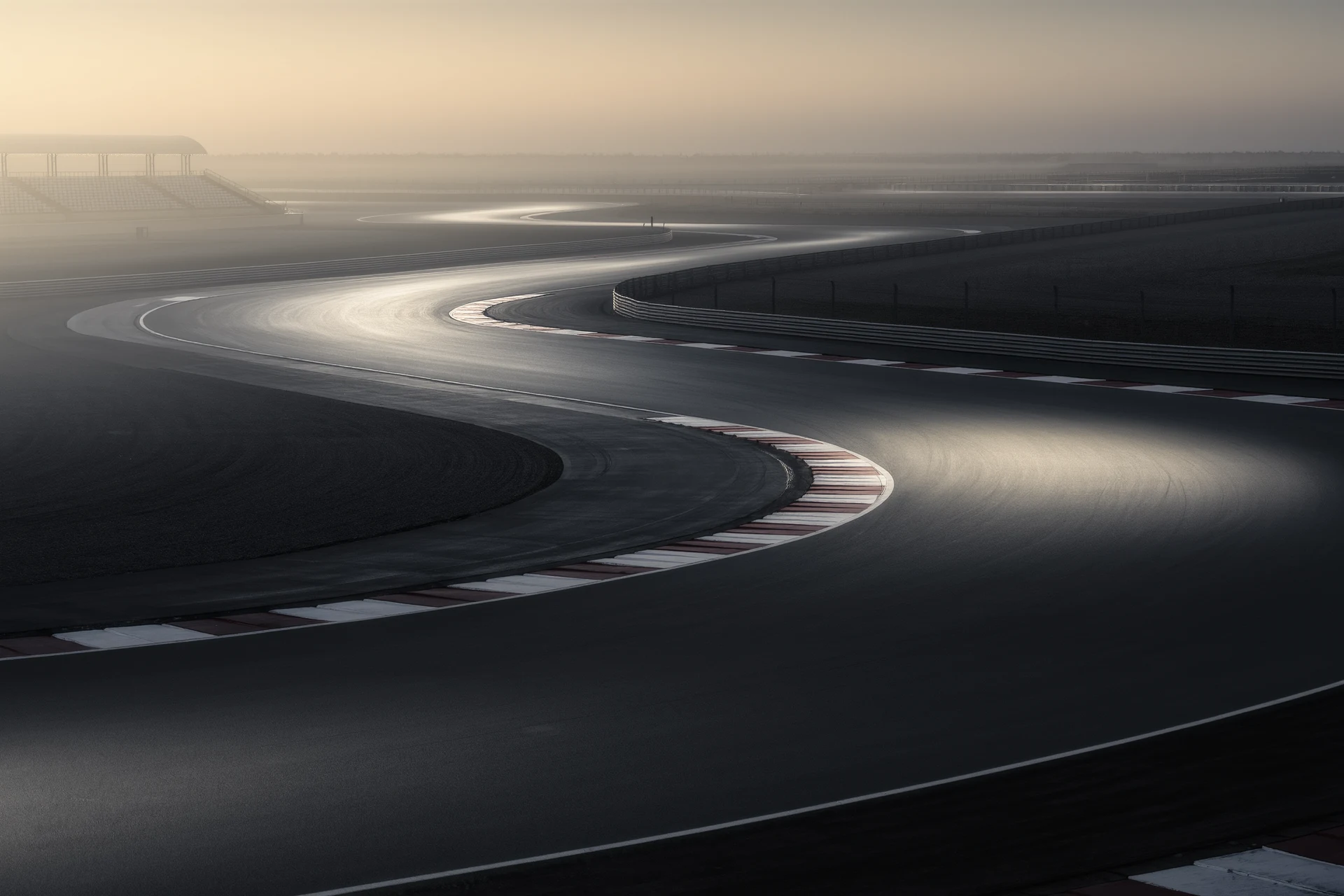
The Nürburgring Nordschleife is 20.832 kilometres long, with 73 corners and about 300 metres of elevation change, according to the circuit. That makes it hard to learn on real track days, where laps are limited and expensive. A simulator with an accurate version of the track lets you repeat a single section as often as you like, and that is the main advantage of learning the ‘Green Hell’ in a sim first.
The Nordschleife is known as a demanding circuit because of its length, its blind crests and its narrow run-off areas. Real-world practice is expensive, risky and limited, and a simulator removes most of those limits.
Safety First, Always
On the Nordschleife, a mistake can be catastrophic for you and your car. In a sim, a mistake means resetting, learning, and trying again, no injuries, no repair bills. This freedom from real-world consequences allows for aggressive exploration of limits.
Unlimited Laps, Unlimited Learning
Imagine running 100 laps on the actual Nordschleife in one day. Impossible, right? In a sim, it’s a Tuesday evening. This sheer volume of practice is transformative. You can focus on individual sections, experiment with different lines, and repeat tricky corners until they’re ingrained in your muscle memory.
Cost-Effective Skill Development
Track days, fuel, tires, potential repairs: learning the Nordschleife in real life burns a hole in your wallet faster than a Porsche GT3 on a straight. Your initial simulator investment, while not insignificant, pays dividends quickly when you consider the cost per hour of track time.
Experimentation Without Fear
Ever wonder what happens if you take that corner wider, or trail-brake a little deeper? In a real car, the answer might involve a barrier. In a sim, you can push those boundaries, understand the physics, and build a mental library of what works and what doesn’t.
Setting Up Your Virtual Nordschleife
You wouldn’t bring a unicycle to a Formula 1 race, and similarly, your sim setup plays a huge role in your Nordschleife learning process. This isn’t about bragging rights, but about creating an environment conducive to serious practice.
The Right Software Choice
Not all racing simulators are created equal, especially when it comes to track fidelity and physics. For the Nordschleife, a few stand out:
- Assetto Corsa Competizione (ACC): While fantastic for GT3 cars and a very detailed physics engine, ACC only features the Nürburgring GP circuit, not the full Nordschleife.
- Assetto Corsa (AC): The original Assetto Corsa remains a popular choice. Its laser-scanned Nordschleife is accurate, and the modding community adds a large selection of cars and other content.
- iRacing: iRacing’s laser-scanned Nordschleife is also excellent, offering competitive multiplayer and a subscription-based model. Its physics are robust, and the car selection is good, though perhaps not as broad as AC’s modded content.
- Automobilista 2 (AMS2): AMS2 boasts fantastic force feedback and a great sense of speed, with a well-modeled Nordschleife. It’s often overlooked but offers a very enjoyable driving experience.
- Forza Motorsport / Gran Turismo: While fun console racers, these generally don’t offer the same level of physics fidelity or real-world accuracy needed for serious Nordschleife mastery in the way the PC sims do.
Essential Hardware Considerations
This isn’t about having the fanciest gear, but about having reliable equipment that won’t hinder your progress.
- Force Feedback Wheel & Pedals: This matters most. A good force feedback wheel communicates vital information about grip, road texture, and understeer/oversteer. Load cell pedals also help with brake modulation, allowing you to accurately feel and control braking pressure.
- Monitor Setup (Single vs. Triple vs. VR):
- Single Monitor: Perfectly adequate to start. Position it as close to your wheel as possible to achieve a realistic field of view (FOV).
- Triple Monitors: Significantly enhances immersion and peripheral vision, which is crucial for anticipating corners on such a long and winding track.
- Virtual Reality (VR): Offers the strongest sense of depth. Being “in” the car helps immensely with judging distances, elevation changes, and apexes. It takes some getting used to, but it suits a track with so many crests.
- A Comfortable Seat/Rig: You’ll be spending hours here. Back pain is not conducive to fast laps. A stable rig prevents your wheel and pedals from shifting around during intense braking or turning.
Optimizing Your Settings
Small tweaks can make a big difference.
- Field of View (FOV): Get this right! An incorrect FOV can severely distort your perception of speed and distance. Use an online FOV calculator to find the correct setting for your screen size and distance from the monitor.
- Force Feedback Settings: Calibrate your FFB to avoid clipping (where the FFB motor maxes out and loses detail) and ensure it’s communicative but not overly strong or noisy. There are plenty of online guides for specific wheel models and sim titles.
- Graphics vs. Performance: For learning, consistent high frame rates are more important than ultra-high graphics. Dropped frames can break immersion and throw off your timing. Prioritize smooth performance.
The Learning Process: Section by Section
The Nordschleife isn’t just a series of corners; it’s a flowing rhythm, a dance with the landscape. You can’t just memorize it like a list; you have to feel it.
Breaking Down the Beast
Trying to learn the entire 12.9 miles (20.8 km) in one go is overwhelming. Break it into manageable chunks. There is no official split, but these five sections, in lap order, work well for practice:
- Section 1 (Hatzenbach to Flugplatz): The narrow esses of Hatzenbach, then faster corners over crests up to the Flugplatz.
- Section 2 (Schwedenkreuz to Adenauer Forst): Very fast, including the descent through the Fuchsröhre, then the tight chicane at Adenauer Forst.
- Section 3 (Metzgesfeld to Kesselchen): Kallenhard and Wehrseifen, down to Breidscheid and Ex-Mühle, then Bergwerk and the long climb through Kesselchen.
- Section 4 (Klostertal to Galgenkopf): The Caracciola-Karussell after Klostertal, the climb to Hohe Acht, then Brünnchen, Pflanzgarten and the Schwalbenschwanz to Galgenkopf.
- Section 5 (Döttinger Höhe to Tiergarten): The only long straight of the lap, Döttinger Höhe, then Antoniusbuche and Tiergarten at the end of the lap.
Deliberate Practice Techniques
Just lapping aimlessly won’t cut it. Your practice needs purpose.
- Walkthrough Laps (Slow and Steady): Start excruciatingly slow. Drive the track at 50-60 km/h, looking for apexes, braking markers, and turn-in points. Use an external camera to get a better view of the track layout and elevation. Focus on where the car needs to be for the next corner.
- Focus on Sections: Pick one sector and drive it repeatedly. Don’t worry about perfect lap times yet. Just get the flow, the braking points, and the gear selections right for that specific section.
- Look Ahead: This is vital on the Nordschleife. You need to be looking at least two corners ahead, sometimes more. The track changes direction rapidly, and anticipating the next move is critical.
- Braking Reference Points: Identify concrete visual markers for braking. A tree, a marshal post, a change in tarmac. These will become your reliable indicators.
- Apex Identification: The Nordschleife has many blind corners. Learn where the actual apex is, not just where it looks like it should be. Sometimes you turn in early, sometimes late, to open up the next section.
- Gear Selection: The track demands precise gear choices. Many corners can be taken in multiple gears depending on the car and your style. Experiment!
- Using Replays and Telemetry: This is your secret weapon.
- Replays: Watch your laps, especially the mistakes. What happened? Why? Watch laps of faster drivers to see their lines, braking points, and throttle application.
- Telemetry: Most advanced sims offer telemetry data. Analyze your speed through corners, braking points, G-forces, and throttle application. Compare your data to faster drivers to pinpoint areas for improvement. Are you braking too early? Getting on the power too late? Carrying enough speed through the mid-corner?
- Consistent Mindset: Don’t chase lap times initially. Focus on consistency and clean laps. Once you can consistently complete a clean lap, then start pushing your limits gradually.
Beyond the Basics: Advanced Techniques and Fine-Tuning
Once you’ve got a decent grasp of the track, it’s time to refine your skills.
Car Choice: From Mild to Wild
Start with a slower, more forgiving car: maybe a production sports car or a GT4. This allows you to learn the lines without being overwhelmed by power. As you gain confidence, gradually move to faster, more demanding machinery. Every car feels different, and understanding how they react to the Nordschleife’s unique challenges is part of the mastery.
Understanding Grip and Elevation
The Nordschleife isn’t flat. Elevation changes significantly affect grip.
- Uphill Sections: Your car will feel heavier, and you might need to brake slightly earlier or carry more speed.
- Downhill Sections: The car will feel lighter, making braking trickier and potentially leading to lockups. Gravity helps you accelerate, so be mindful of managing that extra momentum.
- Compressions and Crests: These are common throughout the track. Learn where the car will compress, increasing grip, and where it will lighten over a crest, potentially losing traction. The legendary Flugplatz jump is a prime example.
The Art of Trail Braking
Crucial for many Nordschleife corners, especially the tighter, technical ones. Trail braking allows you to maintain weight on the front tires as you turn in, increasing front-end grip and helping the car rotate. Practice smoothly releasing the brake pedal as you add steering input.
Throttle Control and Weight Transfer
The Nordschleife demands precise throttle inputs. Smooth acceleration out of corners prevents wheelspin and maintains momentum. Understand how throttle application shifts weight to the rear, influencing handling. Similarly, lifting off the throttle swiftly can transfer weight forward, aiding corner entry rotation.
Dealing with Weather and Track Conditions (If Applicable)
Some simulators (like iRacing) offer dynamic weather and track conditions. Practicing in rain or on a green track (low grip) will build resilience and broaden your skill set, preparing you for anything.
The Mental Game: Patience and Persistence
Mastering the Nordschleife isn’t a quick sprint; it’s a marathon.
Celebrate Small Victories
Don’t get discouraged by slow times or mistakes. Every lap, every sector analysis, every small improvement in a corner is progress. Acknowledge it.
Consistency Over Heroics
A consistently clean, albeit not lightning-fast, lap is far more valuable than a few brilliant corners surrounded by mistakes. Focus on linking sections smoothly.
Take Breaks
Staring at the screen for too long can lead to fatigue and frustration. Step away, clear your head, and come back fresh. Your brain needs time to process all that input.
Enjoy the Process
Ultimately, this is supposed to be fun! The Nordschleife is a special place, even virtually. Appreciate its nuances, its challenges, and the satisfaction of gradually getting faster and smoother.
By following these practical steps, you won’t just be driving the Nordschleife in your simulator; you’ll be actively learning it, building the skills and confidence to tackle its legendary twists and turns. Good luck, and keep those wheels turning!
FAQs
Which sims include the full Nordschleife?
Assetto Corsa, iRacing and Automobilista 2 include the full Nordschleife. Assetto Corsa Competizione only has the Nürburgring Grand Prix circuit.
How long is the Nordschleife?
The circuit gives the length as 20.832 kilometres, with 73 corners and about 300 metres of elevation change.
Where is the Karussell on the lap?
The Caracciola-Karussell comes after Klostertal and before the climb to Hohe Acht, in the second half of the lap. It is not in the section between Ex-Mühle and Kesselchen.
Which car should I learn the Nordschleife in?
Start with a slower, forgiving car such as a road sports car or a GT4, learn the corner order and the references, and move to faster cars once you can complete clean laps consistently.
Does sim practice help for a real track day?
It helps with the corner order, the lines and the visual references. Grip, braking points and the consequences of a mistake are different in a real car, so drive the real track with a wide margin.
Sources
More from Cars & Tracks
Laser scanned tracks: what the scan really changes in a sim
What a laser scan of a circuit captures, what it changes in the car and what it cannot, and which sims say they use scanned tracks: iRacing, ACC,…
Driving Formula Cars in Sim Racing: Rig, Braking and Throttle
How to drive formula cars in a sim: force feedback without clipping, load-cell braking, trail braking, throttle control, dirty air and which sims…
Monza in the sim: chicanes, Lesmos and low downforce
Monza in iRacing, ACC, LMU and AMS2: the three chicanes, the Lesmos, Ascari and the Parabolica, the low downforce setup and how to use the slipstream.