Kids at the simulator: format, safety, supervision
Children at the simulator: the legal frame for a public venue, the seat and pedal problem, and a party format that actually works for eight of them.
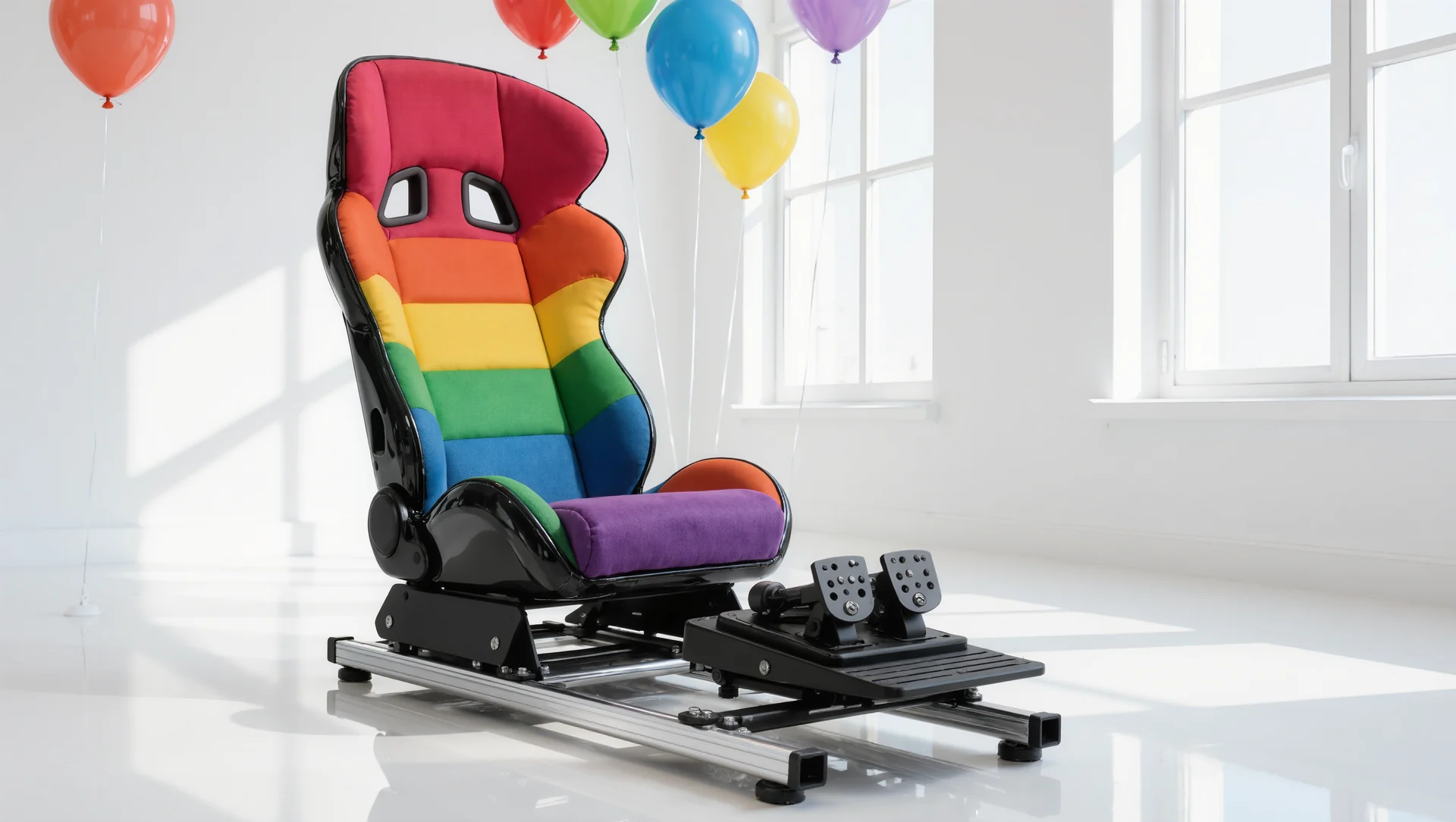
A children's party at a simulator fails on ergonomics long before it fails on anything else: a 9 year old cannot reach the pedals of a rig set up for an adult. Fix that first, then the format, then the paperwork.
The legal frame for a public venue
The definitions come first. A child is a person under 14 years old and an adolescent is 14 but not yet 18, and a supervising adult is any person over 18 acting under an agreement with the person holding parental responsibility.
The relevant rule is about screen based gaming machines without a chance of winning, placed in public. Unaccompanied children and adolescents may play only where the programme has been approved and labelled for their age group by the competent authority or a self regulation body, or where it is a labelled information or teaching programme.
Placement outside supervised commercial rooms is stricter still. Machines on public thoroughfares, outside commercially used rooms or in unsupervised entrances to them may only be set up if their programmes are approved and labelled for children from 6 years, or labelled as an information or teaching programme.
| Item | Detail |
|---|---|
| Child | under 14 years old |
| Adolescent | 14 but not yet 18 |
| Supervising adult | any person over 18 under an agreement with the parent |
| Unaccompanied play in public | only with an approved and labelled age rating, or a labelled teaching programme |
| Machines outside supervised commercial rooms | only if approved and labelled from 6 years, or labelled as information or teaching |
| Wheel force for children | reduce in software, 1 minute per station |
| Seat reset between guests | about 60 seconds with 2 marked rail positions |
| Eight children, two stations, three hours | about 45 minutes of station time each |
| Format | 3 laps, then 5 laps, then a final for the fastest 4 |
| Adults needed | 1 per station plus 1 for the room, so 3 for two stations |
The ergonomics nobody plans for
The pedals are the whole problem. An adult rig has the pedal plate set for an adult leg, and a child who slides forward to reach it loses the seat back that braking pushes against, which turns every stop into a stretch rather than a press.
So build the adjustment into the booking. A rail with 2 marked positions, a firm cushion behind the back and a wheel that lowers by a fixed amount converts a 30 minute fight into a 60 second reset between guests.
And check the wheel force before the party, not during it. A base delivering 8 newton metres into the arms of a 10 year old is unpleasant rather than exciting, and reducing the force in software costs nothing and takes 1 minute per station.
A format that works for eight children
Never leave 7 of them watching. With 2 stations and a 3 hour party, 8 children have about 45 minutes of station time each in theory, but only if the other 6 have something to do for the 45 minutes they are not driving.
Run it as 3 short rounds rather than 1 long turn. A qualifying round of 3 laps, a middle round of 5 and a final for the fastest 4 gives every child 3 separate moments and gives the room 3 separate finishes to shout about.
And publish the board. A visible leaderboard with 8 names on it holds attention between turns better than any decoration, and it turns the waiting into part of the event.
Supervision, and the things that go wrong
One adult per station, plus one for the room. Two stations therefore want 3 adults, and a party where 1 person is running the machines, refereeing the queue and finding the cake is a party that will lose control at about the 90 minute mark.
Watch for motion discomfort rather than dismissing it. A child who goes quiet after 5 minutes should be taken out of the seat, and a rule that any guest may stop at any time without explanation prevents the only genuinely unpleasant outcome of the afternoon.
And plan the last 30 minutes as something else entirely. Eight children who have been concentrating for 2 and a half hours are done, and a scheduled ending beats an ending that happens on its own.
Sources
Frequently asked questions
May children use a simulator in a public venue unaccompanied?
Only where the programme is approved and labelled for their age group, or is a labelled information or teaching programme.
What is the first thing to adjust for a child?
The pedals. A child who slides forward to reach them loses the seat back that braking pushes against.
How many adults does a party of eight need?
Three for two stations: one per station and one for the room.
What format keeps eight children engaged?
Three short rounds with a visible leaderboard, rather than one long turn each.
More in Business & Events
Network latency: what actually causes the warping
Network latency and what actually causes the warping: the published thresholds, why packet loss is worse than ping and the fixes in order of effect.
Head tracking and eye tracking on a flat screen
Head tracking and eye tracking on a flat screen: what each one actually does, the published latency and degrees of freedom, and which problem they solve.
Dashboards and telemetry overlays without the clutter
Dashboards and telemetry overlays without the clutter: what the software does, which four readouts earn their place and where an overlay costs more than it gives.