Springs and dampers: what each one actually controls
Springs and dampers: what each one actually controls, why they are not interchangeable and the order to change them in.
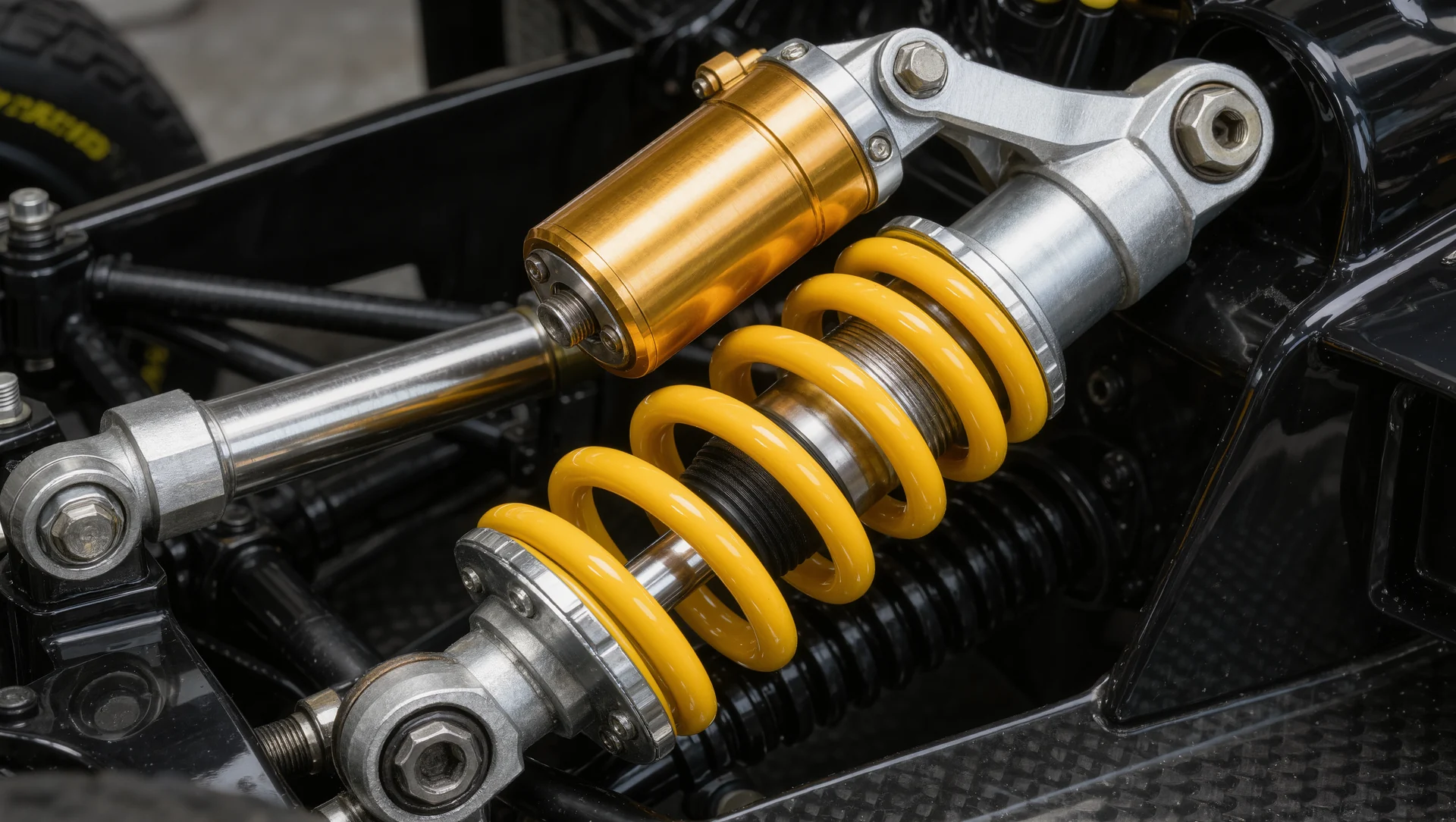
Springs decide how much the car moves, dampers decide how long it takes to get there, and confusing the two is the most common reason a setup session goes backwards. Both matter, but only one of them changes the amount of grip you have.
What a spring does
The guide is direct about the definition: the relative stiffness of a spring is based on the amount of force needed to compress it one inch, so a 900 lb spring is stiffer than an 800 lb spring. It also makes a claim worth taking seriously, that quite literally every bit of feedback a driver senses from the road surface comes through the springs.
The effects are named per axle. Stiffer at the front stabilises the car and shifts the handling balance toward understeer, with less compliance as the compromise. Softer at the front adds a significant amount of front grip, at the cost of a less stable car.
The rear reverses it in a way that catches people out. Stiffer at the rear reduces understeer, particularly at mid corner and exit, and the compromise is less compliance and less grip in the rear. Softer at the rear adds rear grip and shifts the balance toward understeer. Adding grip at one end always moves the balance away from it.
What a damper does, and does not
The guide draws the line clearly: dampers control the energy as it enters and exits the springs, and they will not limit the total amount of load transfer through the car, but will affect the amount of time it takes the loads to transfer. That single sentence is why dampers cannot fix a balance problem.
What they do change is transitions. The guide names them: initial brake application, brake release, initial turn in and application of throttle can all be affected by a damper setting change. If your problem is in a transition, it is a damper problem; if it is in a steady state corner, it is not.
The two adjustments are compression, also called bump, and rebound. Compression happens when additional load is put on the spring, such as hitting a bump or the brake pedal; rebound is the spring returning to normal afterwards. Stiffer front compression slows the car's forward weight transfer on initial brake application, with a slight loss of compliance as the compromise; softer front compression adds front grip through better compliance at the cost of stability.
| Adjustment | What it changes | Where it shows |
|---|---|---|
| Stiffer front spring | stabilises, shifts balance to understeer | everywhere, less compliance |
| Softer front spring | adds significant front grip | everywhere, less stable |
| Stiffer rear spring | reduces understeer at mid corner and exit | mid corner and exit, less rear grip |
| Softer rear spring | adds rear grip, balance to understeer | everywhere |
| Stiffer front compression | slows forward weight transfer | initial brake application only |
| Softer front compression | adds front grip through compliance | transitions, less stability |
Reading the numbers
The scale is not what most people assume. The guide states that a larger number represents added resistance, that the zero setting is simply the midpoint of the available range and could equally be a five on a zero to ten scale, and that even the lowest number provides some resistance. It also notes explicitly that a minus 5 setting is stiffer than a minus 10.
And symmetry is the default. Because of the variety of corners in road racing, the guide advises keeping the car symmetrical on its longitudinal axis, which means left and right settings should match unless you are on an oval.
Changing them in the right order
Springs before dampers, always. Springs decide how much load transfers and how much grip each axle has; dampers only decide how quickly. Setting dampers on top of wrong springs produces a car that feels better in transitions and is still wrong everywhere else.
And change one axle at a time. Because stiffer at one end moves the balance away from that end, changing both simultaneously can leave the balance identical while the grip level and the compliance have both moved, which is the setup equivalent of walking in a circle.
Count the combinations before you start. 4 springs and 8 damper settings, 2 per corner, is 12 adjustments; at 3 positions each that is over 500,000 combinations. A session of 40 laps at 5 laps per test gives you 8 of them. That ratio is why the guide separates the 2 jobs: 4 spring decisions set the grip, and only then do the 8 damper numbers set the timing.
Then test in transitions specifically. A damper change is invisible in a steady state corner and obvious in the first hundred milliseconds of braking, so test it by braking hard at a marked point rather than by lap time alone.
Sources
Frequently asked questions
Can dampers fix understeer?
Only in transitions. The guide states dampers do not limit the total load transfer, only the time it takes, so a steady state balance problem needs springs or bars.
Which number is stiffer on the damper scale?
The larger one. Zero is the midpoint of the range, and minus 5 is stiffer than minus 10.
Should left and right settings match?
On a road course, yes. The guide advises keeping the car symmetrical on its longitudinal axis because of the variety of corners.
Why did adding front grip make the car understeer more?
It probably did not. Check whether you also changed the rear, because stiffer at one end moves the balance away from that end.
More in Setup & Telemetry
Understeer: driver, setup or tyre temperature
Understeer diagnosed properly: driver, setup or tyre temperature, and the order in which to rule each one out before touching the car.

Consistency training: the boring drill that wins races
Consistency training: the unglamorous drill that wins races, why the fastest lap is the wrong target and how to measure progress in a way that does not lie.

The start: clutch, bite point and the first corner
The start: clutch, bite point and the first corner, with the timing arithmetic and the three mistakes that end more races than any overtake.