The start: clutch, bite point and the first corner
The start: clutch, bite point and the first corner, with the timing arithmetic and the three mistakes that end more races than any overtake.
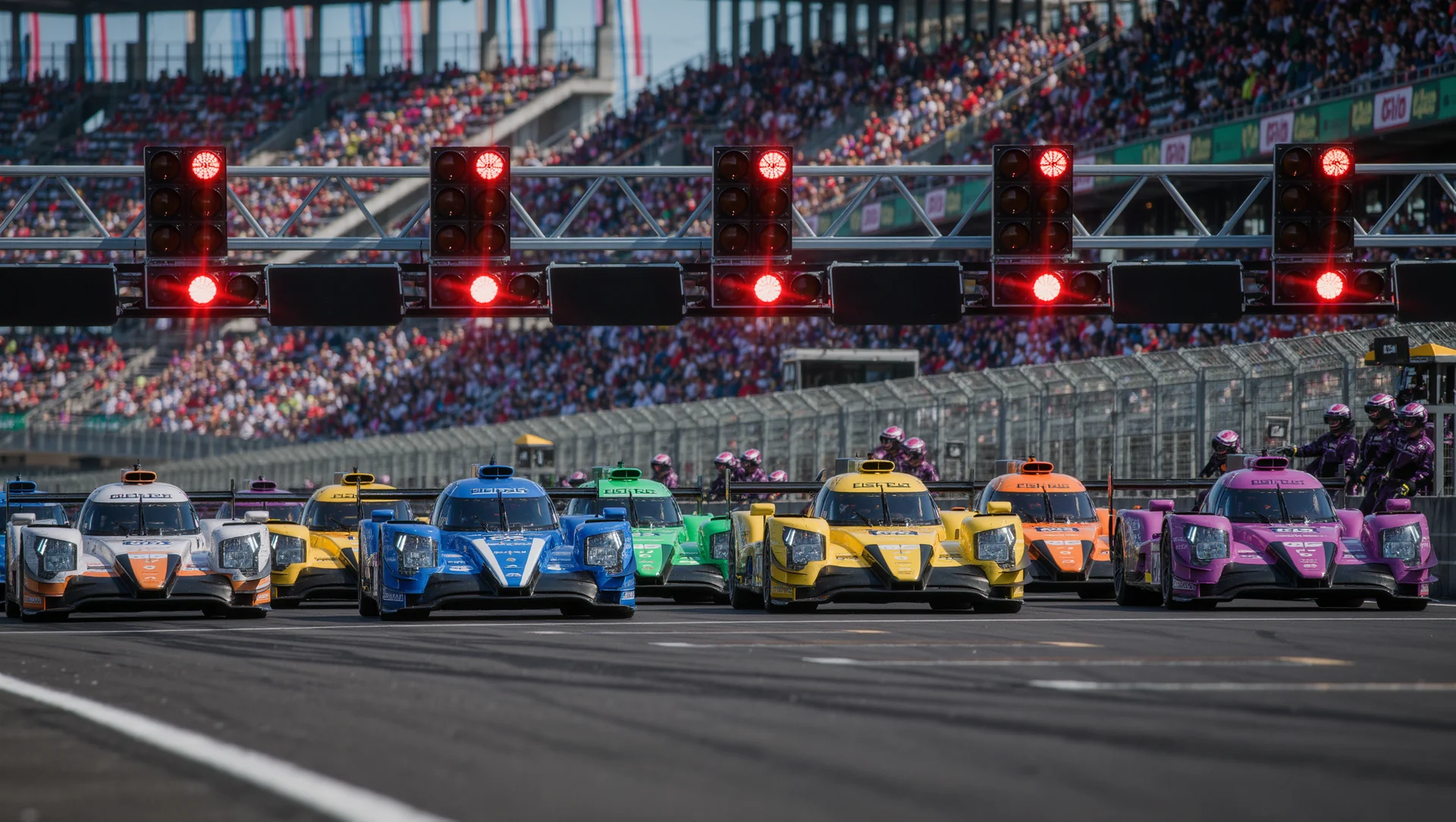
More races are lost in the eight seconds after the lights than in the eight laps that follow. The start is one of the few parts of a race that can be practised in isolation, and almost nobody does, which is why it stays expensive.
The timing arithmetic
Reaction to a visual signal takes roughly 250 milliseconds, so a driver who begins to release the clutch when the lights go out is already a quarter of a second behind the physics. At an acceleration of 1.0 g, which is 9.8 metres per second squared, that quarter second costs about 0.3 metres of position and rather more once the field ahead starts moving.
The reason anticipation is so tempting and so dangerous is the same arithmetic. Guessing the timing removes the 250 milliseconds and creates a jump start, and race rules treat that as an offence rather than as a risk you took. The correct target is not a faster reaction but a shorter chain of actions after it.
The chain is where the time actually goes. A driver holding revs, finding the bite point and modulating the throttle performs three actions; a driver who has preset the revs and knows the bite point performs one. Practising the start is mostly about deleting steps rather than performing them faster.
| Item | Figure |
|---|---|
| Visual reaction time | about 250 milliseconds |
| Acceleration at 1.0 g | 9.8 metres per second squared |
| Actions in an unpractised launch | three: revs, bite point, modulation |
| Actions in a practised launch | one: release from a known position |
| Practice starts in fifteen minutes | about twenty |
| Adjustable clutch resistance range on a sequential lever | about 4.5 to 11 kg |
Finding and using the bite point
The bite point is where the clutch begins to transmit torque, and on a good pedal set it sits at a repeatable position rather than at a feeling. A three pedal set with an adjustable clutch lets you set spring preload and travel so the engagement happens across a usable range rather than in the last five millimetres.
Set it deliberately in practice: hold the car against the brake, raise the revs to your launch figure and release the clutch until the car strains, then note the pedal position. That position, not the sensation, is what you reproduce under pressure with fifty cars around you.
Then decide your launch revs by testing rather than by folklore. Too low bogs the engine, too high spins the wheels, and the correct figure differs per car and per surface. Three runs at three different revs answer the question in ten minutes and hold for the whole season.
The first corner
Position matters more than speed. A car two metres ahead into the braking zone but on the outside line arrives at the apex behind a car that was slower and on the inside. Deciding which side of the track to be on before the lights is worth more than any launch technique.
Brake earlier than you would alone, because you cannot see what is happening two cars ahead. The standard first lap incident is a driver braking at their normal marker into a field that has already slowed, and it is caused by using a practice reference in a situation that is nothing like practice.
And leave the racing line if it is occupied. The rules of racing put the responsibility for a safe rejoin and for leaving room on the driver making the move, and a first lap position is worth far less than the incident points and the damage that come with insisting on it.
Practising the eight seconds
Set up a practice session, take the start twenty times and stop each run at the first corner. Twenty starts take fifteen minutes and teach more than twenty full races, because in a race you get one start and no chance to compare.
Count what the practice is worth. Twenty starts in 15 minutes is 1 start every 45 seconds, against a race weekend that gives you 1 start in 60 minutes of driving. Over a 12 race season you get 12 starts by racing and 240 by practising for one afternoon, and a 2 place gain at the first corner in 6 of those races is worth more than most setup work.
Vary one thing per run: the revs, the bite release speed, the gear you shift into first, the side of the track. Then note which combination produced the best position at the first corner rather than the best acceleration in the first fifty metres, because those are not the same measure.
Sources
Frequently asked questions
Should I anticipate the lights?
No. It removes the reaction time and creates a jump start, which race rules treat as an offence rather than as a gamble.
What launch revs should I use?
Whatever three test runs at three different figures tell you for that car and surface. There is no universal number.
Is a clutch pedal necessary for good starts?
For cars with a manual launch, yes. A button gives you the sequence but not the bite point control, and the bite point is the technique.
Why do I lose places at the first corner despite a good launch?
Usually track position rather than acceleration. Decide which side to be on before the lights go out.
More in Driving Technique
Gran Turismo as a training tool, not a toy
Gran Turismo as a training tool rather than a toy: what the console simulator teaches that transfers, where it stops and how the racing AI changed the case.
The F1 game against a hardcore sim: what transfers
The official F1 game against a hardcore simulator: what actually transfers between them, what does not and how to use both without confusing yourself.
Choosing your first sim without wasting a year
Choosing your first racing simulator without wasting a year: the three questions that decide it, the published prices and what each choice costs you later.