Differential settings: preload, power, coast
Differential settings explained: preload, power and coast, what each number does at which point of the corner and the published ranges behind them.
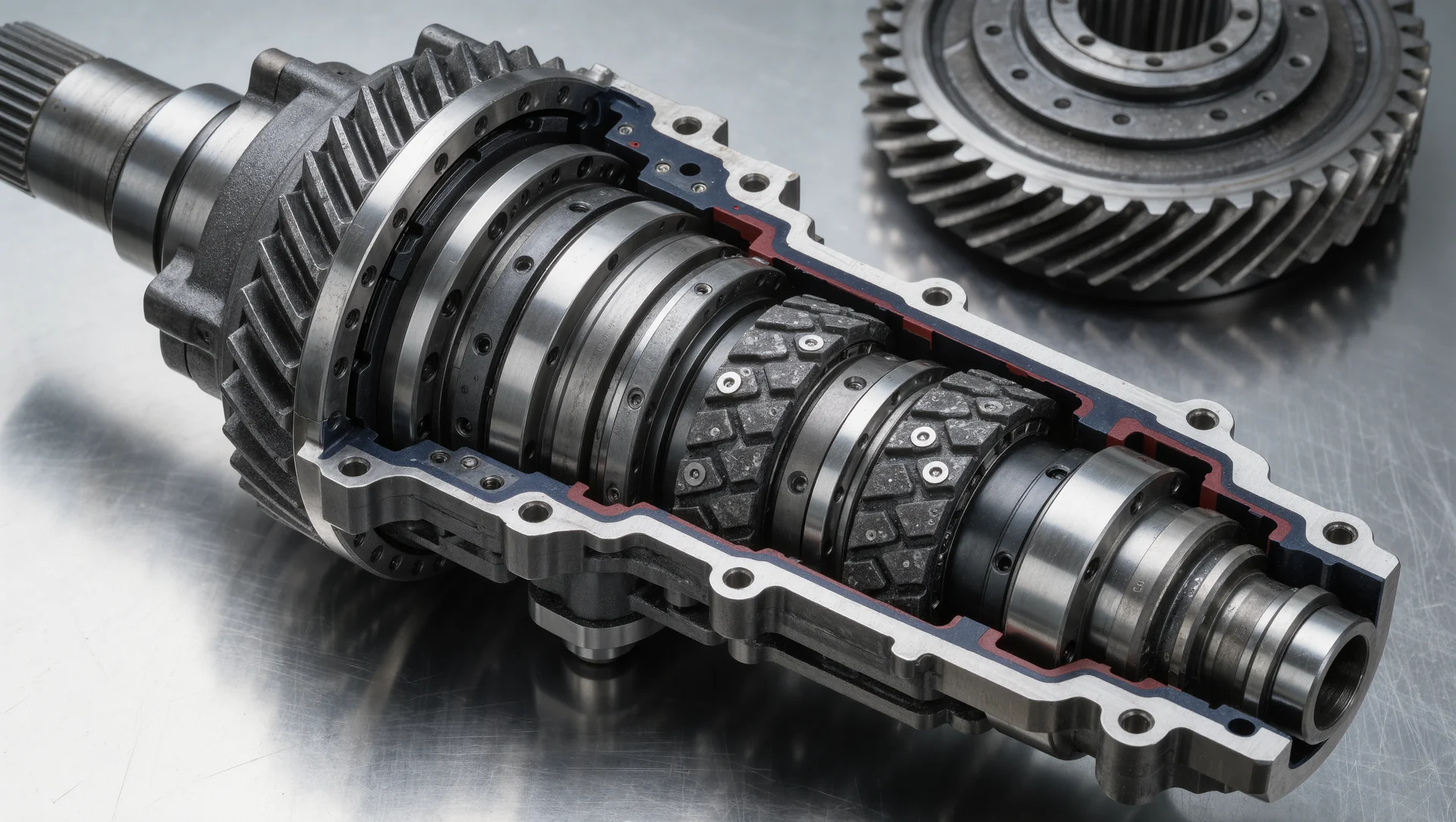
The differential decides how much the two driven wheels are allowed to turn at different speeds, and it does that separately for when you are on the throttle and when you are off it. Those two halves are why one setting fixes corner exit and ruins corner entry.
The three numbers and what they mean
Preload is the coupling that exists before any torque is applied. Vehicle Physics Pro documents a clutch pack preload with a default of 50 Nm, while viscous and torque bias types default to 0 Nm, and the value sets how locked the axle is at zero throttle. High preload makes the car stable and reluctant to rotate; low preload lets the inside wheel spin up early.
Power controls the lock under acceleration. In the clutch pack model it is set by a power ramp angle documented across a range of 10 to 90 degrees with a default of 45, and a steeper ramp locks the axle harder as torque rises. That is what stops the inside wheel spinning on corner exit, at the cost of the car wanting to run wide.
Coast controls the lock when you lift. The same source documents a coast angle across 10 to 90 degrees with a default of 80, deliberately much higher than the power side, because a locked axle under deceleration resists rotation. Real hardware follows the same logic: coast ramps are typically 80, 83 or 90 degrees to load the clutch plates little if at all, while drive ramps run anywhere between 30 and 60 degrees depending on how much lock up is wanted out of the corners.
| Parameter | Documented range | Typical default |
|---|---|---|
| Clutch pack preload | value in Nm | 50 Nm |
| Viscous and torque bias preload | value in Nm | 0 Nm |
| Power ramp angle | 10 to 90 degrees | 45 degrees |
| Coast ramp angle | 10 to 90 degrees | 80 degrees |
| Real hardware coast ramps | typically 80, 83 or 90 degrees | |
| Real hardware drive ramps | 30 to 60 degrees | |
| Clutch pack friction | 0.0 to 1.0 | 0.4 |
Which symptom points at which number
Inside wheel spinning on corner exit is a power setting that is too open. More power lock sends torque to the loaded outside wheel and the car drives out instead of lighting up one tyre.
The car refusing to rotate at corner entry, especially off throttle, is coast lock that is too high or preload that is too high. A locked axle under deceleration behaves like a solid rear axle, and no amount of steering angle fixes it.
Instability on a trailing throttle, where the rear steps out as you lift, is coast lock that is too low. The two ends of that same adjustment produce opposite problems, which is why guessing rarely converges.
And a car that is nervous in a straight line at low speed, or that scrubs in the pit lane, is usually preload rather than either ramp, because preload is the only part of the setting that acts with no torque applied.
The order to set them in
Power first, because corner exit is where lap time is. Set it at the corner that leads on to the longest straight, using the point of full throttle rather than the feeling, and increase the lock until the inside wheel stops spinning.
Coast second, and set it at the slowest corner on the circuit, because that is where the car has to rotate the most. Lower it until the car turns, and stop as soon as the rear starts to move on a trailing throttle.
Preload last and in small steps. Because it acts everywhere, changing it after the ramps shifts everything you have just set, and because a typical model defaults to 50 Nm on a clutch pack, a change of 10 Nm is a fifth of the whole baseline rather than a fine adjustment.
Why the differential interacts with everything
A more locked differential shifts the balance toward understeer at exit and toward stability at entry, which is the same direction a stiffer front anti roll bar moves the car. Change both in one session and you will move twice as far as you intended, and the setup guide's own advice about one change at a time applies with particular force here.
It also interacts with the throttle. A driver who applies throttle progressively needs less power lock than one who snaps it open, so the correct differential setting is partly a description of your right foot. That is why copied differential settings travel worse than almost any other part of a setup.
Count the space you are searching. 3 differential numbers at 5 useful positions each is 125 combinations, and at 5 laps per test a 40 lap session covers 8 of them. Setting power at 1 corner, coast at 1 other and preload in 2 steps is 4 tests and answers the question; sweeping all 3 at once is 8 tests and answers nothing.
Sources
Frequently asked questions
Why is the coast setting so much higher than the power setting?
Because a locked axle resists rotation under deceleration. Documented defaults are 80 degrees coast against 45 power for exactly that reason.
My car will not rotate on entry. Which number?
Coast lock or preload, both too high. Lower coast first because it acts only when you lift, and preload acts everywhere.
My inside wheel spins on exit. Which number?
Power lock, too open. Increase it until the wheel stops spinning at the corner leading onto the longest straight.
Can I copy differential settings from a fast driver?
Less usefully than almost any other setting, because the correct power lock partly describes how progressively that driver applies throttle.
More in Setup & Telemetry

Racecraft: overtaking without collecting penalties
Overtaking without collecting penalties: what the rulebook actually charges for, where the responsibility sits and the three moves that pay.

Wet racing: the line moves, and so does the grip
Wet racing: why the line moves, where the grip actually is and the three adjustments that turn a survival exercise into a result.

The tyre window: how to get in and stay there
The tyre window: how to get into it, how to stay there and which of the four readings on the screen actually tells you something.