Wet racing: the line moves, and so does the grip
Wet racing: why the line moves, where the grip actually is and the three adjustments that turn a survival exercise into a result.
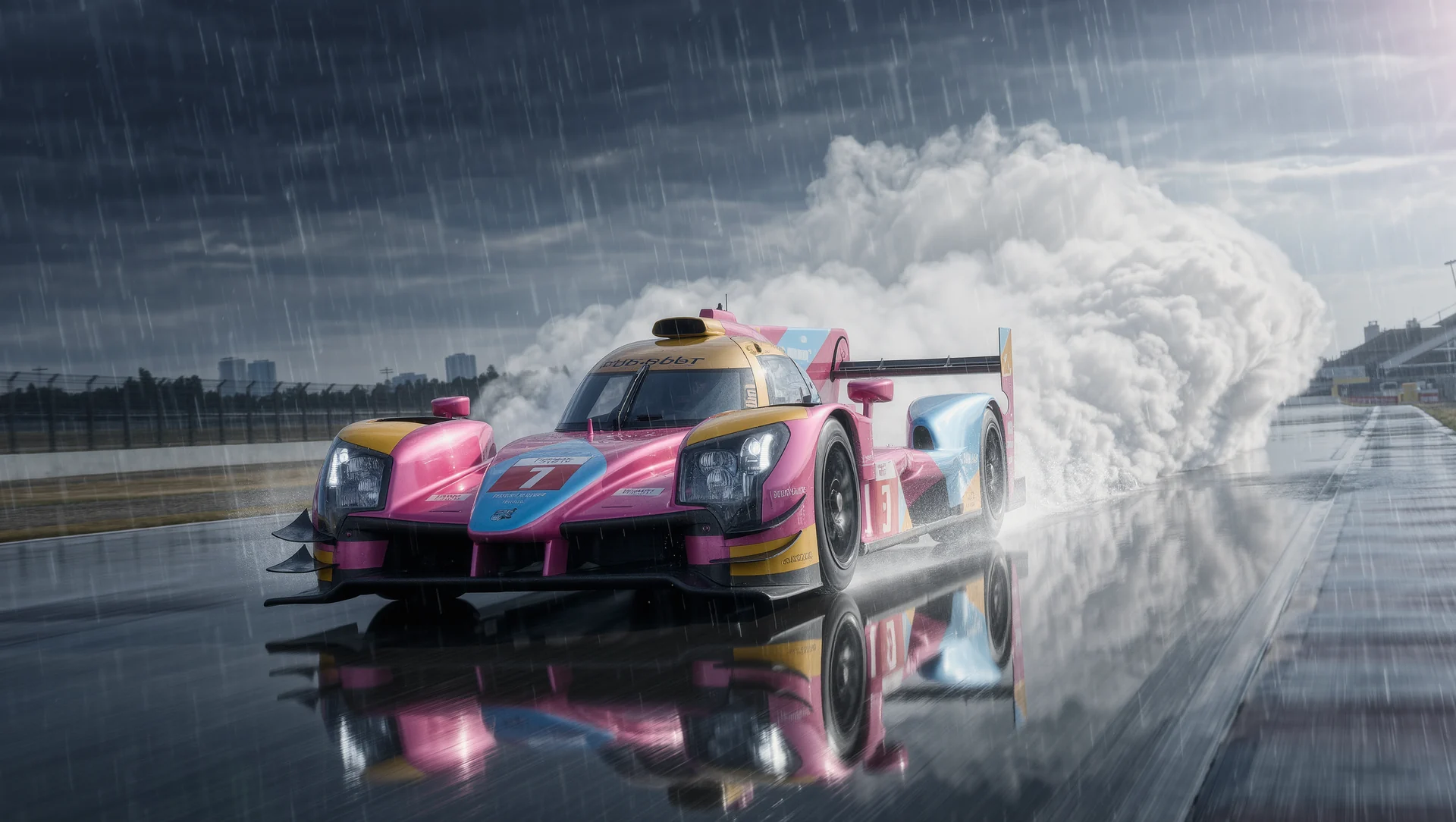
In the wet the fastest way round is usually not the racing line, because the racing line is where the rubber is and rubber under water is the slipperiest surface on the circuit. Everything else about wet racing follows from that one inversion.
Why the line moves
A dry racing line accumulates shed rubber. The official glossary defines marbles as small fragments of shed tyre rubber that litter the track during a race, notes that more accumulate as a race goes on, and states plainly that the presence and amount of marbles adjusts tyre grip. In the dry that rubber helps; under water it is the reason the fast line becomes the slow one.
Simulators model this rather than approximating it. The same rulebook describes a dynamic track system that heats up and collects rubber, marbles and dirt, and notes that when the system is disabled every session begins with identical track state parameters. A wet race on a dynamic track is therefore a different problem from a wet race on a static one.
The practical consequence is that the wet line is usually a metre or two off the dry one: wider on entry, later to the apex, and often across the kerb rather than beside it. Finding it is a search problem, and the drivers who are fast in the wet are the ones who search deliberately rather than hoping.
Where the grip actually is
Off the rubbered line, on the abrasive surface that sees less traffic. That is usually the outside of a corner and the inside of the entry, which is close to the opposite of the dry line. On a corner with camber, the higher part often drains faster and holds more grip than the lower, and that is worth checking specifically.
Painted surfaces are the exception to everything. Kerbs, run off markings and start line paint are slippery when dry and treacherous when wet, and a wet line that crosses paint is not a wet line. This is the single most common cause of a wet spin.
And standing water is a separate hazard from wet tarmac. A car that hits standing water at speed can aquaplane regardless of tyre or technique, so the wet line has to route around depressions rather than through them, and those are found by looking rather than by driving.
The three adjustments that pay
Move the brake bias forward. Less rear braking means less chance of the rear stepping out under a light touch, and in the wet the front tyres have more relative grip than usual because the load transfer is smaller. One or two clicks forward is a normal wet change.
Soften everything you are allowed to soften. Anti roll bars, springs and dampers all benefit from being softer, because a car that rolls more transfers load more slowly and gives you time to feel the slide beginning. The stiff setup that is fast in the dry is actively hostile in the wet.
And raise the tyre pressures slightly rather than lowering them. Higher pressure concentrates the load, which helps cut through the water film, and it is the opposite of the instinct most drivers bring from the dry.
| Item | Dry | Wet |
|---|---|---|
| Fastest line | the rubbered line | off line, on abrasive surface |
| Brake bias | as set up | one or two clicks forward |
| Anti roll bars and springs | stiffer for response | softer for feel |
| Tyre pressures | as set up | slightly higher |
| Limiting factor | grip | visibility in spray |
| Painted surfaces | slippery | avoid entirely |
Racing in it
Visibility is the real limit, not grip. In spray you cannot see the braking reference, the car ahead or the standing water, so the correct pace behind another car is far slower than your pace alone. Most wet incidents happen in spray rather than in the corner.
Put numbers on how much slower everything is. Wet lap times commonly sit 8 to 15 per cent above dry ones, so a 1:30 dry lap becomes roughly 1:37 to 1:43, and a 40 lap race gains 4 to 8 minutes. Braking distances grow by a similar proportion: a 105 metre stop from 200 km/h at 1.5 g becomes about 158 metres at 1.0 g, which is 53 metres more, or roughly 13 car lengths of margin you no longer have.
And weather can change during a race in simulators that model it. Automobilista 2 lists dynamic weather with 24 hour cycles and real weather built from 40 years of meteorological data, which means a wet race can dry out and a dry one can end wet. A driver who checks the forecast and plans a tyre stop is playing a different game from one who reacts.
Sources
Frequently asked questions
Why is the dry racing line slow in the wet?
Because it carries shed rubber, and rubber under water offers far less grip than the abrasive surface beside it.
Should I lower tyre pressures in the wet?
Usually the opposite. Higher pressure concentrates the load and helps cut through the water film.
What is the biggest cause of wet incidents?
Spray rather than grip. You cannot see references or standing water behind another car, so the safe pace in traffic is much slower.
Does the wet line change during a race?
Yes, continuously, as the track dries and a dry line forms. Keep searching rather than settling on the line you found on lap two.
More in Driving Technique
Choosing your first sim without wasting a year
Choosing your first racing simulator without wasting a year: the three questions that decide it, the published prices and what each choice costs you later.
Rally sims: why gravel rewrites everything you learned
Why gravel rewrites everything circuit racing taught you, what the official rally simulator contains and the three techniques that transfer in the other direction.
Oval racing: the discipline road racers underestimate
Oval racing is the discipline road racers underestimate: what actually makes it hard, how the simulators support it and the first month done properly.