Flags and etiquette: the rules nobody explains
Flags and etiquette: what each flag actually means in the rulebook, what it obliges you to do and the unwritten rules that come with them.
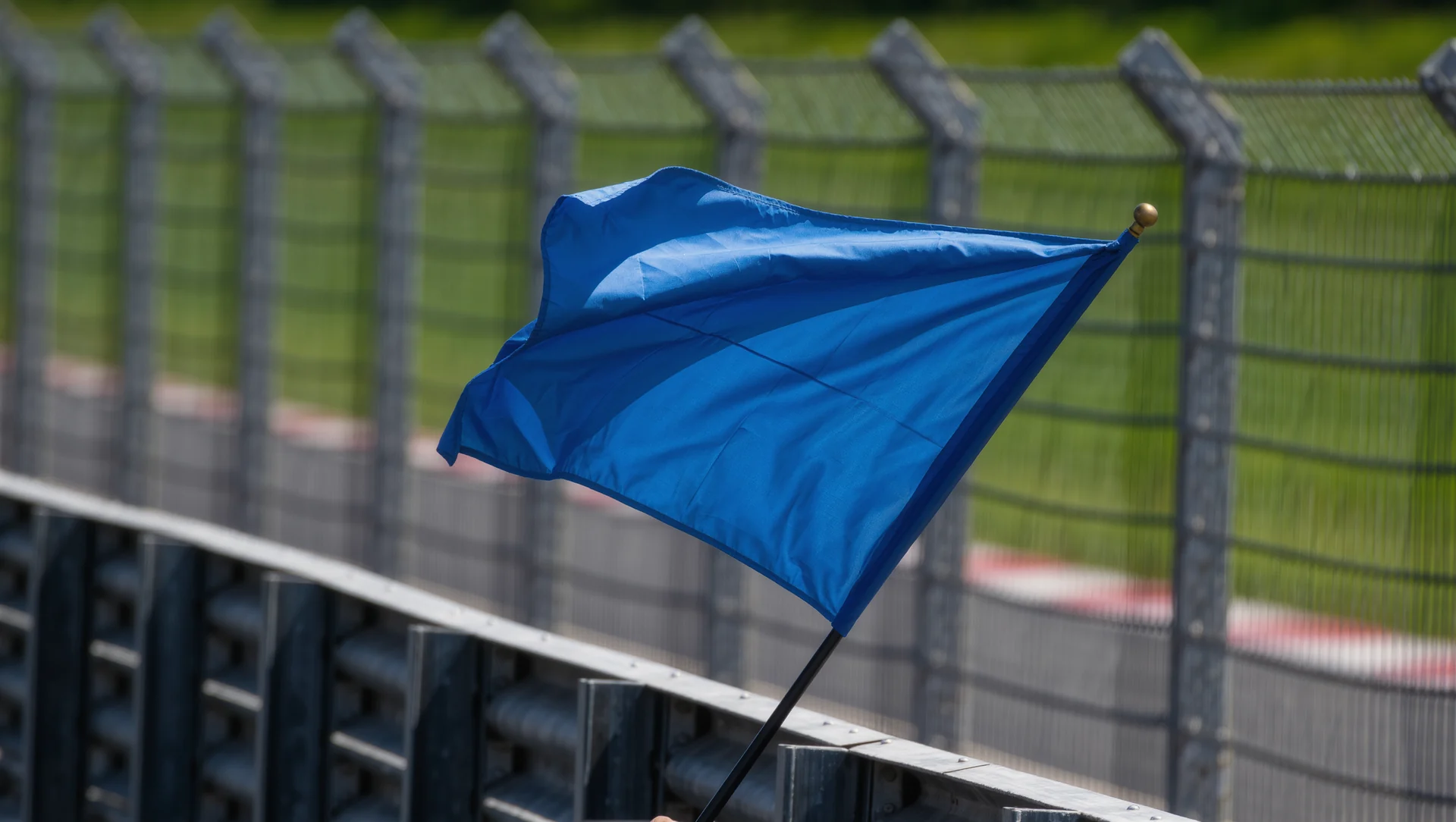
Half the flags tell you about the track and half tell you about yourself, and the ones that tell you about yourself carry obligations that end races when ignored. The official code defines them precisely, and most drivers learn three of them by accident.
The flags that describe the track
Green indicates the start of a race, a clear track condition, or the cancellation of a previous flag condition such as a caution. It is the only flag that removes an obligation rather than adding one.
White at the start finish line indicates the start of the last lap, displayed to the leader first and then to the remainder of the competitors. That ordering matters in a multi class field, because you may see it a corner after the car ahead of you did.
Yellow signals a caution of some kind: danger, passing not advisable, be prepared to slow down, and the track may be partially or completely blocked. Chequered indicates the end of a session, warm up or race, and incidents are still counted through the cool down period afterwards.
The flags that describe you
Blue with a diagonal yellow stripe indicates faster cars are approaching, and the code states plainly that it is informational only. The obligation is split: in all cases it is the responsibility of the faster car to safely overtake the slower car, and the responsibility of the slower car to maintain a consistent line, with a strong recommendation to facilitate a safe pass.
Black signals a warning or penalty of some kind, and its form tells you which. Displayed furled it is a warning from race control and action may be required, such as slowing on course, to avoid an in session penalty. Displayed unfurled it is an in session penalty: the driver must either return to their pit box or drive through pit lane without stopping, and race control will say which.
Black with an orange circle, known as the meatball, means the vehicle has suffered excessive damage and it is unsafe to continue. The driver must return to the pits for required repairs or be disqualified, and the code notes that some damage cannot be repaired during an event, in which case the pit crew informs you that the race is over.
Count them once and the set stops being confusing. There are 6 flags in the code, of which 3 describe the track and 3 describe you, and the black flag alone has 4 forms: furled, unfurled, with an orange circle and with a white X. Learning those 4 covers more of what ends races than the other 5 flags combined.
Black with a white X means disqualification from the session, and the driver is removed. Drivers disqualified this way can still enter subsequent sessions for the same event, which is worth knowing before assuming an evening is finished.
| Flag | Meaning | What it obliges |
|---|---|---|
| Green | start, clear track, or a previous condition cancelled | nothing |
| White | start of the last lap, leader first | nothing |
| Yellow | danger, passing not advisable, track may be blocked | be prepared to slow |
| Chequered | end of session, warm up or race | incidents still counted in the cool down |
| Blue with yellow stripe | faster cars approaching, informational only | maintain a consistent line |
| Black furled | warning from race control | action may be required |
| Black unfurled | in session penalty | return to the pit box or drive through |
| Black with orange circle | excessive damage, unsafe to continue | return to the pits or be disqualified |
| Black with white X | disqualification from the session | removed, may enter later sessions |
The procedures that come with a caution
The timings are published too. Gridding gives each driver between 60 and 120 seconds to place the car, and a driver who misses that window starts from the pit box with a possible hold. The chequered flag at the end of a warm up is followed by 10 seconds before gridding begins. Those 3 numbers decide more first laps than any driving.
The restart is choreographed. When there are two laps of pacing to go, race control may restructure the pace lines, and racers not on the lead lap are shuffled down the pacing order behind racers on the lead lap.
The wave by has its own rules and its own trap. With one lap of pacing to go, race control issues the wave by to all cars between the pace car and the race leader, and pit lane is closed to cars receiving it. A driver who pits anyway has to serve a green flag penalty stop, which is a self inflicted loss of a lap.
The same applies earlier. With two laps of pacing to go, pit lane is closed to all lead lap cars that have not pitted, and a lead lap car that pits under that condition serves the same green flag penalty stop.
The etiquette that is not in the rulebook
The weighting makes the case on its own. An incident in a race counts at 1.00 against 0.50 in open practice and 0.35 in a time trial, so 1 avoidable contact in a race costs twice what the same contact costs in practice and nearly 3 times what it costs alone.
And the cost of ignoring a flag is countable. Wheels off the racing surface is 1x, loss of control is 2x and heavy contact with another driver is 4x, against a typical series limit of 17 that disqualifies automatically. Slowing for a yellow costs 2 seconds; not slowing can cost 4 points and somebody else's race.
Lift when you are the cause. A driver who spins and rejoins has a stronger obligation than any flag imposes, because the incident points are assessed to everybody involved regardless of fault.
Sources
Frequently asked questions
Is a blue flag an order to move over?
No. The code states it is informational only. The faster car owes the safety of the pass; the slower car owes a consistent line.
What is the difference between a furled and an unfurled black flag?
Furled is a warning where action may be required to avoid a penalty; unfurled is the penalty itself, served in the pit box or as a drive through.
Does a meatball flag always end my race?
No. It requires a return to the pits for repairs, and only damage that cannot be repaired ends the race, which the pit crew will tell you.
Can I pit during a wave by?
Pit lane is closed to cars receiving the wave by. Pitting anyway means serving a green flag penalty stop.
More in Esports & Competitions
Anti roll bars: the fastest way to move the balance
Anti roll bars are the fastest way to move the balance: what each end does, the trap of stiffening both and how to tell roll oversteer from snap oversteer.
Camber and toe: grip now against tyre life later
Camber and toe: grip now against tyre life later, what each setting does at which point of the corner and how to read the tread temperatures that judge them.
Differential settings: preload, power, coast
Differential settings explained: preload, power and coast, what each number does at which point of the corner and the published ranges behind them.