What sim racing costs at four budget levels
What sim racing costs at four budget levels, including the recurring costs that hardware reviews never mention and the machine underneath it all.
The wheel is the number everybody quotes and the least reliable guide to what a year actually costs. Below are the four levels, each with the recurring line that outlives the hardware.
The recurring cost, which never appears in a hardware review
A platform subscription runs at 13 US dollars a month, 33 for 3 months, 110 for a year or 199 for 2 years. Paying annually rather than monthly saves 46 dollars against 156, which is about 29 per cent, and the 2 year option works out at 99.50 a year.
The free content is generous enough to start and not enough to stay. Membership includes 32 cars and 29 tracks with over 85 unique configurations, against a platform library of over 180 cars and over 150 tracks.
That gap is the real second cost. A driver who joins a series running a car and a circuit outside the free set is buying content before the first race, and a year of following two series will always cost more than the subscription alone.
| Item | Figure |
|---|---|
| Membership, 1 month | 13 US dollars |
| Membership, 3 months | 33 US dollars |
| Membership, 1 year | 110 US dollars |
| Membership, 2 years | 199 US dollars, so 99.50 a year |
| Saving by paying annually | 46 dollars against 156, about 29 per cent |
| Free content | 32 cars, 29 tracks, over 85 configurations |
| Full library | over 180 cars, over 150 tracks |
| Recommended machine | 6 cores, 16 GB memory, 8 GB video memory |
| Minimum machine | 4 cores, 6 GB video memory |
| Storage | 40 GB minimum, 225 GB for the full library |
| Level two base | 5 to 8 newton metres, with a load cell brake |
| Level three base | above 8 newton metres, on a profile frame |
The machine, which sets the floor
The published recommendation is 6 processor cores, 16 gigabytes of memory and 8 gigabytes of dedicated video memory, against a minimum of 4 cores and 6 gigabytes of video memory.
Storage is the quiet line. The minimum install wants 40 gigabytes and a full library wants 225, so a drive chosen for the minimum is a drive that will be full within a season of buying content.
And an existing computer changes everything. A driver who already owns a machine at the recommended specification starts 1 large purchase ahead of somebody who does not, and that single fact reorders every budget below.
The four levels, by capability rather than by brand
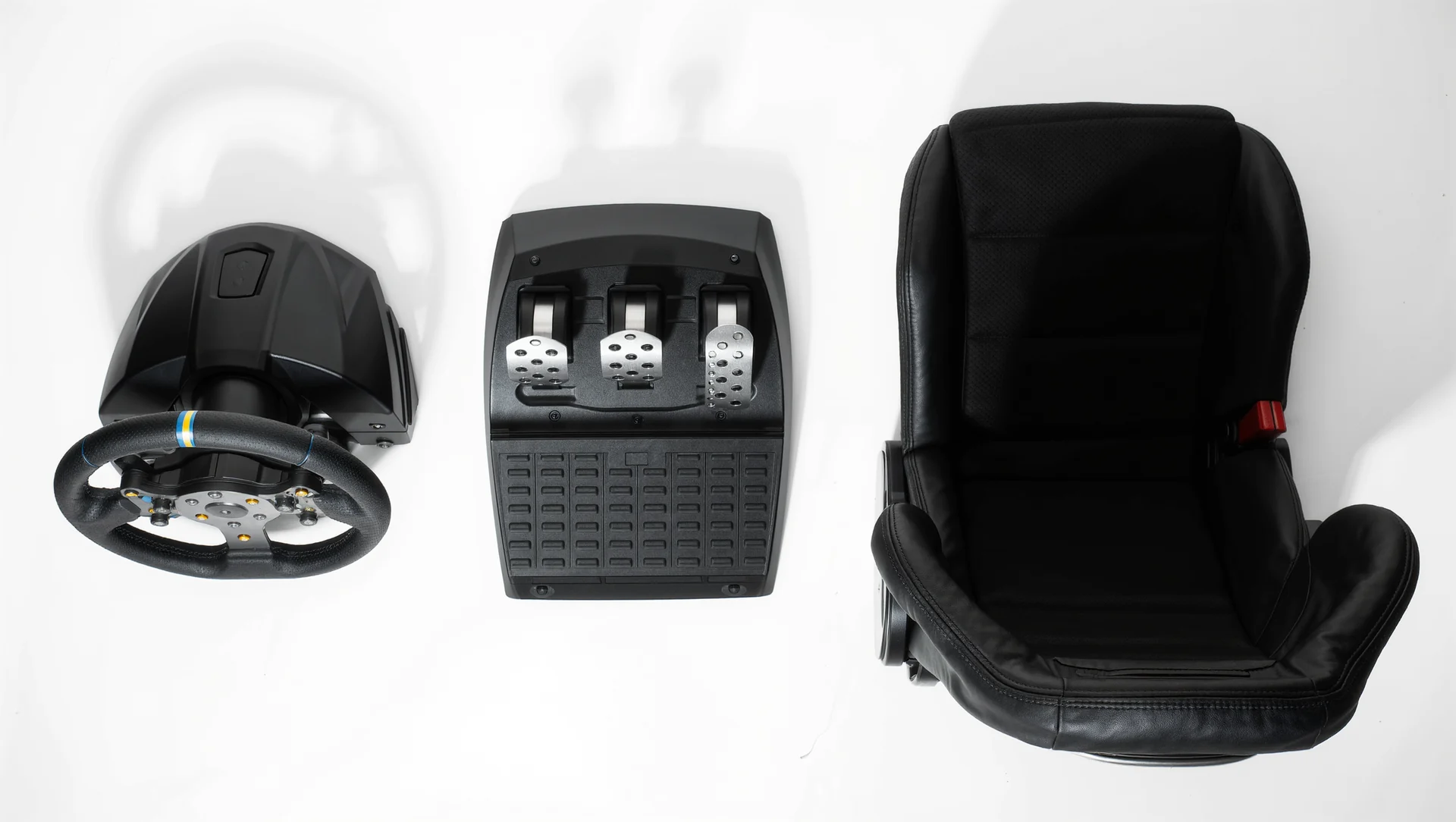
Level one is a gear driven wheel, potentiometer pedals and a desk clamp. It teaches braking points and racecraft, it will not teach braking with the leg, and it costs roughly the same as 2 to 3 years of annual membership.
Level two adds a load cell brake and a belt or entry direct drive base around 5 to 8 newton metres. This is the level where lap times stop being limited by the equipment for almost everybody, and it costs roughly what 6 to 10 years of membership costs.
Level three is a rigid aluminium profile frame, a direct drive base above 8 newton metres and hydraulic or high load pedals. The frame matters more than the base here, because a flexing desk wastes torque no matter what generates it.
Level four adds motion, triple screens or a headset and a dedicated room. It changes immersion far more than it changes lap time, and a driver buying it for pace has misdiagnosed the problem.
How to spend the money in the right order
Pedals before wheel. Braking with a load cell is the single change that moves lap times most for a driver at level one, and it is usually the cheapest of the upgrades available.
Rigidity before torque. A base at 8 newton metres on a solid frame delivers more usable feel than one at 15 on a desk that moves, and the frame does not become obsolete.
And the subscription before all of it. 110 a year buys the thing that actually generates improvement, which is competition against other people, and no amount of hardware substitutes for it.
Sources
Frequently asked questions
What does a year actually cost beyond the hardware?
110 US dollars for an annual membership, plus content beyond the 32 free cars and 29 free tracks whenever a series needs it.
Is it cheaper to pay monthly or yearly?
Yearly. 110 against 156 saves 46 dollars, about 29 per cent, and 2 years works out at 99.50 a year.
What should I upgrade first?
Pedals. A load cell brake moves lap times more than any wheel upgrade at the entry level.
Does motion make you faster?
Not meaningfully. It changes immersion far more than lap time, and buying it for pace misdiagnoses the problem.
More in Business & Events
Audio in a sim: the cheapest lap time you can buy
Audio is the cheapest lap time in sim racing: which sounds carry information, what to set and why headphones beat most hardware upgrades for the same money.
Wind simulators: gimmick or genuine speed cue
Wind simulators: gimmick or genuine speed cue, what the airflow figures mean and the one physiological reason they work better than they should.
USB power: the invisible cause of random disconnects
USB power is the invisible cause of random disconnects: the published current budgets, why a hub fixes it and how to diagnose it in ten minutes.