Wind simulators: gimmick or genuine speed cue
Wind simulators: gimmick or genuine speed cue, what the airflow figures mean and the one physiological reason they work better than they should.
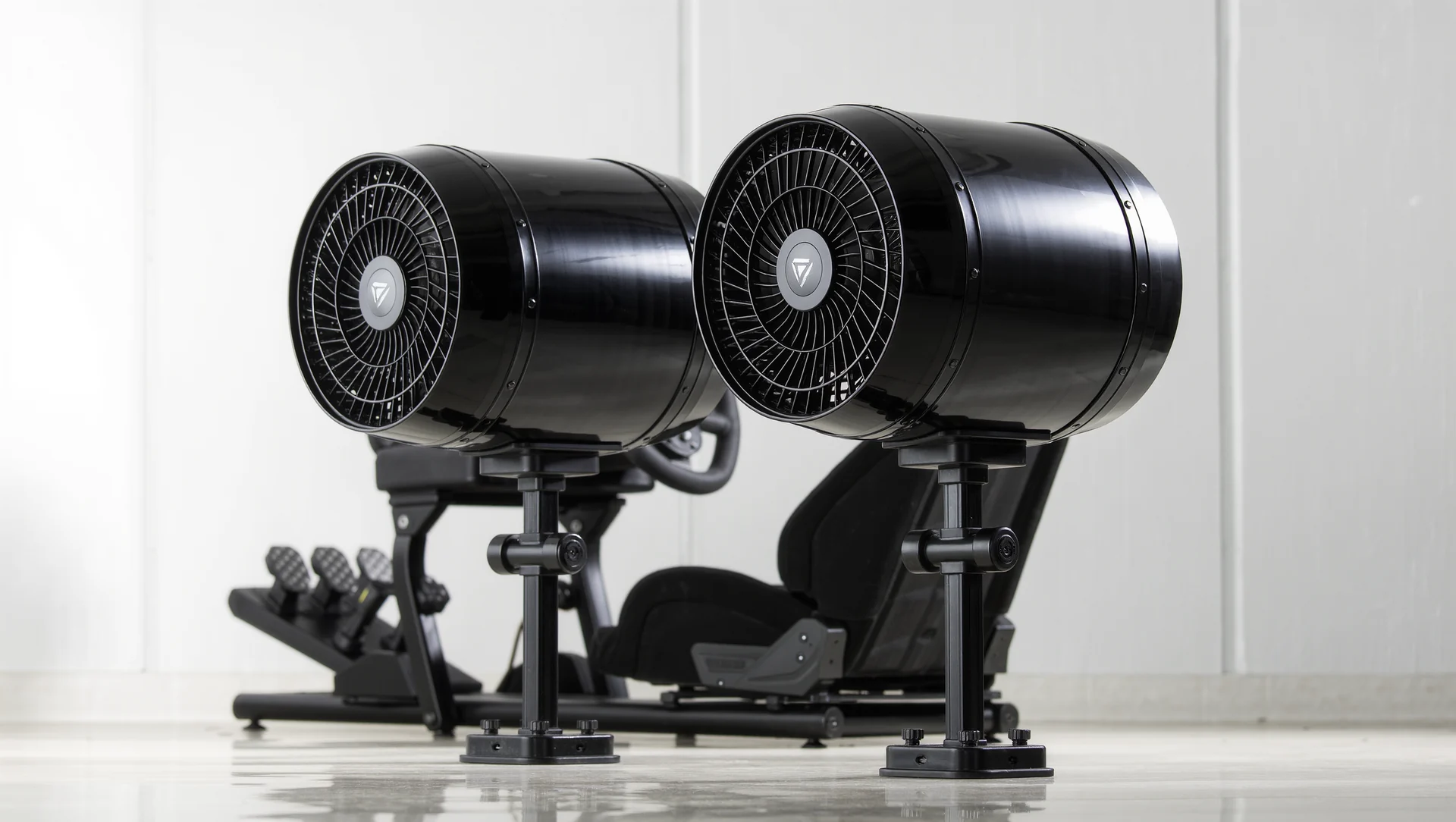
A wind simulator does not simulate wind, it gives your body a physical cue that rises and falls with speed, and the body has been using that cue since long before cars existed. Whether it is worth the money depends on which of two problems you have.
What the figures actually mean
Airflow is measured in cubic feet per minute or cubic metres per hour, and the range in sim racing kits is wide. A quiet 120 mm fan such as the Arctic P12 Max delivers up to 81 CFM at 0.6 sone; a high output fan like the Wathai 12038 reaches 230 CFM at 5300 rpm; and a dedicated kit such as the R Fun PRO V2.3 is stated at 452 cubic metres per hour.
Two numbers matter and they pull against each other. Airflow decides how much cue you get, and noise decides whether you can still hear the tyres. A fan at 35 CFM and 17 dBA is inaudible and barely noticeable; one at 230 CFM at full speed is unmistakable and loud enough to compete with headphones.
The response time matters as much as the peak. A fan that takes two seconds to spin up from idle to full is reporting a speed you had two seconds ago, which is worse than no cue at all on corner exit. Kits designed for the purpose use pulse width modulation specifically so the change is fast.
| Fan or kit | Airflow | Noise |
|---|---|---|
| AC Infinity MULTIFAN S2 | 35 CFM | 17 dBA |
| Arctic P12 Max, 120 mm | up to 81 CFM | 0.6 sone |
| SCCCF dual 140 mm | 138 CFM | quiet operation stated |
| Wathai 12038 PWM | 230 CFM at 5300 rpm | not published |
| R Fun PRO V2.3 | 452 cubic metres per hour | not published |
| Telemetry link | speed channel through SimHub |
Why it works better than it should
Because it addresses the same mismatch that causes simulator sickness. Your eyes report acceleration and your inner ear reports nothing, and an airflow that rises with speed gives the body a second channel that agrees with the eyes. Many drivers report that the fan reduced their discomfort before they noticed any effect on lap times.
The lap time effect, where it exists, is on braking. A cue that falls as you slow gives you a rate of deceleration in a channel that is not the picture and not the wheel, and drivers commonly describe better braking point judgement rather than more grip.
And it is cheap in the right way. Compared with a motion platform, which addresses the same mismatch with actuators and load ratings, a pair of fans and a telemetry link is a fraction of the cost for a portion of the benefit.
How it is driven
Through telemetry rather than through audio. SimHub reads the speed from the simulator and adjusts fan output accordingly, increasing airflow as the car accelerates and reducing it under braking, and its wind module can also raise airflow from the left or right during cornering.
That means the quality depends on the telemetry link rather than on the fan. A kit driven from game audio is guessing; one driven from the speed channel is reporting. The difference is obvious the first time you coast.
And it means the same software that runs your dashboards and your tactile transducers can run this too, which is the practical argument for keeping the whole tactile and airflow chain in one program rather than in three.
Whether to buy one
If you suffer from simulator sickness, it is one of the cheapest interventions available and it addresses the actual mechanism rather than the symptom. Try a desk fan before buying a kit, because the effect is either there or it is not, and a fan you already own answers the question for nothing.
If you are chasing lap time, it is far down the list. The published gains from a load cell pedal set, a stiffer rig or a correct field of view are larger and better documented, and a wind kit is a comfort and immersion purchase that occasionally helps braking.
Sources
Frequently asked questions
Does a wind simulator make me faster?
Occasionally, through better braking point judgement. It is far down the list against pedals, rig stiffness and a correct field of view.
Can I test the idea cheaply?
Yes. Aim a desk fan at your face for one session. The effect is either there or it is not, and a fan you own answers the question for nothing.
How much airflow do I need?
Enough to feel the change rather than the peak. Kits range from 35 CFM to 230 CFM, and the loud end competes with your headphones.
Audio driven or telemetry driven?
Telemetry. A kit reading the speed channel reports what the car is doing; one reading audio is guessing.
More in Technology
Running a league: the software that saves the weekend
The tools a league actually needs: what has to be tracked, what a spreadsheet still does better than an application and where automation earns its keep.
Streaming your races without wrecking your frame rate
Streaming your races without wrecking them: the encoder numbers that matter, the headroom the simulator needs and the setup that survives a full race distance.
From sim to seat: what a shootout really tests
What transfers from the simulator to a real car, what does not, and the licence steps that stand between a fast sim driver and a race entry.