Simulators in real driver training: what transfers
Simulators in professional driver training: what the regulation already allows, which exercises transfer and where a simulator teaches the wrong lesson.
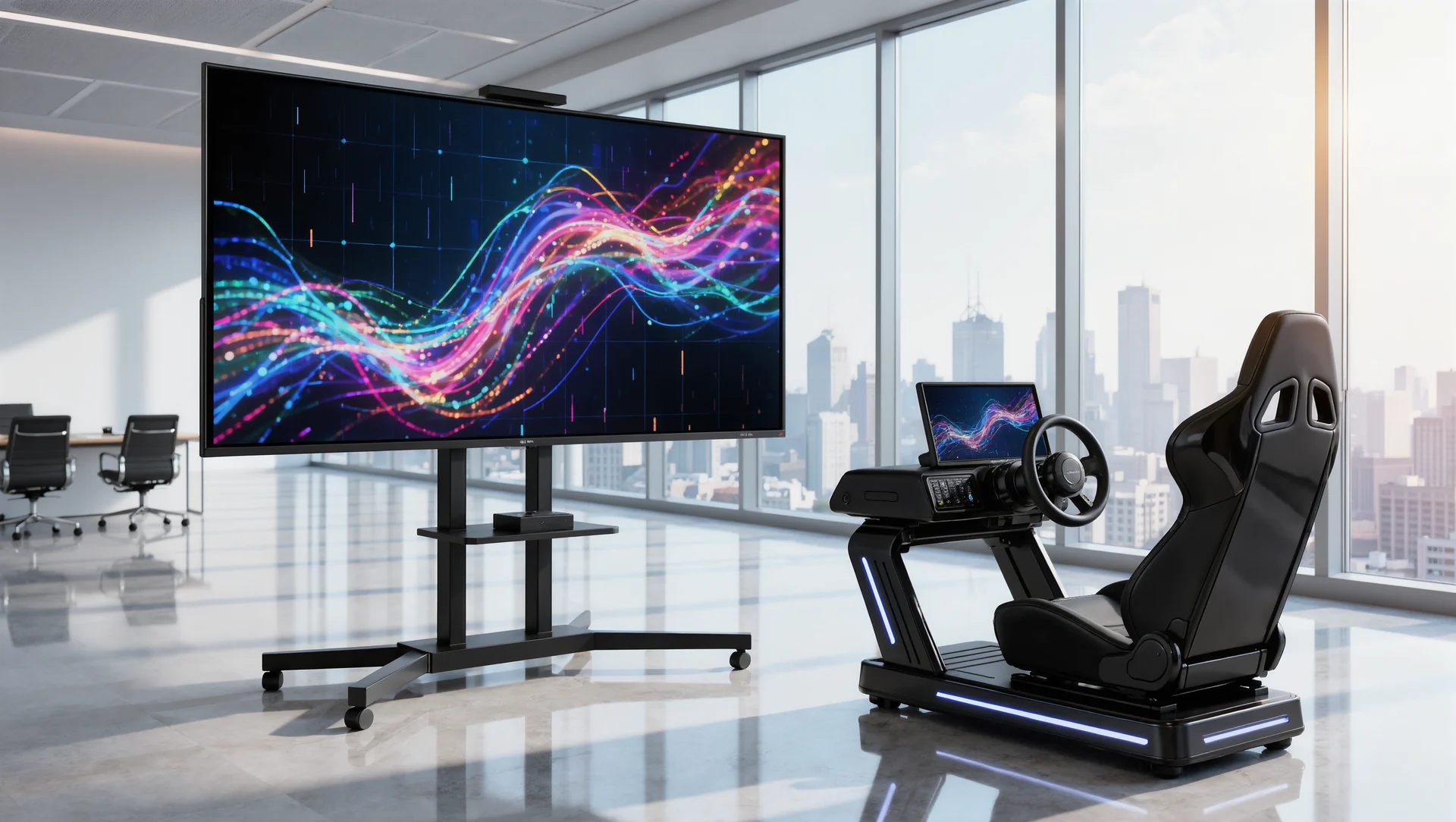
German professional driver training already permits part of the mandatory refresher to take place in a capable simulator, which settles the question of whether it counts. What remains is the harder question of which exercises belong there.
What the regulation actually says
The mandatory refresher runs to 35 teaching units, delivered in self contained blocks of at least 7 units each, and a block may be split across 2 consecutive days. Drivers repeat it at intervals of 5 years.
The relevant clause is short and permissive: part of the refresher may consist of exercises on a dedicated site as part of a driver training course, or in a capable simulator. The regulation names no percentage, which leaves the split to the training centre.
Group size is capped at 25 people per lesson. That number matters more than it looks, because 25 participants against 4 simulator stations is the same rotation problem every event faces, and it decides whether the simulator hour is training or queueing.
| Item | Figure |
|---|---|
| Refresher length | 35 teaching units |
| Block size | at least 7 teaching units |
| Splitting a block | across 2 consecutive days |
| Interval | every 5 years |
| Maximum group size | 25 people per lesson |
| Simulator share | a part, with no percentage named |
| Hazard repetitions per hour | about 10, against far fewer on a site |
| Recommended machine | 6 processor cores, 16 GB memory, 8 GB video memory |
The exercises that transfer well
Hazard recognition, because it is a decision rather than a sensation. A participant can be shown the same emerging hazard 10 times in an hour, which is 10 times more repetitions than a proving ground delivers in the same time.
Route and vehicle familiarisation, because the geometry is identical. A driver who has seen a junction, a loading yard or a mountain descent before arriving has already done the part of the task that costs most attention the first time.
And consequence free error. A skid, a misjudged gap or a late brake can be repeated immediately, and the repetition is where the learning happens. On a proving ground the same exercise costs a reset, a queue and a tyre.
Where a simulator teaches the wrong lesson
Anything whose entire content is physical force. Load transfer felt through the body, the weight of an unassisted steering wheel and the fatigue of a long shift are the substance of those exercises, and a seat that does not move cannot deliver them.
Anything about consequence. A participant who knows the session resets will approach a limit differently from one who knows the vehicle will not, and that difference is exactly what a safety course is trying to change.
And anything that depends on peripheral awareness at full scale. A mirror on a screen is not a mirror at the position and size of the real one, and a blind spot exercise conducted at the wrong scale teaches a habit that has to be unlearned.
Building a session that is worth the 7 units
Pair every simulator exercise with a debrief. The value is in the replay, not the lap, and a group of 25 that watches 1 recording together learns more than 25 people each driving alone.
Plan the rotation before the room is booked. Four stations and 25 participants across a block of 7 units means each person gets a small fraction of the time, so the exercise has to be short, identical and repeatable.
And specify the hardware honestly. A capable simulator is not a games console on a folding stand; the platform recommendation alone is 6 processor cores, 16 gigabytes of memory and 8 gigabytes of video memory, and a training centre buying below that will be explaining stutter to a room of 25 professionals.
Sources
Frequently asked questions
Does simulator time count towards professional driver training?
Part of the refresher may take place in a capable simulator. The regulation names no percentage, so the split is the training centre's decision.
How long is the mandatory refresher?
35 teaching units in blocks of at least 7, repeated every 5 years, with a block splittable across 2 consecutive days.
Which exercises work best in a simulator?
Hazard recognition, route familiarisation and consequence free error, because all three reward repetition rather than physical force.
What does not work in a simulator?
Anything whose content is physical force or real consequence, and blind spot work at the wrong scale.
More in Business & Events

USB power: the invisible cause of random disconnects
USB power is the invisible cause of random disconnects: the published current budgets, why a hub fixes it and how to diagnose it in ten minutes.

Network latency: what actually causes the warping
Network latency and what actually causes the warping: the published thresholds, why packet loss is worse than ping and the fixes in order of effect.
Head tracking and eye tracking on a flat screen
Head tracking and eye tracking on a flat screen: what each one actually does, the published latency and degrees of freedom, and which problem they solve.