Simulators on a trade show stand: dwell time and leads
A simulator on a trade show stand: what it does to dwell time, how many contacts it can realistically produce and how to stop it becoming an arcade.
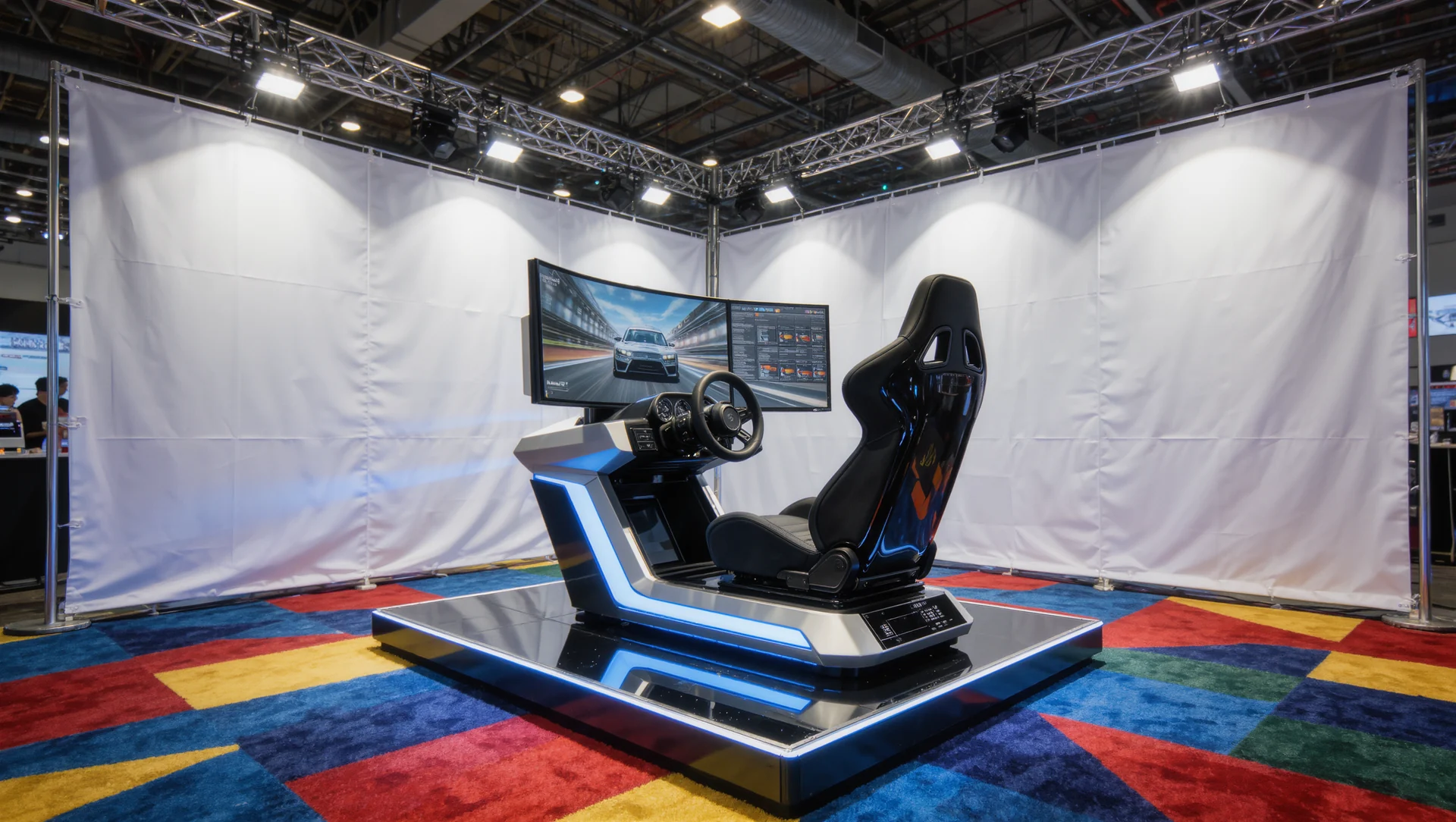
A simulator on a stand buys dwell time, and dwell time is only worth anything if somebody is standing next to the driver asking questions. Unattended, it produces a queue of strangers and no contacts at all.
What the stand actually costs
The hardware is the small line. A study by the ifo Institute for the German trade fair association found the average participation splits into 21 per cent stand rental and basic costs, 30 per cent stand construction and design, 16 per cent personnel, about 23 per cent travel and accommodation and about 10 per cent other costs.
Read that split again with a simulator in mind. It lands inside the 30 per cent for stand construction and equipment, which is already the largest single block, and it adds nothing to the 16 per cent for personnel unless you deliberately staff it.
Which is the whole argument. An attraction financed from the largest cost block and staffed from the smallest is an attraction that will generate footfall and no leads.
| Item | Figure |
|---|---|
| Stand rental and basic costs | 21 per cent of participation |
| Stand construction, equipment and design | 30 per cent |
| Personnel | 16 per cent |
| Travel and accommodation | about 23 per cent |
| Other costs | about 10 per cent |
| Run plus changeover | 5 plus 2, so 7 minutes per visitor |
| Visitors per station | about 8 an hour, about 64 a day |
| Runs across a 3 day fair | about 192 from one station |
| Realistic qualified conversations | around 96 |
| Staff per station | 2, one running and one talking |
| Power per station | around 700 watts |
The contact arithmetic over three days
Work from the slot. A 5 minute run plus 2 minutes of changeover is 7 minutes per visitor, so 1 station manages about 8 visitors an hour and roughly 64 across an 8 hour day.
Across a 3 day fair that is about 192 driven runs from a single station. If half of those visitors are relevant to your business, the realistic ceiling is around 96 qualified conversations, and every one of them requires somebody free to have it.
So staff it at 2 people, not 1. One runs the station and resets it; the other talks to the person waiting and the person who just finished, and that second role is where all 96 of those conversations actually happen.
Making it a lead generator rather than an arcade
Put the leaderboard on the stand, not in the machine. A public board with a name against each time gives you a reason to ask for the name, and a reason to contact the person afterwards that is not a cold email.
Keep the run short and identical. 3 laps of a circuit under 90 seconds means everybody drives the same thing, the times compare, and no single visitor occupies the station for 20 minutes while 8 others leave.
And brand the content, not just the frame. A stand where the car on screen has nothing to do with the exhibitor has bought a queue for somebody else's product.
The stand build details that go wrong
Power, which the hall bills separately. Plan around 700 watts per station, and remember that stand rental and energy sit inside that 21 per cent block, which means an under-declared power requirement is a surcharge rather than a saving.
Circulation, which is a safety matter rather than a design preference. Workplace rules require escape routes to match the use and dimensions of a space and emergency exit doors to open outwards, and a queue that forms across an aisle is the arrangement most likely to attract an instruction from the hall.
And sound. Headphones keep the driver immersed and keep the stand quiet enough for the conversation that is the actual point, and open speakers do the opposite of both.
Sources
Frequently asked questions
How many contacts can one simulator produce at a fair?
About 8 visitors an hour and roughly 192 across a 3 day fair, of which perhaps half are relevant, so around 96 qualified conversations.
How many people should staff it?
Two. One runs and resets the station, the other talks to the visitor waiting and the one who just finished.
How long should a run be?
About 5 minutes, or 3 laps of a circuit under 90 seconds, so the times compare and nobody blocks the station.
Where does the cost of a simulator sit in a fair budget?
Inside stand construction and equipment, which is already the largest block at 30 per cent of participation.
More in Business & Events
Motion platforms: degrees of freedom explained honestly
Motion platforms explained honestly: what each degree of freedom adds, where the threshold of usefulness sits and what the published travel figures mean.
Simulator sickness: causes you can actually remove
Simulator sickness: the causes you can actually remove, in the order that removes the most, and the ones that are a hardware limit rather than a settings problem.
Audio in a sim: the cheapest lap time you can buy
Audio is the cheapest lap time in sim racing: which sounds carry information, what to set and why headphones beat most hardware upgrades for the same money.