Aluminium profile or steel: which rig frame holds up
Aluminium profile against a steel tube frame: what the published weights and profile sizes tell you, and which construction survives a strong direct drive.
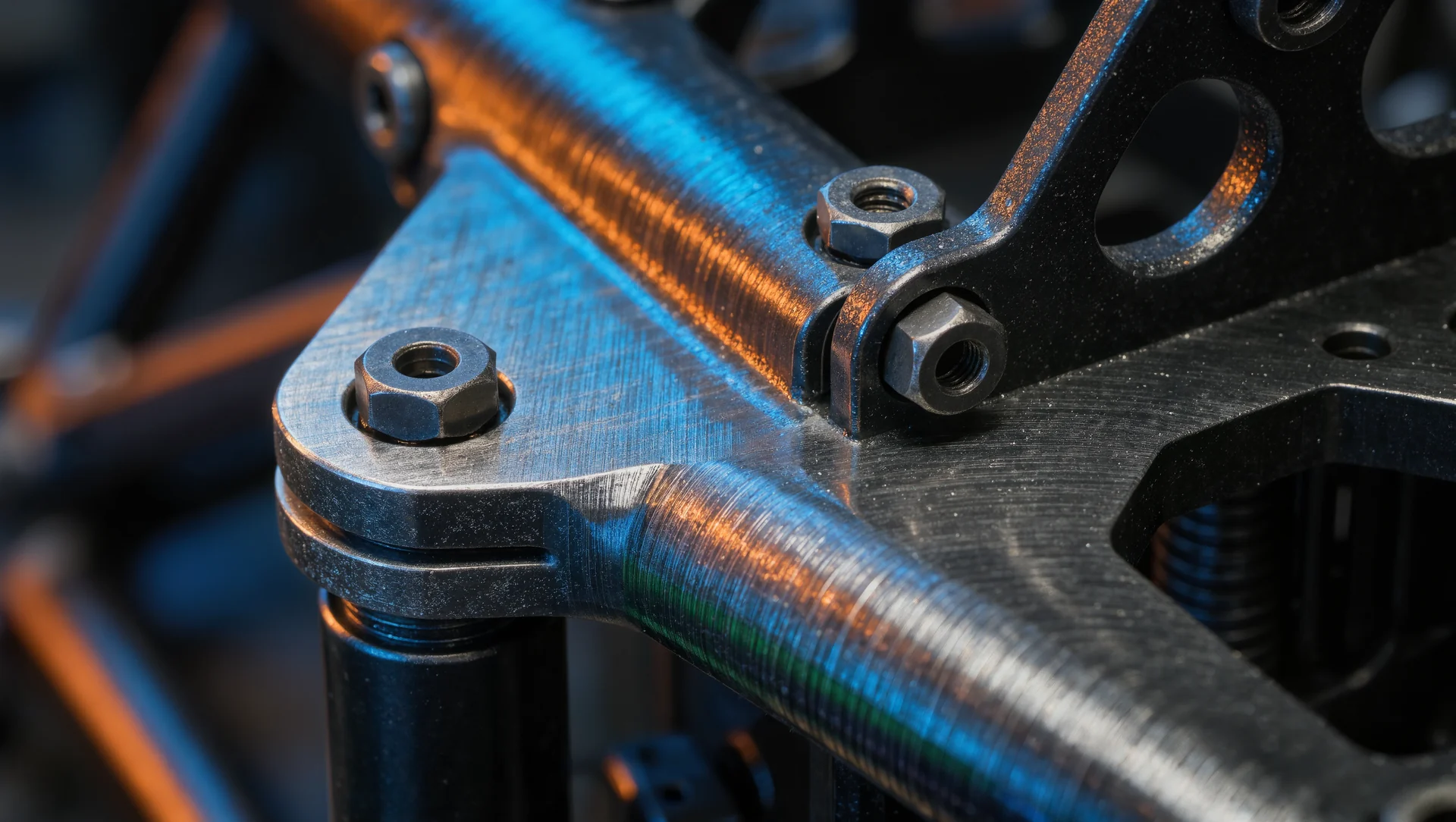
A steel tube rig is lighter, cheaper and faster to build; an aluminium profile rig is heavier, dearer and adjustable forever. The published figures make the trade visible: the same manufacturer sells an 18 kg steel frame and a 41 kg profile frame, and the 23 kg difference is exactly what you are paying for.
What the two constructions actually are
A steel tube rig is welded or bolted from round or square tube. The geometry is decided in the factory, and the driver adjusts what the maker built in: a seat slider, a few holes in the pedal plate, sometimes a telescoping wheel mast. It arrives in fewer boxes, the published assembly time is around one hour, and there is nothing to align because nothing can move sideways.
An aluminium profile rig is bolted from extruded T-slot beams. Nothing is welded, every bracket slides along a groove, and the position of the wheel, the pedals and the seat is continuous rather than a set of holes. That freedom has a price in time: for the larger profile builds the published assembly time runs to seven hours and more, and every bracket you loosen has to be squared again.
The numbers behind the two frames
Trak Racer publishes the whole range side by side, and the spread is instructive. The steel entry frame weighs 18 kg, listed as 40 lbs. The TR160 V5, built from 160 by 40 mm anodised T-slot extrusion with 120 by 40 mm wheel supports, weighs 41 kg or 90.4 lbs and measures 660 by 1445 mm assembled, with the frame itself 580 mm wide and 1400 mm long. Between those two sit frames of 24, 32, 37, 38, 42 and 51 kg, and at the top of the range an 89 kg build.
Sim-Lab publishes comparable dimensions for the P1X Pro: 1350 mm long, 580 mm wide and 770 mm high, 680 mm at the widest point, listed at 789 dollars against a regular 849. The profile sizes follow the same logic as the Trak Racer: 160 by 40 mm along the base, 120 by 40 mm for the uprights and 80 by 40 mm for the shifter and pedal mounts, so the heavy section carries the load and the light section carries the accessories.
Weight is the honest proxy for stiffness here, because both frames are the same material family in a different section. A 41 kg frame with a 160 by 40 mm base beam resists the twisting moment of a strong base in a way an 18 kg tube frame cannot, and no amount of bracing plates changes the section modulus of the tube you started with.
| Frame | Construction | Weight | Assembled size |
|---|---|---|---|
| Trak Racer steel entry frame | Steel tube | 18 kg (40 lbs) | not published |
| Trak Racer TR160 V5 | 160 x 40 mm profile | 41 kg (90.4 lbs) | 660 x 1445 mm |
| Trak Racer TR120S V2 | 120 x 40 mm profile | not published | 620 x 1507 mm |
| Sim-Lab P1X Pro | 160 x 40 mm profile | not published | 1350 x 580 x 770 mm |
Where each one wins
Steel wins on price, on floor space and on the day you move house. It also wins for a driver whose base produces 5 to 8 Nm, because at that level the frame is not the limit and the money is better spent on the pedals. A tube frame with a proper seat and a load cell will beat a profile frame with a gear driven wheel every single time.
Profile wins the moment two things become true: the base exceeds roughly 15 Nm, or the rig has to change shape. Changing between a GT and a formula position on a profile frame means loosening four bolts and sliding; on most tube frames the published answer to that question is that it is not applicable. If two drivers share the rig, or if a motion platform is on the plan, the groove is worth its weight.
The third case is the one people forget: profile is repairable and extendable. A bent steel tube is scrap, while a damaged profile beam is a spare part with a length in millimetres. Ten years of accessories, from a 110 mm seat slider to a monitor mount rated for a single 80 inch screen or triples up to 45 inches, bolt into the same groove that was there on day one.
What to check before you decide
Measure the room before the rig. A 1445 mm long frame plus a seat and a monitor stand needs roughly two metres of clear floor, and the 680 mm widest point decides whether a door still opens. Then check the wheel mount: a Fanatec Podium DD1 or DD2 needs two 5 mm spacer plates on the Trak Racer mount and the GT DD Pro needs four, which is the kind of detail that turns a Saturday into a Sunday if you find out after the frame is built.
Sources
Frequently asked questions
Is steel always the cheaper option?
For the frame itself, yes. Over five years of accessories it often is not, because every addition to a tube frame needs its own bracket while a profile groove takes them all.
How much torque can a tube frame take?
Up to roughly 8 Nm most tube frames are fine. Between 8 and 15 Nm it depends on the wheel mast, and above 15 Nm the flex is usually visible at the wheel rim.
Does a heavier frame really feel different?
Yes, but through stiffness rather than mass. Weight is a symptom of a larger profile section, and it is the section that stops the twist.
Can I start with steel and upgrade later?
You can, and the resale market for tube frames is healthy. Just do not buy a tube frame with a base already ordered that produces more than 15 Nm.
More in Cockpits & Rigs
How to measure rig flex instead of guessing it
Rig flex is measurable with a ruler and a phone. The method, the numbers that separate a stiff frame from a soft one, and what to tighten first.
GT or formula seating: what the angle changes
GT and formula seating are two different jobs for the same body. The published angles, what each position gives you and what it costs over a two hour stint.
Pedal plate angle: the setting most rigs get wrong
Pedal plate angle decides how much of your leg strength reaches the load cell. The geometry, the published adjustment ranges and how to set it in one session.