A rig that fits a flat: folding, wheel stand or profile
Folding cockpit, wheel stand or a full profile rig in a small flat: the published dimensions, the storage figures and what each option really costs in floor space.
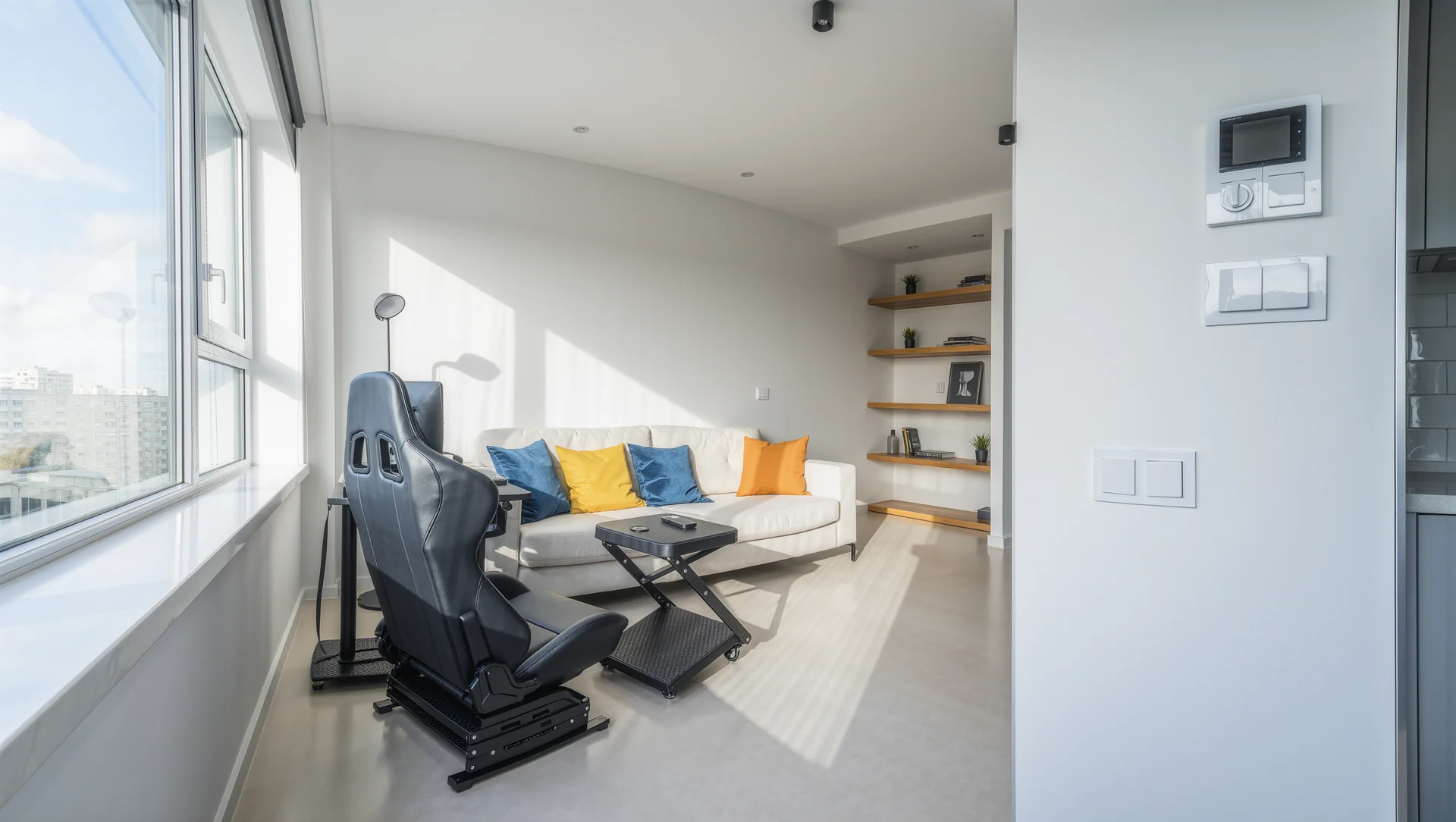
A folding cockpit occupies 136 by 54 cm in use and packs away in ten seconds; a profile rig occupies 1350 by 580 mm and never moves again. Between those two numbers sits every decision a driver in a small flat has to make, and the wheel base you own decides which way it goes.
The three options in published numbers
Playseat publishes the Challenge ActiFit at 136 by 54 by 96 cm assembled and 9 kg, with an assembly time of five minutes without tools and storage in ten seconds even with the wheel and pedals attached, at 229 dollars. The driver range is stated as 120 to 220 cm in height and 20 to 120 kg in weight, so it is not a compromise on who fits, only on what it can hold.
The Challenge X is the same idea one size up: 140 by 60 by 105 cm assembled, 11.6 kg, a carbon quality steel frame and six reclining positions covering GT, rally and formula stances. The extra 2.6 kg and 9 cm of height buy the recline range that the smaller model handles with velcro straps.
A profile rig is a different species. Sim-Lab publishes the P1X Pro at 1350 mm long, 580 mm wide and 770 mm high with 680 mm at the widest point, at 789 dollars. It does not fold, it does not move, and the two metres of clear floor it needs with a seat and a monitor stand is the real number to measure against your room, not the 1350.
| Option | In use | Weight | Price |
|---|---|---|---|
| Playseat Challenge ActiFit | 136 x 54 x 96 cm | 9 kg | 229 dollars |
| Playseat Challenge X | 140 x 60 x 105 cm | 11.6 kg | not published here |
| Sim-Lab P1X Pro | 1350 x 580 x 770 mm | not published | 789 dollars |
| Wheel stand plus seat | varies, folds flat | varies | varies |
What the folding rig cannot do
The honest limit is torque. A folding cockpit with a tensioned frame handles a belt or gear driven wheel comfortably, and it will physically hold a small direct drive base, but the frame flexes visibly above roughly 8 Nm and the force feedback arrives rounded. If your base is already stronger than that, the folding rig is the wrong purchase no matter how well it fits the room.
The second limit is the pedal load. A load cell calibrated to 60 kg puts 588 newtons into the pedal mount on every corner, and on a folding frame that force goes partly into flexing the frame rather than into the sensor. Drivers usually notice this as a brake that feels different in the first and last hour of a session.
The third limit is accessories. There is no groove, so a shifter, a handbrake or a button box each need their own solution, and by the third accessory the folding rig has stopped being the cheap option.
The middle path most people miss
A wheel stand with a separate seat is the option that gets forgotten. The stand carries the wheel and the pedals and folds flat; the seat is whatever you already own or a used sport seat on a low frame. It costs less than a folding cockpit, holds more torque because the load path is short, and it lets the seat and the wheel be adjusted independently, which is exactly what a folding cockpit does not allow.
The catch is that pedals on a stand slide unless the stand braces against the seat or the wall. That is solvable with a floor mat and a stop, and it is worth solving: the combination of a stiff stand and a real seat is closer to a profile rig than to a folding cockpit, at roughly the same price.
Measuring your room honestly
Measure three numbers before you buy anything. The floor length you can give up while driving, the storage space you have when not driving, and the width of the narrowest door the rig has to pass. A folded Challenge ActiFit ships in a 80 by 60 by 20 cm package, which is the shape it takes in a cupboard; a P1X Pro at 680 mm across its widest point will not go through a 60 cm doorway assembled.
Then be honest about the fourth number, which is how often you will actually fold it. A rig that takes ten seconds to store gets stored; a rig that takes ten minutes stays up, and at that point you have paid for folding you never use and given up the stiffness you would have had.
Sources
Frequently asked questions
Can a folding rig hold a direct drive base?
Physically yes, usefully up to roughly 8 Nm. Above that the frame flexes and the detail you paid for in the base is filtered out before it reaches your hands.
Is a wheel stand really stiffer?
Often, because the load path from the base to the floor is short. The weak point moves to the pedals, which slide unless they are braced.
How much room does a profile rig actually need?
About two metres of clear floor with a seat and a monitor stand, and enough width for the 680 mm widest point plus room to get in.
Does folding damage the rig over time?
Not the frame, but the wheel and pedal mounts see the load. Check those bolts every few months rather than every few years.
More in Cockpits & Rigs
Freestanding monitor stands and why motion needs them
Free standing monitor stands against rig mounted arms: the published load ratings, VESA ranges and the reason motion platforms leave no choice.
Bass shakers on a rig: placement, power, limits
Bass shakers on a sim rig: the published power and frequency figures, where to mount them, how many you need and where the limits genuinely are.
Cable management that survives a motion platform
Cable routing that survives a moving rig: the published filling rules for energy chains, the USB length limits and the order in which to lay a loom.