The racing line: early apex, late apex, and why
Early apex or late apex and why: the radius arithmetic behind the racing line, what each choice costs and how to pick one per corner rather than per driver.
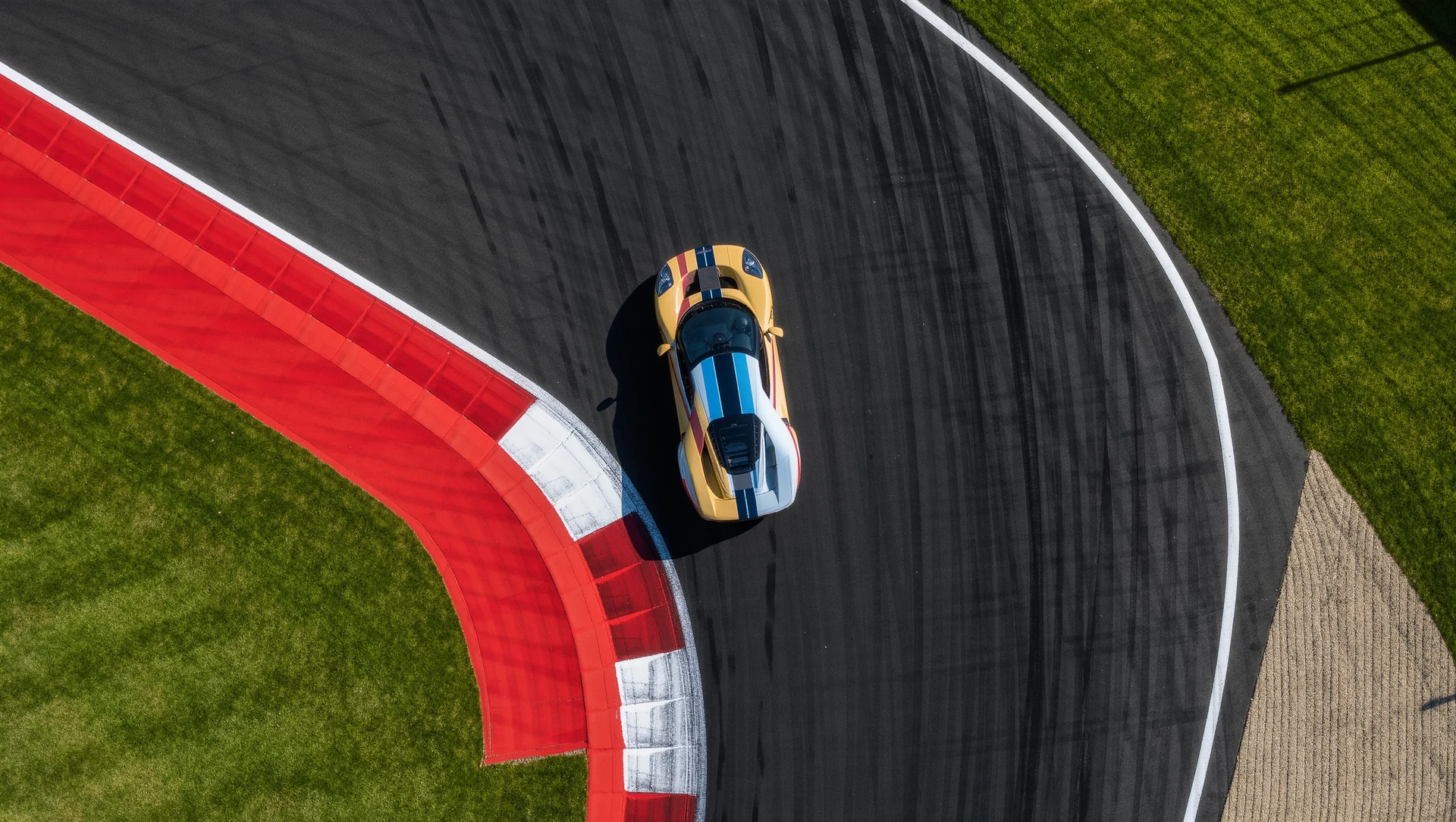
The racing line is not a line, it is a decision about which radius you buy and what you pay for it. A wider radius carries more speed, a later apex buys a wider exit, and every corner on a circuit is a different answer to the same trade.
The arithmetic that decides everything
Cornering speed follows from radius and grip: speed equals the square root of acceleration times radius. At 1.5 g, which is 14.7 metres per second squared, a 50 metre radius allows about 27.1 metres per second, or 97.6 km/h. Widen that radius to 80 metres and the same grip allows 34.3 metres per second, or 123 km/h.
Twenty five per cent more speed for sixty per cent more radius is the whole reason the racing line exists. A driver who uses the full width of the circuit is not being tidy, they are buying radius, and radius is the only thing that raises cornering speed without changing the car.
The number that makes this concrete is the exit. A corner leading onto a 900 metre straight rewards exit speed for the whole straight, so 5 km/h more at the exit is worth far more than 5 km/h more at the entry. On a circuit like the 5.4 km MADRING with 22 corners, only a handful lead onto long straights, and those are the ones where the line actually matters.
| Radius at 1.5 g | Speed |
|---|---|
| 30 metres | about 21 metres per second, 76 km/h |
| 50 metres | about 27.1 metres per second, 97.6 km/h |
| 80 metres | about 34.3 metres per second, 123 km/h |
| 120 metres | about 42 metres per second, 151 km/h |
| 200 metres | about 54.2 metres per second, 195 km/h |
What each apex buys
An early apex gives you the widest possible entry radius and the narrowest exit. You arrive faster, you turn earlier, and you finish the corner pointing at the outside kerb with the car still turning. It is fast into corners that lead into another corner, and it is the classic way to lose a car onto the grass at the exit.
A late apex costs entry speed and buys exit radius. You turn in later, brake deeper, and cross the apex already pointing down the following straight, which lets you go to full throttle earlier. On any corner leading to a straight, this is almost always the faster answer.
The geometric apex, exactly halfway, is rarely correct in a car and almost always correct in a physics textbook. Real cars accelerate more slowly than they decelerate, which pushes the optimum later than pure geometry suggests.
Choosing per corner, not per driver
Ask one question at every corner: what comes after it. If a straight follows, use a late apex and judge the corner by the speed at the end of the straight rather than by the corner itself. If another corner follows, the two have to be solved together and the first one is often compromised deliberately.
Then ask what the car does. A car with strong traction can afford a later apex because it converts the exit into speed; a car that spins its wheels gains nothing from pointing straight earlier and may prefer more entry speed instead.
And ask what the tyres allow late in a stint. A line that works on fresh tyres may not survive lap thirty, and drivers who set a line in qualifying trim and never revisit it spend the race fighting a choice they made in different conditions.
Testing it properly
Measure the exit, not the corner. Pick a point 200 metres after the corner exit and compare speed there across five laps of each line. The lap time hides which corner produced the gain, and the exit speed does not.
Change one apex at a time and drive five laps between changes. A driver who moves three apexes in one session learns that the lap got faster and not which change did it, and next week the same driver will move them all again.
Sources
Frequently asked questions
Is a late apex always faster?
Whenever a straight follows, almost always. Into a corner that leads to another corner, the two have to be solved together and the answer can be earlier.
Why does the ideal line change during a race?
Because grip changes. Fuel load, tyre wear and rubber laid down all move the radius the car can hold.
How much is exit speed worth?
Proportional to the length of what follows. Five km/h at the exit of a corner onto a long straight is worth several tenths; the same at the exit of a short link is worth almost nothing.
Should I copy a fast driver's line?
Only with their setup and their car. A line is the answer to a specific balance, and copying it without the balance copies the shape and not the reason.
More in Driving Technique

How the big sims differ where it counts: the tyre model
Where the big simulators really differ: not graphics or content, but the tyre model and the rate it runs at. What the published figures mean at the wheel.
Assetto Corsa mods: quality, safety and the legal edge
Assetto Corsa mods between quality, safety and copyright: what the official tools allow, where converted content crosses a line and how to judge a mod before installing it.
rFactor 2 in 2026: still the reference for feel
rFactor 2 in 2026: what it still does better than anything else, what the published requirements tell you and whether it is worth starting now.