Best Sim Racing Pedals Guide
Best sim racing pedals guide for 2026: why load-cell brakes beat position sensors, plus ranked picks from Thrustmaster T-LCM to the Heusinkveld Sprint.…
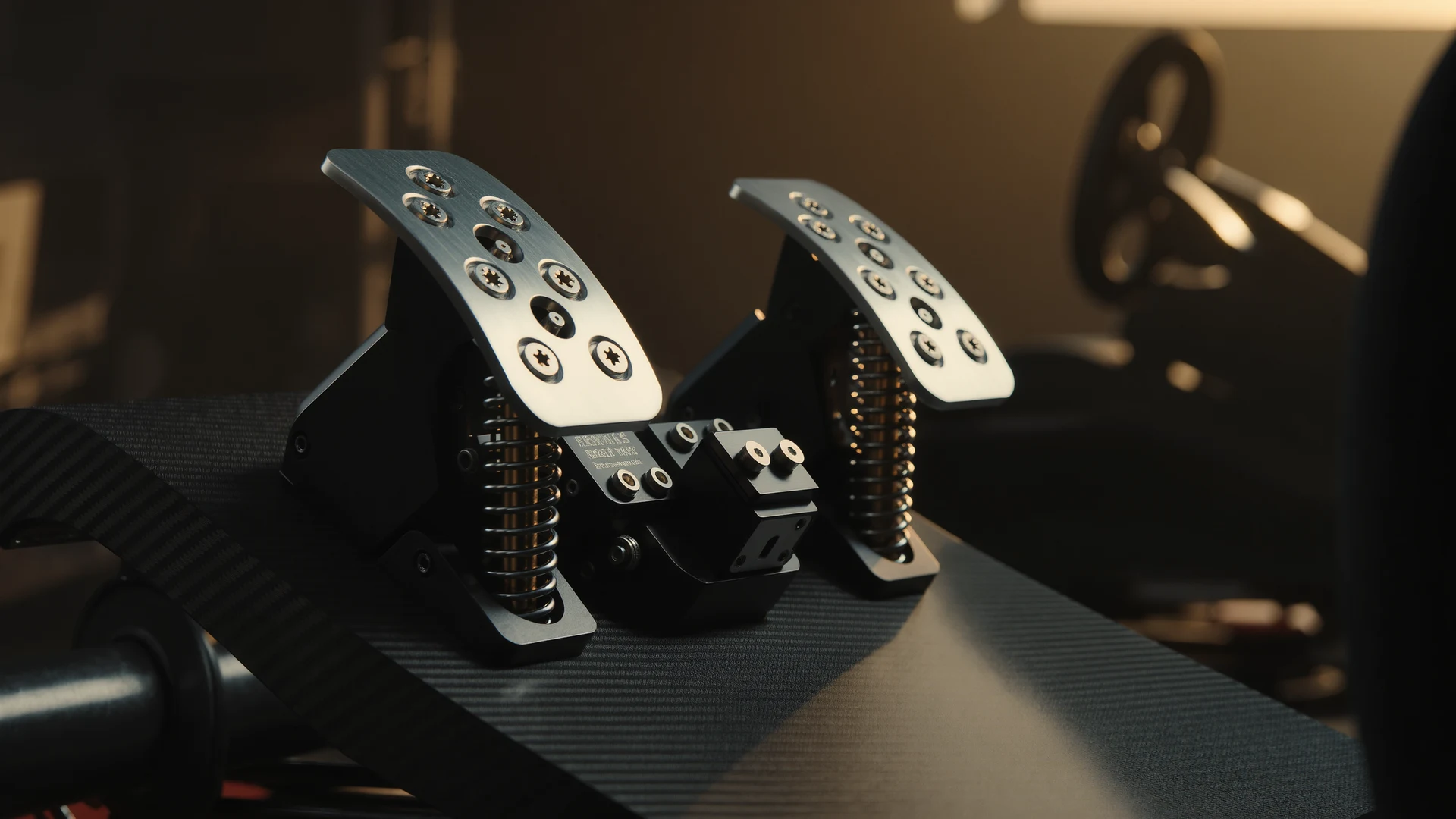
The brake pedal is the most critical part of any sim racing rig, and a load-cell pedal that measures pressure rather than position is your single best upgrade.
Key Takeaways
- Pedals, especially the brake pedal, matter more to your lap time and driver development than any steering wheel upgrade at any price, yet they remain the most overlooked component in beginner rigs.
- Load-cell brakes measure how hard you press rather than how far the pedal travels, and drivers switching to them typically cut their lap time variance by thirty to fifty percent.
- Potentiometer pedals, like those bundled with the Logitech G29, G920, and G923, wear out within twelve to eighteen months of heavy use; Hall-effect sensors avoid this by using magnetic fields with no physical contact.
- The Thrustmaster T-LCM at 229.99 dollars is the most affordable genuine load-cell set, while the Fanatec CSL Pedals LC at 199.95 dollars is the budget value champion with a ninety-kilogram load cell.
- The Moza CRP at 499 dollars offers all-metal 6061 aluminium construction with load cells on all three axes, and the Heusinkveld Sprint at 629 dollars is the high-end reference standard with about thirty-eight millimetres of progressive travel.
- Hydraulic pedal sets from makers like Heusinkveld, Simtag, HPP Simulation, and Ricmotech cost roughly 1,200 to 2,800 dollars, but a high-end load cell delivers about ninety-five percent of the feel and one hundred percent of the performance benefit for a third of the cost.
- Mounting rigidity is non-negotiable, brake force should be calibrated to seventy-five to eighty-five percent of your sustainable maximum, and a purely linear output curve is optimal for most drivers.
Why Pedals Are the Most Critical Component in Your Sim Racing Rig
Ask any professional sim racer, any high-level driving coach, or any real-world motorsport competitor what single piece of equipment matters most in a driving simulator, and the answer will be immediate, unanimous, and delivered without a moment of hesitation: the pedals, and specifically the brake pedal. Braking is where lap time is made or lost, a driver who consistently brakes ten meters too early for every corner on a given circuit is hemorrhaging multiple seconds per lap, while a driver who consistently brakes ten meters too late is in the gravel trap, the tire wall, or worse. Your accelerator foot controls the critical weight transfer that occurs at corner exit, modulating the delicate balance between rear tire grip under power and destructive, time-costing wheelspin. Your clutch foot, in manual-transmission vehicles, manages race starts where gaining or losing a single position in the first two hundred meters can fundamentally determine the outcome of your entire race, and executes downshifts with rev-matching precision that keeps the car stable and balanced. A precise, communicative, reliable, and above all consistent pedal set is genuinely worth more to your lap time, your race results, and your overall development as a driver than any steering wheel upgrade at any price, a statement that surprises newcomers but is regarded as obvious, foundational truth by every experienced sim racer. Yet pedals remain the single most overlooked and underinvested component in the vast majority of beginner and even many intermediate-level sim racing rigs.
The fundamental, irreducible distinction in sim racing pedal technology is between position-based sensors, potentiometers and Hall-effect magnetic sensors that measure how far the pedal has physically traveled through space, and pressure-based load-cell sensors that measure how hard you are pressing against the pedal face. Your brain and your muscle memory, through well-established principles of motor learning science validated by decades of empirical research, are vastly and demonstrably better at learning, retaining, and accurately reproducing a specific pressure level than a specific physical position. This is not opinion, not preference, and not subject to debate, it is objective, measurable fact confirmed by every analysis of human motor performance. Every real race car on the planet uses a pressure-based hydraulic braking system where the force applied by the driver’s foot against the pedal, not the distance the pedal travels, determines braking torque delivered to the wheels. Correspondingly, every high-end sim racing pedal set designed for serious competition uses a load-cell brake pedal. The performance differential is not marginal and it is not subtle: drivers who transition from a position-sensing brake pedal to a pressure-sensing load-cell brake pedal typically and consistently reduce their lap time variance, the statistical spread between their fastest and slowest laps, by thirty to fifty percent, because their leg automatically and unconsciously applies the same brake pressure at the same point on the track every single corner, every single lap, without requiring conscious thought, deliberate effort, or visual confirmation.
Pedal Sensor Technologies: A Complete Technical Explanation
Potentiometer Pedals: The Affordable Entry Point with Inherent Limitations
Potentiometers are variable resistors: simple, inexpensive electrical components whose resistance value changes as a physical wiper arm, mechanically connected to the pedal lever, moves along a resistive track. When the driver presses the pedal, the wiper arm moves, the electrical resistance between the terminals changes, and the resulting voltage is measured by the pedal controller electronics and interpreted as a pedal position between zero and one hundred percent. Potentiometers are cheap to manufacture, simple to design into a product, and electrically straightforward to integrate, which is exactly why they are used in every entry-level pedal set on the market, including the pedals bundled with every Logitech G29, G920, and G923 wheel base. The disadvantages of potentiometer technology are fundamental, well-understood, and ultimately unavoidable regardless of manufacturing quality or materials selection. Potentiometers involve direct physical contact between the wiper arm and the resistive track surface. That physical contact causes mechanical wear. Over months of regular daily use, typically within twelve to eighteen months of heavy driving, the resistive track develops worn, polished, or eroded spots at the positions corresponding to the most frequently used pedal travel ranges, the wiper arm accumulates microscopic debris from the wearing track, and the electrical signal becomes dirty, characterized by random voltage spikes that manifest in the simulation as sudden, unintended, and dangerous brake or throttle inputs. Environmental contaminants, household dust, pet hair, carpet fibers, ambient humidity, enter the potentiometer housing through even well-designed seals and dramatically accelerate this degradation process. Potentiometer pedals are entirely adequate for learning the fundamentals of sim racing and are perfectly functional when brand new. They are not a durable long-term solution for anyone who takes the hobby even moderately seriously.
Hall-Effect Sensor Pedals: The Maintenance-Free Position-Sensing Alternative
Hall-effect sensors measure pedal position using magnetic fields rather than physical electrical contact. A small, lightweight permanent magnet is affixed to the moving pedal arm, and a stationary sensor integrated circuit mounted on the pedal base structure detects minute changes in the magnetic field strength and orientation as the magnet moves past the sensor during pedal travel. Because there is absolutely no physical contact whatsoever between the moving magnet and the stationary sensor, the measurement principle is entirely electromagnetic, there are no surfaces to wear, no debris to accumulate, no electrical noise to develop, and no mechanism to degrade over the functional lifetime of the hardware. The output signal is inherently smooth, clean, and free of the electrical artifacts that inevitably plague aging potentiometers. Thrustmaster’s T3PM pedal set uses Hall-effect sensors on all three pedal axes, throttle, brake, and clutch, and represents what should be considered the minimum acceptable standard for anyone who intends to drive regularly for more than a few months. Thrustmaster’s T-LCM pedal set uses Hall-effect sensors for the throttle and clutch axes, paired with a genuine load-cell brake sensor. The transition from potentiometer to Hall-effect technology is not a marginal improvement in component quality, it eliminates what is, by a wide margin, the single most common and most frustrating failure mode in entry-level pedal hardware, and it provides a signal quality that remains constant and reliable for the entire functional service life of the product.
Load-Cell Brake Pedals: The Competitive Standard and Your First Upgrade Priority
A load cell is a precision strain gauge transducer: a carefully machined metal element, typically fabricated from high-quality steel or aluminum alloy, whose electrical resistance changes by an extremely small but precisely measurable and highly repeatable amount when it undergoes mechanical deformation under applied load. When the driver presses the brake pedal, the pedal lever arm transmits force through a mechanical linkage to the load cell element. The metal element deforms elastically by a few microns, a deflection far too small for the human eye or hand to perceive. The bonded strain gauge sensor converts this microscopic deformation into an electrical signal that is directly, linearly, and repeatably proportional to the applied force. There is no potentiometer track to wear or contaminate. There is no Hall-effect magnet to misalign or demagnetize over decades. There is no calibration drift, no signal degradation, and no failure mode associated with normal use throughout the product’s design life. Load-cell brake pedals are engineered to require between twenty and ninety kilograms of applied force to register one hundred percent braking output, with the exact resistance profile adjustable through user-configurable elastomer spring stacks, die springs, or interchangeable elastomer bushings of varying hardness. The pedal face itself moves only minimally, typically one to three millimeters of total physical travel, which feels profoundly unnatural and disorienting when first experienced by a driver accustomed to position-sensing pedals with thirty to fifty millimeters of stroke. This minimal travel is a deliberate and mechanically correct design feature: in a real race car equipped with a dual master cylinder braking system and rigid brake lines, the brake pedal is effectively a direct force transducer, and pedal travel is negligible because the entire hydraulic system is mechanically incompressible once the brake pads have contacted the rotors. The driver’s brain adapts to this new sensory mapping, associating specific pressure levels rather than specific physical positions with braking force, within approximately two to four hours of concentrated practice. Once this neural adaptation has occurred, there is genuinely no going back to position-sensing braking. The consistency, precision, and confidence that a load cell provides cannot be replicated or even approximated by any position-based sensor technology at any price.
Hydraulic Pedal Systems: The Ultimate Expression of Mechanical Realism
Hydraulic sim racing pedals replicate the exact mechanical architecture used in real-world race cars and high-performance vehicles. The system comprises a master cylinder filled with genuine automotive brake fluid, a hydraulic line running from the master cylinder to a pressure transducer or remote slave cylinder, and a pedal linkage that converts the driver’s foot pressure into hydraulic fluid compression. Manufacturers including Heusinkveld with their Ultimate+ product line, Simtag, HPP Simulation, and Ricmotech produce hydraulic pedal assemblies that cost between approximately $1,200 and $2,800 per complete pedal set. These products are mechanically indistinguishable from the pedal boxes installed in actual GT3, GT4, and Formula category race cars, the materials, the seals, the fluid specifications, and the pressure-response characteristics are all identical to genuine motorsport components. The primary advantage is absolute, uncompromised, no-concession realism: the pedal feel, the initial compliance as virtual brake pads make contact with virtual rotors, the progressive resistance increase as hydraulic system pressure builds, and the rock-hard, unyielding wall of incompressible fluid at maximum pedal pressure are all indistinguishable from what a professional racing driver experiences in their actual competition vehicle. The disadvantages are primarily practical and economic: hydraulic systems require periodic maintenance including brake fluid changes every twelve to twenty-four months to prevent moisture absorption and corrosion, bleed procedures to remove air bubbles that compromise pedal firmness, and seal inspections to prevent fluid leakage. They are also extraordinarily expensive. Unless you are a professional racing driver using a simulator for genuine, mission-critical training, a motorsport engineer conducting vehicle dynamics research, or an extreme enthusiast for whom budget is genuinely irrelevant and who demands and will accept nothing less than perfect fidelity, a high-end load-cell pedal set delivers approximately ninety-five percent of the physical experience and one hundred percent of the measurable performance benefit for roughly one-third of the financial cost.
The Best Sim Racing Pedals of 2026: Comprehensive Rankings with Detailed Analysis
Best Entry-Level Load-Cell: Thrustmaster T-LCM at $229.99
The Thrustmaster T-LCM is the most affordable pedal set on the global market that incorporates a genuine, functional, and well-engineered load-cell brake pedal. It is excellent by any absolute standard, not merely “excellent considering the price.” The brake pedal mechanism utilizes a user-configurable combination of metal coil springs and elastomer blocks, six springs are included in the retail package, comprising two complete sets of three springs each, color-coded by stiffness rating, that can be arranged in multiple valid configurations to produce a remarkably wide range of brake pedal resistance curves. A driver can configure the brake to feel soft, compliant, and progressive with thirty-plus millimeters of pedal travel, suitable for road cars and relaxed driving, or hard, short-travel, and essentially positionless with less than five millimeters of movement, suitable for formula cars and aggressive threshold braking. The pedal faces are fully and independently adjustable for angular tilt relative to the foot, height above the pedal base platform, and lateral spacing between the three individual pedals. The calibration and configuration software is unusually sophisticated and capable for a product at this price tier, providing independent dead-zone configuration for each pedal axis and the ability to define custom, non-linear output curves. The most significant compromise relative to more expensive alternatives is the plastic pedal base structure, which exhibits measurable flex under the fifty to eighty kilograms of force that serious braking generates, this structural flex absorbs a small but real percentage of the braking energy that should be transmitted to and measured by the load cell, introducing inconsistency unless the pedal assembly is rigidly bolted to a solid cockpit or wheel stand. For $229.99, the T-LCM is arguably the single best value upgrade available to any sim racer, and it represents the precise point at which sim racing pedal technology transitions from “acceptable gaming peripheral” to “legitimate driving simulator component.”
Best Budget Load-Cell: Fanatec CSL Pedals LC at $199.95
Fanatec’s CSL Pedals LC configuration is the undisputed value champion of the load-cell pedal market. For $199.95, thirty dollars less than the Thrustmaster T-LCM, the buyer receives a ninety-kilogram-capacity load-cell brake pedal and a Hall-effect sensor throttle pedal, both constructed from stamped and formed steel rather than plastic, with cast metal pedal faces and a rigid steel base plate incorporating an integrated heel rest. The deliberate decision to ship a two-pedal configuration without a clutch pedal is intelligent and well-justified by market data: a substantial percentage of sim racers, particularly those focused exclusively on modern GT cars, prototypes, and formula cars that use sequential paddle-shift transmissions, never touch a clutch pedal at any point in their racing. For those who do require a clutch, the CSL Pedals Clutch Kit is available as a separate purchase for $39.95 and installs in minutes using the provided hardware. The brake pedal uses interchangeable elastomer spring stacks, three sets with Shore durometer hardness values of sixty-five, seventy-five, and eighty-five are supplied in the box, enabling the driver to tune the brake feel across a range from soft and compliant to firm and essentially immovable. The pedals can connect directly to any PC via USB as a standalone USB Human Interface Device, or through any Fanatec wheel base using the proprietary RJ12 data cable, with the latter connection method providing tighter integration into the Fanatec ecosystem including FanaLab software support for the vibration motors found on higher-tier Fanatec pedal sets. The primary compromises relative to more costly competitors are reduced adjustability of the individual pedal faces compared to the T-LCM and the absence of a clutch in the base configuration. For anyone who already owns or is actively planning to purchase a Fanatec wheel base, the CSL Pedals LC are the obvious, correct, and most economical choice for maintaining seamless single-ecosystem integration.
Best Mid-Range All-Metal Construction: Moza CRP Pedals at $499
Moza’s CRP pedal set is a statement of manufacturing capability and engineering ambition. Every visible and structural component, every pedal arm, every mounting bracket, every pivot housing, every adjustment mechanism, is CNC-machined from solid billet 6061 aluminum alloy. Industrial-grade sealed ball bearings are installed at every rotational pivot point throughout the assembly. All stainless steel fasteners are used exclusively to prevent any possibility of corrosion. All three pedal axes, throttle, brake, and clutch, use load-cell force sensors, making the CRP one of a very small number of pedal sets priced below $500 where every pedal benefits from pressure-based rather than position-based measurement. The brake pedal employs a distinctive and mechanically sophisticated resistance design that combines a heavy die spring with an adjustable hydraulic damper unit, rather than the simple elastomer stacks used by most competitors at this price point and below. This dual-element design provides a brake pedal feel that is genuinely progressive through its entire range: initial pedal travel has perceptible compliance, analogous to the sensation of brake pads traversing the small gap to the rotor surface, followed by a smooth, linear, and proportional force buildup as more pressure is applied. This avoids the rock-hard, zero-travel, all-or-nothing sensation that some drivers find unnatural and difficult to modulate with elastomer-only designs. The pedal faces are extensively adjustable for approach angle, mounting height, lateral position relative to the pedal base, and the brake pedal assembly incorporates a separate, dedicated travel adjustment screw that controls the physical stroke distance before the load cell begins to register force. Moza’s Pit House configuration software provides per-pedal calibration with fully customizable dead zones, output curves that can be defined as linear, progressive, or fully custom multi-point mappings, and the ability to save, export, and switch between multiple complete hardware profiles optimized for different simulators, different car categories, or different driving styles. At $499, the CRP pedals undercut the Heusinkveld Sprint by a meaningful $130 while offering build quality, material selection, and manufacturing precision that numerous independent reviewers have judged to equal or, in specific aspects such as the pedal arm machining, exceed the established Dutch benchmark.
Best High-End Reference Standard: Heusinkveld Sprint at $629 for Three-Pedal Set
The Heusinkveld Sprint is the product against which all other high-end sim racing pedal sets are measured and has occupied this definitive reference position continuously since its introduction. Designed, engineered, and hand-assembled in the Netherlands by a company founded by a mechanical engineer and lifelong sim racing enthusiast, the Sprint reflects an obsessive organizational commitment to quality at every level of design, material selection, manufacturing process, and final inspection. All three pedal axes employ industrial-grade load-cell sensors. The brake pedal utilizes a carefully engineered and extensively tested arrangement of elastomer springs, five different Shore durometer hardness formulations are included in every retail box, spanning from soft and compliant to extremely firm, that provides approximately thirty-eight millimeters of measured, progressive pedal travel. This is notably more physical travel than either the Moza CRP or the Fanatec Clubsport V3 provide, and many experienced drivers find this additional stroke more natural and more intuitive to modulate, particularly during the subtle pressure releases that define effective trail braking. The SmartControl configuration application is the most powerful, most flexible, and most thoroughly developed pedal configuration software available in the consumer sim racing market. It enables the user to define fully non-linear, multi-segment output curves with independently adjustable slope and transition points for each segment, to configure a dual-stage clutch with a precisely adjustable bite-point position and engagement force level, a feature that is genuinely essential for generating consistent, competitive race starts in iRacing, ACC, and any simulator with realistic clutch modeling, and to create, name, and store an unlimited number of complete hardware profiles for instant recall. Every individual Sprint pedal set is assembled by a named technician who personally calibrates each pedal’s load-cell sensor output against a certified force measurement standard and signs a quality control document before the product is packaged. The physical construction is industrial-grade in the most positive sense: thick, precision laser-cut steel plate throughout, sealed ball bearings at every rotational axis that are rated for millions of cycles and will never require lubrication, cleaning, or replacement, and stainless steel fasteners at every bolted joint that will never corrode, seize, or degrade. At $629 for the complete three-pedal configuration, the Heusinkveld Sprint is the safe, proven, universally respected, and completely future-proof choice for anyone building a high-end sim racing setup intended to provide a decade or more of daily service.
Pedal Setup, Calibration, and Ergonomic Configuration
Installing and configuring pedals correctly is at least as important to your driving performance as selecting the correct pedal hardware in the first place. A $1,249 Heusinkveld Ultimate+ bolted carelessly to a flexible, inadequately supported pedal plate at an incorrect ergonomic angle will produce less consistent, less precise braking performance than a correctly installed and properly configured $229 Thrustmaster T-LCM.
Mounting rigidity is absolutely non-negotiable. Any flex, compliance, or movement in the pedal mounting plate or the cockpit structure to which it is attached absorbs a portion of the braking force that should be transmitted to and measured by the load-cell sensor. The pedal base must be solidly bolted to a rigid steel or aluminum profile mounting plate using every available mounting point and fastener. If you can detect any perceptible movement, flex, or deflection anywhere in the pedal assembly or its mounting when you apply maximum sustained brake pressure with your leg, your mounting solution is inadequate and is actively costing you lap time and consistency with every braking zone.
Maximum brake force calibration is a personal ergonomic setting, not a performance target. Configure your pedal’s maximum registered force to approximately seventy-five to eighty-five percent of what you can comfortably, repeatedly, and sustainably press using your normal seated driving posture without bracing your entire body against the seat back, pulling on the steering wheel for leverage, or physically straining. You should never need to grunt with effort to achieve one hundred percent brake output during normal racing conditions.
Brake force output curve. For the overwhelming majority of drivers in the overwhelming majority of vehicles and simulators, a purely linear brake force output curve, where twenty-five percent of your calibrated maximum force produces exactly twenty-five percent brake output, fifty percent produces fifty percent, and so forth, is the correct, optimal choice. It is predictable, consistent, and allows your muscle memory and motor programs to develop naturally and efficiently through repetition. Non-linear S-curves, progressive curves, and custom multi-point profiles should only be explored after you have developed fundamentally sound, consistent braking technique and can articulate a specific, measurable reason why the linear curve is failing to meet your needs.
Pedal face angle. The brake pedal face should be adjusted so that it is approximately perpendicular, at or very near ninety degrees relative to the vector of force application, to the sole of your foot when your foot is positioned at the point of maximum sustained braking pressure. If the pedal face tilts significantly away from your foot, your foot will tend to slide upward and off the pedal face under maximum load. If it tilts significantly toward your foot, the upper edge of the pedal face will create an uncomfortable and distracting pressure point. Most drivers find that angling the brake pedal face slightly forward, tilting the top edge toward the driver by five to ten degrees from vertical, produces the most natural and secure foot placement.
Pedal Maintenance: Preserving Performance Over Years of Service
Load-cell pedal sets are fundamentally low-maintenance devices by design, but they are not zero-maintenance. A simple inspection and maintenance routine performed every six to twelve months, with frequency determined by usage intensity, will preserve optimal performance and extend service life indefinitely. Remove the elastomer spring stack from the brake pedal assembly and visually inspect each individual elastomer for compression set, permanent deformation where the elastomer has lost its original shape and fails to fully rebound to its original dimensions when unloaded. Rotate elastomers within the stack to equalize wear distribution, or replace them entirely if they exhibit visible surface cracking, hardening, discoloration, or permanent shape deformation. Apply a single small drop of light machine oil, sewing machine oil or a PTFE-based dry lubricant, never WD-40 which deposits a sticky residue that actively attracts and retains abrasive particulate contamination, to each pivot point and work the pedal through its full travel range several times to distribute the lubricant. Clean the electrical contacts on the load-cell amplifier printed circuit board and the USB controller board with purpose-formulated electrical contact cleaner if you observe signal noise, unexplained calibration drift, or intermittent device disconnection in software. For Hall-effect sensor pedals, visually verify that the magnet mounting is secure and has not shifted, and remove any accumulated metallic debris from the area surrounding the sensor path.
The Definitive Bottom Line on Pedal Investment
If you absorb and retain exactly one principle from this entire analysis, let it be this: upgrade your pedals before you upgrade anything else in your sim racing rig, before your wheel base, before your cockpit, before your monitors, before any accessory or enhancement. A $229 Thrustmaster T-LCM paired with a $299 Logitech G923 will produce faster, more consistent, and more competitive lap times than a $1,400 Simucube 2 Pro paired with $50 plastic potentiometer pedals. Brake control is the fundamental, irreducible foundation upon which every other driving skill is constructed. You cannot trail-brake effectively without a pedal that communicates applied force with precision and repeatability. You cannot hit consistent, repeatable braking points without a pedal that provides identical resistance and feedback on every application. You cannot race at your genuine potential with equipment that is actively working against the natural capabilities of your neuromuscular system, corrupting the very feedback loop through which driving skill is developed. Invest in your pedals first, invest as much of your available budget as you reasonably can, and treat the purchase as the long-term foundation of your sim racing hardware collection. Everything else, the wheel base, the cockpit, the monitors, the motion platform, the accessories, can and should follow later, built upon the solid, unshakeable foundation of excellent pedal hardware.
Frequently Asked Questions (FAQ)
What is the most important component in a sim racing rig?
The pedals, and specifically the brake pedal, are the most critical component. Braking is where lap time is made or lost. Professional sim racers and driving coaches unanimously agree that a precise, consistent pedal set is worth more to your lap time and development than any steering wheel upgrade at any price.
Why are load-cell brake pedals better than position-based pedals?
Load-cell brakes measure how hard you press rather than how far the pedal travels. Human muscle memory reproduces a specific pressure level far more accurately than a specific position, which is why every real race car uses pressure-based braking. Drivers who switch typically reduce their lap time variance by thirty to fifty percent.
What is the best entry-level load-cell pedal set?
The Thrustmaster T-LCM at 229.99 dollars is the most affordable set with a genuine, well-engineered load-cell brake. It ships with six configurable springs, fully adjustable pedal faces, and capable calibration software. Its main compromise is a plastic base that flexes under heavy braking unless rigidly bolted to a solid cockpit or wheel stand.
How do the Fanatec CSL Pedals LC compare to the Thrustmaster T-LCM?
The Fanatec CSL Pedals LC cost 199.95 dollars, thirty dollars less than the T-LCM. They offer a ninety-kilogram steel load-cell brake and Hall-effect throttle but ship as a two-pedal set without a clutch, which costs 39.95 dollars extra. The T-LCM offers more pedal-face adjustability and includes a clutch in the base configuration.
Are expensive hydraulic sim racing pedals worth the money?
For most people, no. Hydraulic sets from Heusinkveld, Simtag, HPP Simulation, and Ricmotech cost roughly 1,200 to 2,800 dollars and deliver uncompromised realism, but require fluid changes and bleeding. A high-end load-cell set provides about ninety-five percent of the feel and one hundred percent of the measurable performance benefit for a third of the cost.
What makes the Heusinkveld Sprint the high-end reference standard?
The Heusinkveld Sprint at 629 dollars uses industrial load cells on all three axes and provides about thirty-eight millimetres of progressive travel, more than the Moza CRP or Fanatec Clubsport V3. It is hand-assembled in the Netherlands, individually calibrated and signed by a named technician, and built from laser-cut steel for a decade of daily service.
How should I calibrate the maximum brake force on my pedals?
Set your maximum registered force to roughly seventy-five to eighty-five percent of what you can comfortably and repeatedly press in your normal seated posture, without bracing against the seat or pulling the wheel for leverage. Maximum brake force is a personal ergonomic setting, not a performance target, and you should never need to grunt to reach full output.
How long do potentiometer pedals last before they wear out?
Potentiometer pedals, including those bundled with the Logitech G29, G920, and G923, typically degrade within twelve to eighteen months of heavy use. Physical contact between the wiper arm and resistive track causes wear, producing dirty signals and sudden unintended inputs. Hall-effect sensors avoid this entirely by measuring position with magnetic fields and no physical contact.
More from Equipment & Gear
Sim Racing PC Build Guide
Sim racing PC build guide: why the AMD Ryzen 7 7800X3D wins on single-thread cache, how to match your GPU to your display, plus four complete budget b…
Sim Racing VR vs Triples Guide
VR vs triple monitors for sim racing in 2026: compare Quest 3, Pimax Crystal Light and triple 1440p setups on field of view, depth, comfort, cost and …
Sim Racing Motion Platforms Guide
Sim racing motion platforms guide: compare seat movers, chassis movers, D-BOX, PT Actuator, and bass shakers, with prices from $150 to $20,000-plus an…