Future of Sim Racing
The future of sim racing: how AI tire models, mixed reality, cloud streaming, cheaper direct-drive hardware and the sim-to-real pipeline reshape motorsport by 2035.…
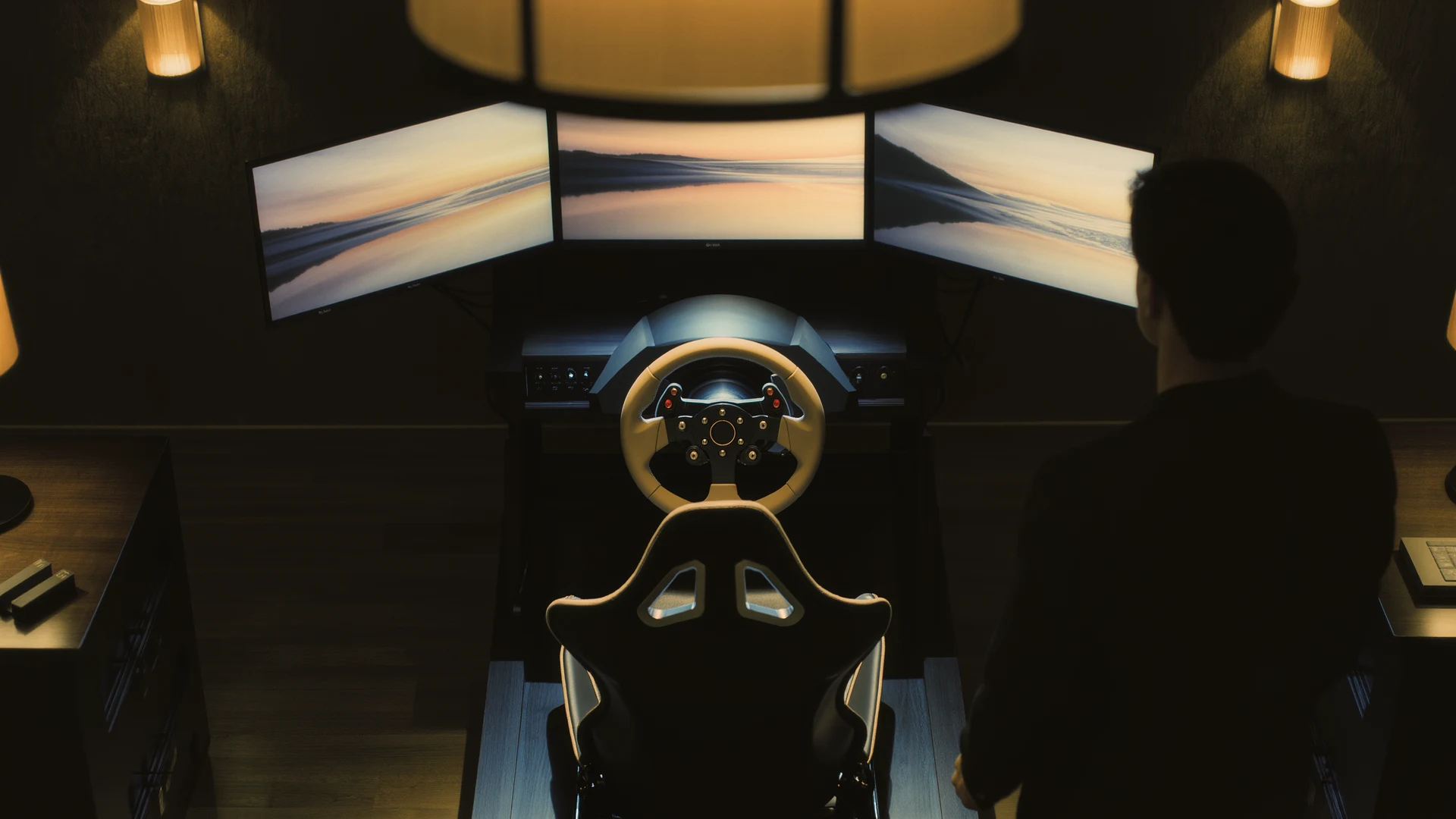
The future of sim racing is the progressive dissolution of the boundary between virtual and physical motorsport, driven by AI, mixed reality, cloud streaming, and ever-cheaper professional hardware.
Key Takeaways
- Direct-drive wheel bases that cost about $699 in 2020 now start at $199, with the Moza R3 producing 3.9 Newton-meters of torque; by 2035 a 15 Newton-meter base is expected under $250.
- Machine-learned neural-network tire models will replace empirical Pacejka Magic Formula curves once AI accelerators like NVIDIA Tensor Cores make them real-time feasible within roughly five years.
- DeepMotions demonstrated reinforcement-learning AI drivers racing wheel-to-wheel through five Nurburgring Nordschleife corners unscripted at the 2025 Sim Racing Expo, with consumer integration expected between 2028 and 2030.
- Trophy.ai's real-time AI coaching prototype, backed by former McLaren F1 engineers, cut novice lap times by an average of 2.1 seconds in a single 30-minute coached session.
- Cloud sim racing connects peripherals directly to the server so physics latency stays near zero, making single-screen cloud delivery a mainstream option by 2027 to 2028 via services like GeForce NOW and Xbox Cloud Gaming.
- The sim-to-real pipeline has produced drivers like Jann Mardenborough, William Byron, Jimmy Broadbent and Max Verstappen, replacing a $150,000-$250,000 Formula 4 season with a one-time $5,000-$10,000 rig.
- Sim racing is being reclassified as digital motorsport, FIA-sanctioned since 2021 and contested on Gran Turismo 7 in the 2023 Olympic Esports Series, with a possible Olympic medal event from the 2032 Brisbane Games onward.
The Future of Sim Racing: Technology, Trends, and the Dissolution of the Virtual-Real Boundary
Sim racing in 2026 is functionally unrecognizable from sim racing in 2016, which was itself a fundamentally different activity from sim racing in 2006. A decade ago, direct-drive wheel bases were the exclusive province of boutique European manufacturers serving a tiny, wealthy niche. Virtual reality in sim racing was an experimental curiosity plagued by low resolution, narrow field of view, and motion sickness so severe that most users abandoned the attempt. Cloud computing was irrelevant to simulation. Artificial intelligence in sim racing meant scripted, predictable computer opponents that followed a single racing line with robotic precision. Today, direct-drive wheel bases from multiple competitive manufacturers are available from $350, VR headsets delivering near-retina resolution are mainstream consumer products, cloud streaming of graphically intensive simulation titles is technically feasible and commercially available, and AI research is producing driver models that learn, adapt, and race with emergent, unscripted behaviors. The pace of technological change across every dimension of sim racing, hardware, software, connectivity, artificial intelligence, spatial computing, and the relationship between virtual and real motorsport, is not merely continuing. It is accelerating. The trends that will define sim racing’s next decade are already visible in research laboratories, startup pitch decks, and the development roadmaps of the industry’s major players. Here is a comprehensive, evidence-based analysis of where sim racing is going, what technologies will drive that evolution, and what the sim racing experience will look like in 2035.
Artificial Intelligence and Machine Learning: The Next Physics Revolution
Neural Network Tire Models: From Empirical Approximation to Physical Simulation
The most computationally intensive and scientifically challenging component of any vehicle dynamics simulation is the tire model, the mathematical representation, running in real time at hundreds of Hertz, of how a geometrically complex, materially heterogeneous composite structure made of rubber compounds, steel belts, nylon carcass plies, and pressurized air deforms under load, generates grip through molecular adhesion and mechanical keying with the road surface, heats up through internal friction and surface scrubbing, wears progressively through material loss, and responds to changes in inflation pressure, camber angle, and vertical load. Traditional tire models used in every current consumer simulator, the various implementations of Pacejka’s Magic Formula empirical curves, brush models that treat the tire as a series of independent elastic elements, and finite-element simplifications, are useful engineering approximations that require extensive, expensive empirical testing on specialized tire test rigs to parameterize and that fundamentally break down at the edges of the tire’s performance envelope, precisely where the driver most needs accurate feedback. The next fundamental advance in simulation fidelity will come from machine-learned tire models, neural networks trained on millions of hours of finite-element simulation data or, eventually, on direct physical measurement data from instrumented tires, that can reproduce the behavior of every individual tread block, every belt ply, and every compound layer with genuine physical accuracy rather than empirical curve-fitting. These models are currently too computationally expensive to execute in real time within the physics budget of a consumer simulator. However, the dedicated AI accelerator hardware. NVIDIA’s Tensor Cores, Intel’s neural processing units, Apple’s Neural Engine, that is rapidly becoming standard equipment in consumer computing devices will, within approximately five years, make real-time neural tire models feasible for consumer simulation. The impact on driving realism will be transformative, particularly in the simulation of limit handling, wet-weather behavior, and tire degradation across long race stints.
AI Opponents That Drive Like Human Beings
Current-generation AI opponents in every consumer racing simulator are, at their computational core, sophisticated finite-state machines. They follow a precomputed optimal racing line, typically the geometric racing line with the minimum curvature profile, and they brake, turn, and accelerate at predetermined trigger points defined in distance or time along that line. They can be parameterized to exhibit variation in aggression, consistency, and pace, creating the illusion of individual driving personalities. But they cannot set up an overtaking maneuver over multiple consecutive corners. They cannot defend a position with genuine spatial awareness, adjusting their line reactively based on the pursuing car’s position and closing speed. They do not make the kinds of unforced errors, a slightly late braking point, a moment of wheelspin on corner exit, a misjudged gap, that create the organic, unpredictable texture of human competition. The next generation of AI opponents, already demonstrated in research prototypes by startups including DeepMotions, uses reinforcement learning, the same machine-learning paradigm behind DeepMind’s AlphaGo and behind real-world autonomous vehicle research, to develop driving behaviors through millions of simulated laps rather than through explicit programming. These learned behaviors include emergent skills that were never explicitly taught: alternative racing lines that sacrifice optimal geometric curvature for overtaking positioning, defensive car placement that varies based on the opponent’s known tendencies, dive-bomb overtaking attempts that would be suicidal for a scripted AI but that a learned model executes with statistically calibrated risk assessment, and the kind of small, human-scale mistakes that create racing opportunities. DeepMotions demonstrated a working prototype at the 2025 Sim Racing Expo in which two reinforcement-learning-trained AI drivers raced wheel-to-wheel through five consecutive corners at the Nurburgring Nordschleife without contact and without any scripting whatsoever of their interactive behavior. Consumer integration of learned AI opponents is expected between 2028 and 2030.
Real-Time AI Driving Coaching
Existing telemetry analysis tools, Virtual Racing School, Z1 Analyzer, Motec i2 Pro, compare a driver’s logged data against a reference lap and identify, after the session has concluded, where time was lost relative to the reference. The next generation of coaching technology, currently in active development by startups including Trophy.ai with backing from former McLaren Formula 1 engineers, observes the driver’s inputs and the car’s response in real time and provides immediate, corner-specific verbal coaching: “You are braking twelve meters too early for Turn 3, costing approximately two-tenths of a second. Your minimum corner speed is four kilometers per hour below the reference. On your next lap, move your braking reference point to the 150-meter board and maintain five percent brake pressure deeper into the corner.” In controlled testing demonstrated at the 2025 Sim Racing Expo, Trophy.ai’s prototype system reduced novice drivers’ lap times by an average of 2.1 seconds within a single thirty-minute coached session. AI coaching will transition from premium third-party add-on to standard integrated feature within consumer simulators within three to five years.
Hardware: The Democratization of Professional-Grade Equipment
The cost trajectory of sim racing hardware over the past five years is the most important economic story in the hobby’s history. In 2020, the least expensive direct-drive wheel base on the market, a Fanatec CSL Elite retrofitted with an aftermarket direct-drive conversion kit, not an official product, cost approximately $699. In 2026, the Moza R3, a fully integrated, manufacturer-supported direct-drive wheel base producing 3.9 Newton-meters of torque, retails for $199 as part of a bundle. The cost curve for the underlying technologies, brushless servo motors, precision motor controllers, CNC machining, continues to decline, driven not primarily by sim racing demand but by the electric vehicle industry’s massive and growing consumption of similar components. Within three years, direct-drive will be the default motor technology for any force-feedback wheel retailing above $200, and gear-driven wheels will be relegated permanently to the toy category.
The next hardware frontier: the product category that will follow the same democratization trajectory that direct-drive wheels have traced, is active pedals. The Simucube Active Pedal, currently priced at $1,899 for a single pedal unit, is the first consumer-market device to provide fully programmable, software-defined pedal feel. The brake pedal can simulate ABS system pulsation at the precise frequency and amplitude of the real car being simulated. It can reproduce pad knockback, the slight increase in pedal travel that occurs when the brake pads are pushed back from the rotor surface after cornering loads flex the wheel bearing assembly. It can simulate a brake pedal that becomes progressively softer as brake fluid temperature increases and fluid viscosity decreases over a long race stint. It can reproduce a clutch bite point that moves as the clutch friction material wears and heats. Today, an active pedal set, two pedals, brake and throttle, costs approximately $3,800. The technology will follow the same cost-reduction curve as direct-drive wheel bases. Expect active pedals priced at approximately $500 per unit, for a two-pedal set at $1,000, by approximately 2029.
Cloud Sim Racing: Simulate Anywhere, on Any Device
Cloud gaming: rendering a video game on a remote server and streaming the compressed video output to the player’s local device, has historically failed to gain traction in latency-sensitive genres including competitive first-person shooters, fighting games, and rhythm games, where the additional video-streaming latency of twenty to fifty milliseconds renders the experience unplayable at competitive levels. Sim racing occupies a unique and favorable position relative to cloud streaming because the critical latency path is not between the player’s visual perception and their input response, but between their physical control inputs and the simulation’s physics response. In a cloud-streamed sim racing architecture, the player’s steering wheel, pedals, and other peripherals connect directly to the cloud gaming instance, not to the local device, and the physics engine executes on the cloud server with effectively zero additional input latency beyond the network round-trip time. The video stream displaying the rendered output incurs the streaming latency, but this visual latency is perceptually far less damaging to driving performance than control latency would be.
NVIDIA’s GeForce NOW cloud gaming service, Microsoft’s Xbox Cloud Gaming, and specialized simulation-focused services such as Shadow are investing significantly in sim racing support and optimization. The transformative application of cloud sim racing, the use case that could fundamentally expand the hobby’s addressable audience, is a subscription service model in which a driver pays a single monthly fee for access to every major simulator, iRacing, ACC, AMS2, rFactor 2, the F1 series, and others, with all associated cars, tracks, and downloadable content included, streamed to any device capable of decoding a video stream: a budget laptop, a tablet, or eventually a smart television with a USB port for connecting a wheel. No gaming PC required, ever. The single largest barrier to sim racing’s growth, the requirement to purchase, build, and maintain a powerful, expensive gaming computer, would be eliminated. Challenges remain significant: VR is fundamentally incompatible with cloud streaming because head-tracking latency cannot be hidden or masked by any architectural approach, triple-monitor configurations require substantial bandwidth beyond what most residential internet connections provide, and force-feedback-over-network introduces new latency considerations that remain active research areas. But for the large and growing segment of sim racers who drive on a single screen, cloud delivery will be a viable, mainstream option by 2027 to 2028.
Spatial Computing: Mixed Reality and the Blending of Physical and Virtual
Virtual reality places the user entirely within a virtual environment, the real world is completely occluded, and everything the user sees is computer-generated. Augmented reality overlays virtual information onto a view of the real world. Mixed reality, supported by current-generation consumer headsets including the Meta Quest 3 at $499 and the Apple Vision Pro at $3,499, combines both paradigms: the user’s real-world environment remains visible, but virtual objects are rendered into it with correct occlusion, real objects in front of virtual objects correctly block them from view, correct lighting, and correct physical scale. For sim racing, mixed reality is a genuinely transformative concept. The driver sits in their physical cockpit, they can see their actual steering wheel, their actual hands, their actual button box, their actual dashboard display, their actual keyboard, their actual beverage container. All of these physical objects remain fully visible, fully interactive, and fully present. But beyond the boundaries of the cockpit, the driver’s living room walls, floor, and ceiling are replaced, seamlessly and with correct spatial mapping, by the Circuit de Spa-Francorchamps in morning light, or the Nurburgring Nordschleife in gathering dusk, or the streets of Monaco at night. The virtual car’s bodywork, the track surface, the competing cars, the sky, the grandstands, all are virtual renderings perfectly and seamlessly blended with the physical cockpit. You reach out with your actual hand and press a button on your actual steering wheel; you see your actual finger press your actual button. There is no disconnect, no reaching for a button box you cannot see, no accidentally knocking over a drink, no fumbling for a keyboard that exists only as a memorized spatial location relative to your body. The technology to deliver this experience exists today, the Varjo XR-3 enterprise mixed-reality headset has demonstrated exactly this use case in Ferrari’s professional driver simulation facility. Consumer headsets have the required hardware capabilities, depth sensors, high-resolution stereo passthrough cameras, spatial mapping processors, but consumer simulators have not yet integrated the necessary software. Expect the first consumer mixed-reality sim racing experiences within two to three years, likely led by Assetto Corsa EVO, Kunos Simulazioni’s upcoming next-generation title, or by iRacing, whose engineering team has publicly discussed mixed-reality integration as a development interest.
Sim-to-Real: The Dissolution of the Boundary Between Virtual and Physical Motorsport
The pipeline connecting sim racing achievement to real-world motorsport opportunity is no longer a curiosity, a novelty, or a marketing narrative. It is a demonstrated, validated, and increasingly institutionalized talent identification pathway that is fundamentally reshaping how the motorsport industry discovers and develops driving talent. The data points are individually compelling and collectively dispositive. Jann Mardenborough won the 2011 GT Academy competition, a Gran Turismo-based talent search, and transitioned directly into a professional racing career spanning Super GT, Super Formula, and the 24 Hours of Le Mans; his story was adapted into a major motion picture released by Sony Pictures in 2023. William Byron, a multiple-race winner in the NASCAR Cup Series and a Championship 4 contender, began racing on iRacing at age fourteen and had never driven a physical race car before his first Legend Car test, at which he was immediately, naturally competitive because the vehicle dynamics and racing skills he had developed in simulation transferred directly to physical reality. Jimmy Broadbent progressed from full-time sim racing YouTube content creator to podium-finishing driver in the British GT Championship and Porsche Carrera Cup Great Britain within two seasons. Max Verstappen, the reigning Formula 1 World Champion, practices every circuit on the F1 calendar in iRacing before real-world Grand Prix weekends and has publicly credited simulation training with developing the specific car-control skills that enable his uniquely aggressive, precise, and successful driving style.
The economic logic driving this sim-to-real pipeline is compelling and irreversible. A single season of Formula 4, the FIA’s entry-level, junior single-seater category, costs between $150,000 and $250,000 depending on the team, the championship, and the level of support. A complete, top-tier sim racing rig. Simucube wheel base, Heusinkveld pedals, aluminum profile cockpit, VR headset or triple monitors, high-end PC, costs between $5,000 and $10,000, and it is a one-time capital expenditure that serves for years of daily use rather than a single season of consumable costs. A driver who arrives at their first real-world car test having accumulated 2,000 hours of high-fidelity simulation experience, who has already developed fundamental car control, learned dozens of circuits, and internalized race craft through thousands of competitive online races, can compress the traditional multi-year, million-dollar junior formula progression into a dramatically shorter and more affordable timeline. Racing teams facing the existential crisis of motorsport’s chronic, structural inaccessibility, the sport has always been and remains overwhelmingly gated by family wealth, are investing in sim-to-real scouting and development programs because they represent the most efficient, most scalable, and most meritocratic talent identification mechanism the sport has ever possessed.
Assetto Corsa EVO: The Most Anticipated Sim Racing Release in Years
Kunos Simulazioni’s Assetto Corsa EVO, announced for a 2025 release window and built on an entirely new, proprietary engine distinct from both the original AC’s in-house technology and ACC’s Unreal Engine 4 foundation, is the single most anticipated product release in the contemporary sim racing landscape. Based on Kunos’s public statements and development communications, EVO promises: a fully dynamic, physically simulated weather system with track evolution and a drying racing line modeled on actual water displacement physics; a complete 24-hour day-to-night-to-day cycle with astronomically correct celestial positioning and physically based lighting; photorealistic graphics leveraging the capabilities of current-generation GPUs and potentially incorporating ray-traced global illumination; native, first-class triple-screen and virtual reality support without the workaround configurations required by many current simulators; an open, accessible modding platform with official tools and documentation available at launch, affirming Kunos’s understanding that modding is the reason for the original AC’s extraordinary longevity; and a career mode of unprecedented scope that integrates road cars spanning the full spectrum from affordable hot hatches to seven-figure hypercars, track-day experiences, club racing, and full professional-level organized competition. If Kunos delivers on these commitments with the technical execution quality their track record suggests, EVO has the potential to unify the currently fragmented Assetto Corsa community, divided between original AC players who value modding breadth and ACC players who value competitive polish, under a single, modern, forward-looking platform.
Sim Racing as an Olympic Sport: From Video Game to Digital Motorsport
The International Olympic Committee has formally, publicly embraced competitive video gaming through the Olympic Esports Series, which in 2023 included a motorsport event contested on Gran Turismo 7 with drivers representing their nations in an officially Olympic-branded competition. The FIA, motorsport’s global governing body with authority over everything from Formula 1 to the World Rally Championship, has formally sanctioned sim racing championships since 2021 and has integrated sim racing into the FIA Motorsport Games, an Olympic-style multi-disciplinary competition in which nations field teams across multiple motorsport categories, as an official, medal-awarded discipline alongside physical racing categories. The institutional infrastructure required to support sim racing as a future Olympic medal event, international federation governance structures, standardized equipment regulations, anti-doping protocols adapted for cognitive rather than physical enhancement, national team selection and qualification procedures, is being actively constructed by the relevant governing bodies. Whether simulated motorsport appears on the official Olympic program at the 2032 Brisbane Games, the 2036 Games, or a subsequent Olympiad remains uncertain and depends on factors including the IOC’s evolving relationship with technology-mediated competition. But the directional trajectory is unambiguous and probably irreversible. Sim racing is undergoing the same cultural reclassification that chess underwent in the twentieth century, transitioning in public perception and institutional recognition from pastime or game to legitimate, governed, competitive discipline. The phrase digital motorsport, increasingly used by rights holders, governing bodies, and broadcasters in preference to esports or gaming, reflects and reinforces this ongoing reclassification.
The Decade Ahead: Sim Racing in 2035
Extrapolating from the technological, economic, and institutional trends that are already visible and measurable in 2026, a representative sim racing experience in 2035 will likely include: a neural-network-based tire model simulating individual tread-block behavior in real time on affordable consumer hardware incorporating dedicated AI accelerators; a direct-drive wheel base producing 15 Newton-meters of torque purchased for under $250 as the default, entry-level force feedback technology; active pedals providing fully programmable, software-defined brake, throttle, and clutch feel for under $500 per pedal; AI opponent drivers whose behavior is learned rather than programmed and who are functionally indistinguishable from skilled, fallible human competitors; real-time, voice-interactive AI coaching that observes every corner and provides specific, actionable feedback without requiring post-session analysis; mixed-reality headsets that seamlessly blend the driver’s physical cockpit with photorealistic virtual circuit environments; the option to stream the entire experience from a cloud data center to any screen-capable device, eliminating the gaming PC as a hardware requirement; a mature, institutionalized sim-to-real talent pipeline that has produced multiple Formula 1, IndyCar, NASCAR, and World Endurance Championship drivers; and the genuine possibility of sim racing, now rebranded and culturally understood as digital motorsport, featuring as a medal event on the official Olympic Games program. The future of sim racing is not fundamentally about more detailed graphics, higher polygon counts, or shinier paint effects. It is about the progressive, irreversible dissolution of the boundary between simulation and physical reality, a process that democratizes motorsport participation, transforms talent identification, and makes the experience of driving a racing car at the absolute limit accessible to any human being with the passion to pursue it, regardless of their geography, their financial resources, or their physical circumstances. The golden age of sim racing is not behind us. It is only just beginning.
Frequently Asked Questions (FAQ)
What is the future of sim racing according to current technology trends?
The future of sim racing is the progressive, irreversible dissolution of the boundary between simulation and physical reality. The article identifies accelerating change across AI, hardware, cloud streaming, mixed reality and the sim-to-real pipeline, projecting that by 2035 these technologies will democratize motorsport participation and transform how driving talent is identified.
How will neural network tire models change sim racing realism?
Neural network tire models will replace empirical approximations like Pacejka's Magic Formula by reproducing every tread block, belt ply and compound layer with genuine physical accuracy. Trained on finite-element or measured tire data, they currently demand too much computation, but dedicated AI accelerators should make them real-time feasible within about five years, transforming limit handling, wet behavior and tire degradation.
What did DeepMotions demonstrate with AI opponents at the 2025 Sim Racing Expo?
DeepMotions demonstrated two reinforcement-learning-trained AI drivers racing wheel-to-wheel through five consecutive corners at the Nurburgring Nordschleife without contact and without any scripting of their interactive behavior. These learned drivers develop emergent skills like alternative racing lines and calibrated dive-bomb overtakes. Consumer integration of such AI opponents is expected between 2028 and 2030.
How much does a direct-drive sim racing wheel base cost now compared to a few years ago?
Direct-drive wheel bases have fallen sharply in price. In 2020 the cheapest option cost about $699, while in 2026 the Moza R3, a fully supported base producing 3.9 Newton-meters of torque, retails for $199 in a bundle. The article credits the electric vehicle industry's demand for motors and controllers for this decline.
Can cloud streaming work for competitive sim racing without lag?
Yes, sim racing is uniquely suited to cloud streaming. Peripherals connect directly to the cloud instance rather than the local device, so the physics engine responds with effectively zero added input latency beyond network round-trip. Only the video stream incurs delay, which is far less damaging than control latency. Single-screen cloud delivery should be mainstream by 2027 to 2028.
How does mixed reality improve the sim racing cockpit experience?
Mixed reality keeps the driver's physical cockpit, wheel, hands and dashboard fully visible while replacing the surrounding room with photorealistic virtual circuits like Spa-Francorchamps or Monaco. This removes the disconnect of reaching for buttons you cannot see. The Varjo XR-3 already demonstrated this at Ferrari, and consumer experiences are expected within two to three years.
Which real racing drivers came from sim racing through the sim-to-real pipeline?
Several drivers prove the sim-to-real pathway. Jann Mardenborough won the 2011 GT Academy and raced at Le Mans; William Byron started on iRacing at fourteen before NASCAR success; Jimmy Broadbent reached British GT podiums; and Formula 1 champion Max Verstappen practices every circuit in iRacing, crediting simulation with developing his car-control skills.
Could sim racing become an Olympic sport?
Sim racing is on a clear path toward Olympic recognition. The IOC included a Gran Turismo 7 motorsport event in the 2023 Olympic Esports Series, and the FIA has sanctioned sim racing since 2021 within its Motorsport Games. Governing bodies are building the required infrastructure, with a possible medal event from the 2032 Brisbane Games, 2036, or later.
More from Racing Simulators
F1 Sim Racing Guide
F1 sim racing guide: compare F1 24, iRacing, RSS and AMS2, choose the right wheel and load-cell brake, and master braking, ERS and tire strategy.…
Assetto Corsa Ultimate Guide
Assetto Corsa ultimate guide: the best mods (Content Manager, CSP, SOL, Pure), free cars and tracks, online racing, performance tuning, and AC vs ACC …
iRacing Complete Guide
IRacing complete guide: how the online racing sim works, real pricing, iRating vs Safety Rating, the Rookie path, and whether iRacing is worth the cos…